| Important questions for UPSC Pre/ Mains/ Interview:
1. What triggered the recent thaw in India–US trade relations? 2. What are the key trade-related announcements made by the United States? 3. What has been claimed about a broader India–US trade deal? 4. How do energy and geopolitics intersect with this trade reset? 5. What is the strategic and diplomatic context of this announcement? 6. Why is this reset strategically significant for India? 7. What challenges and concerns arise from the proposed reset? 8. What should be India’s way forward? |
Context
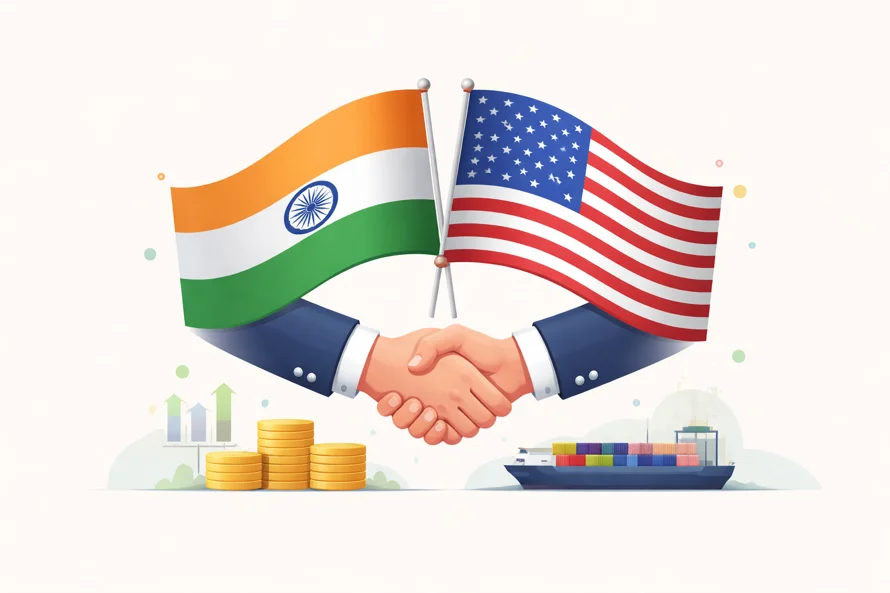
After months of tariff tensions, India–US trade ties eased following a leaders’ call, with the U.S. agreeing to cut tariffs on Indian goods to 18%, signalling a strategic and economic reset.
Q1. What triggered the recent thaw in India–US trade relations?
- India–US economic ties had come under strain due to high U.S. tariffs imposed in 2025, including penalties linked to India’s Russian oil imports.
- A telephonic conversation between the Indian Prime Minister and the U.S. President led to a reassessment of the trade trajectory.
- The U.S. agreed to roll back punitive tariffs, indicating willingness to recalibrate relations amid global supply-chain realignments.
- The moment reflects the broader geopolitical context of great-power competition and fragmented global trade.
Q2. What are the key trade-related announcements made by the United States?
- The U.S. will reduce reciprocal tariffs on “Made in India” products from an effective 50% to 18%.
- This includes:
- Withdrawal of 25% “Liberation Day” tariffs, and
- Rollback of an additional 25% penalty imposed over India’s Russian oil imports.
- The Indian Prime Minister described the decision as a boost to Make in India by improving U.S. market access for Indian exports.
- The announcement has immediate implications for export competitiveness in sectors facing tariff barriers.
Q3. What has been claimed about a broader India–US trade deal?
- S. President Donald Trump claimed that India and the U.S. have “agreed” to a broader trade deal.
- According to the claim, India has committed to:
- Reducing tariff and non-tariff barriers on U.S. goods, allegedly moving towards near-zero tariffs.
- Purchasing over $500 billion worth of U.S. products, including:
- Energy (natural gas and coal),
- Technology,
- Agricultural commodities, and
- Nuclear equipment.
- For perspective, India’s total goods imports in FY25 were about $720 billion, making the claimed figure exceptionally large.
- Importantly, these claims have not been officially confirmed by India.
Q4. How do energy and geopolitics intersect with this trade reset?
- The U.S. President asserted that India has agreed to stop importing Russian oil and increase energy imports from the U.S. and possibly Venezuela.
- Such claims link trade concessions to broader U.S. geopolitical objectives, including pressure related to the Russia–Ukraine conflict.
- India’s Ministry of External Affairs (MEA) has not endorsed these statements, underlining the sensitivity of the issue.
- Any binding commitment on energy sourcing would have direct implications for India’s energy security and strategic autonomy.
Q5. What is the strategic and diplomatic context of this announcement?
- The announcement coincided with External Affairs Minister Jaishankar’s visit to the U.S.
- He is participating in the Critical Minerals Ministerial, focusing on:
- Supply-chain resilience,
- Clean energy transition, and
- Reducing dependence on China in critical minerals.
- India, the U.S., and partner countries are expected to sign a non-binding framework covering mining, processing, recycling, and pricing cooperation.
- This situates trade talks within a broader strategic supply-chain agenda.
Q6. Why is this reset strategically significant for India?
- India as a counterweight to China:
- The tariff cut reinforces the U.S. view of India as a strategic alternative to China.
- With Western economies restricting Chinese imports, India gains relative export advantage in U.S. and EU markets.
- Macroeconomic and market implications:
- The deal came amid concerns over capital outflows and rupee pressure.
- Improved investor sentiment could stabilise markets and support the currency.
- India’s expanding trade footprint:
- With evolving arrangements with the U.S., UK, and EU, India is better positioned than many East Asian economies heavily dependent on China.
- A tentative thaw in India–China trade adds complexity to India’s external economic strategy.
Q7. What challenges and concerns arise from the proposed reset?
- Ambiguity of the fine print:
- Actual benefits depend on detailed terms, which remain undisclosed.
- Past experience suggests U.S. negotiations under President Trump can be highly extractive.
- Energy security and autonomy: Any formal commitment to halt Russian oil imports could limit India’s flexibility in energy sourcing.
- Dependence on China:
- India’s imports from China exceeded $112 billion last year.
- China’s dominance in rare earth elements already constrains Indian manufacturing sectors like automobiles.
- Risk of Chinese retaliation: China has warned of consequences if trade agreements are concluded at its expense, raising supply-chain risk concerns.
- Domestic political reactions: The opposition has criticised the move, alleging undue concession under U.S. pressure.
Q8. What should be India’s way forward?
- Clarity and transparency: Ensure all commitments on tariffs, energy imports, and non-tariff barriers are clearly defined and balanced.
- Export leverage: Use improved U.S. market access to boost manufacturing, value-added exports, and employment.
- Supply-chain diversification: Deepen cooperation through platforms like the Critical Minerals Ministerial to reduce reliance on China.
- Strategic balancing: Preserve autonomy in energy sourcing and foreign policy while expanding Western partnerships.
- Domestic capacity building: Align trade gains with Make in India, PLI schemes, and MSME competitiveness.
Conclusion
The cut in U.S. tariffs marks a decisive reset in India–US trade relations, reflecting India’s rising strategic relevance. Its long-term value will depend on the fine print, protection of strategic autonomy, and conversion of access into sustained export-led growth.