| Important questions for UPSC Pre/ Mains/ Interview:
1. What is the Prevention of Corruption Act, 1988? 2. What does Section 17A of the PCA mandate? 3. Why was Section 17A considered necessary by Parliament? 4. What have earlier Supreme Court rulings held on prior approval? 5. What led to the current split verdict on Section 17A? 6. What was Justice K. V. Viswanathan’s view? 7. What was Justice B. V. Nagarathna’s view? 8. Why is the issue now before a larger Bench? 9. What systemic reforms are needed to tackle corruption effectively? |
Context
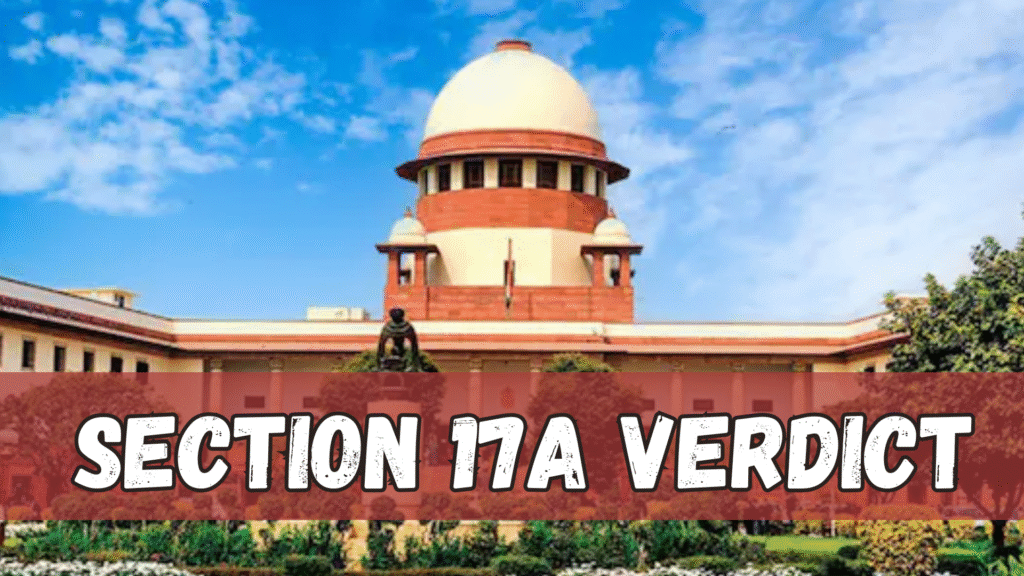
A two-judge Bench of the Supreme Court has delivered a split verdict on the constitutional validity of Section 17A of the Prevention of Corruption Act, 1988 (PCA). The provision mandates prior government approval before initiating investigation against public servants for decisions taken in official capacity.
Q1. What is the Prevention of Corruption Act, 1988?
- The PCA, 1988 is India’s primary law to combat corruption among public servants.
- It has its origins in the recommendations of the Santhanam Committee (1962-64), which highlighted the need to strengthen anti-corruption laws.
- The Act consolidates laws relating to:
- Bribery
- Obtaining undue advantage
- Criminal misconduct by public servants
- “Public servant” under the Act has a wide scope, covering government employees, local authority officials, judges, and others performing public duties.
- “Public duty” refers to duties in which the State, public, or community has an interest.
Q2. What does Section 17A of the PCA mandate?
- Section 17A was inserted through the 2018 amendment to the PCA.
- It requires prior approval of the appropriate government before any police inquiry or investigation is initiated against a public servant.
- This applies only when:
- The alleged offence relates to a recommendation made or decision taken
- The act was done in discharge of official functions or duties
- The objective behind introducing Section 17A was:
- To protect honest officers from harassment
- To prevent “policy paralysis” caused by fear of investigation for bona fide decisions
Q3. Why was Section 17A considered necessary by Parliament?
- Existing safeguards like Section 19 of the PCA already require prior sanction before prosecution in court.
- However, officers argued that:
- Investigations themselves had a chilling effect
- Fear of probes discouraged bold and timely administrative decisions
- Section 17A was intended to differentiate:
- Malicious or frivolous complaints
- From genuine allegations of corruption
Q4. What have earlier Supreme Court rulings held on prior approval?
- Vineet Narain v. Union of India (1998):
- The Supreme Court struck down the “Single Directive”.
- This executive order required prior sanction before CBI investigation against senior officers.
- The Court held that executive control over investigations undermined rule of law.
- Section 6A of the DSPE Act (2003 amendment):
- Introduced prior approval for investigating officers of Joint Secretary rank and above.
- Subramanian Swamy v. Director, CBI (2014):
- The Supreme Court struck down Section 6A.
- It held that:
- Differential treatment based on rank violated Article 14 (Equality before law)
- Even preliminary inquiries should not be obstructed
- These rulings established that fetters on investigation, especially at the threshold stage, are constitutionally suspect.
Q5. What led to the current split verdict on Section 17A?
- The case arose from a Public Interest Litigation filed by the Centre for Public Interest Litigation.
- The petition challenged Section 17A as unconstitutional and contrary to earlier Supreme Court judgments.
- The two-judge Bench delivered divergent opinions, reflecting fundamentally different readings of constitutional principles and precedent.
Q6. What was Justice K. V. Viswanathan’s view?
- Justice Viswanathan upheld the purpose behind Section 17A.
- He emphasised that:
- Honest officers form the “steel frame” of governance
- Absence of safeguards could promote a “play-it-safe” bureaucratic culture
- However, he identified a constitutional flaw:
- Allowing the government itself to grant approval compromises independence
- To save the provision, he adopted a constructive interpretation:
- Approval should be granted by the government based on binding recommendations of:
- Lokpal (for Central government officials)
- Lokayuktas (for State government officials)
- According to him, this would:
- Preserve investigative independence
- Protect honest officers
- Align Section 17A with constitutional requirements
- Approval should be granted by the government based on binding recommendations of:
Q7. What was Justice B. V. Nagarathna’s view?
- Justice Nagarathna held Section 17A to be unconstitutional.
- She described it as “old wine in a new bottle”, reviving restrictions already struck down earlier.
- Her key arguments were:
- Section 17A blocks investigation even at the preliminary stage
- This violates the core principles laid down in Vineet Narain and Subramanian Swamy
- She found it violative of Article 14 because:
- It protects only decision-makers, not lower-level officials
- There is no rational nexus between the classification and the objective
- She rejected the idea of judicial reconstruction:
- Courts cannot replace “government” with “Lokpal” in the statute
- Such an exercise amounts to judicial legislation
- She also held that:
- Adequate protection already exists under Section 19 at the prosecution stage
Q8. Why is the issue now before a larger Bench?
- The split verdict creates legal uncertainty on:
- Whether Section 17A is valid
- Who can grant approval
- Given the constitutional and governance implications, the matter has been referred to a larger Bench for a final and authoritative ruling.
Q9. What systemic reforms are needed to tackle corruption effectively?
- Speedy investigation and trial:
- Delays weaken deterrence
- Swift punishment increases credibility of anti-corruption law
- Penalising false complaints:
- Malicious and vexatious complaints should attract penalties
- This would discourage abuse of anti-corruption mechanisms
- Strengthening independent institutions:
- Lokpal and Lokayuktas must be operationally strong and autonomous
- Balancing accountability with decisional freedom:
- Honest decision-making should be protected
- Corrupt practices should face prompt and impartial action
Conclusion
The debate over Section 17A reflects a deeper tension between clean governance and administrative efficiency. While protecting honest officers is essential, placing excessive barriers on investigation risks undermining the fight against corruption. The larger Bench’s decision will be crucial in shaping India’s anti-corruption framework and the balance between integrity, accountability, and effective governance.