| Important questions for UPSC Pre/ Mains/ Interview:
1. What is the Export Preparedness Index (EPI) 2024, and why is it significant for India’s export-led growth strategy? 2. How is the EPI 2024 framework structured in terms of pillars, sub-pillars, indicators, and weightages, and what does this reveal about India’s export priorities? 3. Why is export infrastructure treated as a foundational pillar in EPI 2024, and how does it influence trade competitiveness? 4. How does the Business Ecosystem pillar reflect modern theories of export competitiveness and industrial development? 5. Why are policy and governance considered decisive factors for export preparedness in a federal economy like India? 6. What does the Export Performance pillar measure, and why is outcome-based assessment essential for credible policy evaluation? 7. How does the Leaders–Challengers–Aspirers (LCA) framework strengthen cooperative federalism in export promotion? 8. What insights does EPI 2024 offer regarding India’s integration into global value chains (GVCs)? 9. What strategic policy lessons emerge from EPI 2024 for strengthening India’s export ecosystem? |
Context
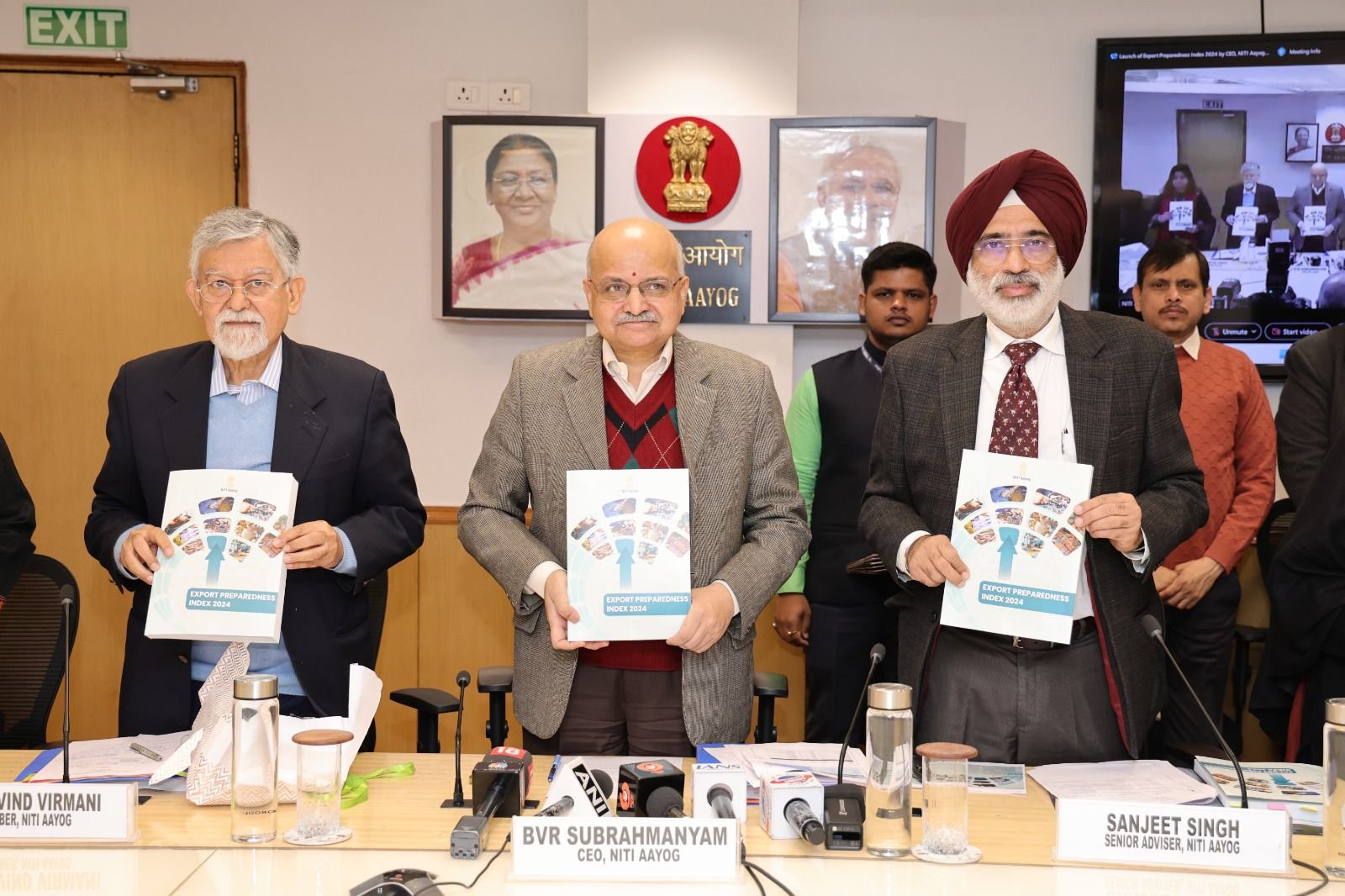
The Export Preparedness Index (EPI) 2024, released by NITI Aayog, provides a comprehensive, multi-dimensional assessment of India’s States and Union Territories on their readiness to promote exports. The index aligns with India’s strategic objective of achieving USD 1 trillion in merchandise exports by 2030 and supports the broader vision of Viksit Bharat @2047.
Unlike conventional export rankings, EPI recognises that exports are not generated by firms alone but emerge from ecosystems shaped by infrastructure, governance, human capital, and market access
Q1. What is the Export Preparedness Index (EPI) 2024, and why is it significant for India’s export-led growth strategy?
- The Export Preparedness Index 2024 is a diagnostic and benchmarking framework that evaluates how well States and UTs are positioned to enable exports.
- From a development economics perspective, exports act as:
- A driver of productivity growth
- A source of foreign exchange
- A channel for technology transfer
- Why EPI matters for India
- India’s export capacity is spatially uneven
- States play a critical role in infrastructure, labour, and regulation
- National targets cannot be achieved without sub-national readiness
- EPI 2024 translates macro export ambition into micro-level governance action.
Q2. How is the EPI 2024 framework structured in terms of pillars, sub-pillars, indicators, and weightages, and what does this reveal about India’s export priorities?
- EPI 2024 adopts a systems approach to export competitiveness.
- Framework structure
- 4 pillars
- 13 sub-pillars
- 70 indicators
- Pillars and weightage
- Export Infrastructure – 20%
- Business Ecosystem – 40%
- Policy & Governance – 20%
- Export Performance – 20%
- This reflects the idea that comparative advantage today is created, not inherited.
- Business conditions and institutions matter more than natural endowments alone.
Q3. Why is export infrastructure treated as a foundational pillar in EPI 2024, and how does it influence trade competitiveness?
- Infrastructure determines the cost, speed, and reliability of exports.
- According to trade cost theory, even small logistics delays can:
- Reduce export volumes
- Eliminate low-margin exporters (especially MSMEs)
- Infrastructure components assessed
- Ports, railways, roads, air cargo
- Warehousing and cold chains
- Power and water reliability
- States with efficient infrastructure reduce transaction costs, enabling firms to compete in time-sensitive global markets.
Q4. How does the Business Ecosystem pillar reflect modern theories of export competitiveness and industrial development?
- The Business Ecosystem pillar carries the highest weight because exports depend on firm-level competitiveness.
- Key elements
- Cost of production (power, water, labour)
- Human capital and skills
- MSME depth and scale
- Industrial clusters and innovation
- This aligns with New Trade Theory and Porter’s competitiveness framework, which emphasise productivity, clusters, and learning effects over mere scale.
Q5. Why are policy and governance considered decisive factors for export preparedness in a federal economy like India?
- Exports are deeply affected by institutional quality.
- Governance dimensions
- Predictability of regulations
- Digital clearance systems
- Trade facilitation and standards compliance
- Export promotion agencies
- Federal relevance: In India, states control land, labour, utilities, and local clearances. Effective governance lowers uncertainty and encourages long-term export-oriented investment.
Q6. What does the Export Performance pillar measure, and why is outcome-based assessment essential for credible policy evaluation?
- Preparedness must translate into outcomes.
- What is measured
- Export growth and stability
- Product and market diversification
- District-level export participation
- Why outcome-based evaluation matters
- From a public policy perspective, performance indicators:
- Prevent “policy on paper”
- Encourage accountability
- From a public policy perspective, performance indicators:
- Highlight implementation gaps
- This ensures EPI is action-oriented, not merely descriptive.
Q7. How does the Leaders–Challengers–Aspirers (LCA) framework strengthen cooperative federalism in export promotion?
- The Leaders–Challengers–Aspirers framework recognises asymmetric development.
- Benefits of LCA
- Encourages peer learning
- Avoids unfair comparisons
- Motivates reform through competition
- Federal logic: It supports competitive-cum-cooperative federalism, where states learn from best practices rather than chase uniform benchmarks.
Q8. What insights does EPI 2024 offer regarding India’s integration into global value chains (GVCs)?
- EPI 2024 highlights a shift toward value-added exports.
- Emerging patterns
- Growth in electronics and engineering exports
- Strong pharmaceutical and chemical base
- District export hubs gaining importance
- GVC perspective: Successful GVC integration requires:
- Reliable logistics
- Skilled labour
- Standards compliance
- States scoring high on EPI are better positioned to move up the value chain, not just export raw goods.
Q9. What strategic policy lessons emerge from EPI 2024 for strengthening India’s export ecosystem?
- EPI 2024 offers a reform roadmap.
- Key lessons
- Move from incentive-driven to ecosystem-driven export policy
- Strengthen district export promotion committees
- Invest in logistics and trade facilitation
- Integrate MSMEs into global supply chains
- Use data for continuous policy monitoring
- Export success must be broad-based, resilient, and institutionally anchored.
Conclusion
The Export Preparedness Index 2024 represents a mature shift in India’s export strategy—from headline targets to ground-level capability building. By highlighting the role of infrastructure, business ecosystems, governance, and outcomes, EPI reinforces the idea that exports are not accidental but policy-enabled and institutionally sustained. As India advances toward its trillion-dollar export ambition, EPI 2024 serves as a vital instrument for aligning state capacity, federal cooperation, and global competitiveness.