| Important questions for UPSC Pre/ Mains/ Interview:
1. Why was there a need to develop PSLV (Background)? 2. What is the PSLV, and why is it considered India’s workhorse launch vehicle? 3. Explain the design & working of PSLV (Four-stage architecture – solid & liquid propulsion). 4. What are the 5 different variants of PSLV (PSLV-G, PSLV-CA, PSLV-XL, PSLV-Ql, PSLV-DL)? 5. Discuss the major achievements of PSLV (Chandrayaan-1, Mars Orbiter Mission, etc). 6. How is PSLV different from GSLV (Geosynchronous Satellite Launch Vehicle)? 7. What is the significance of PSLV-C62 failure (January 2026)? 8. What went wrong in the third stage of PSLV (C61 and C62) and how did it affect the success and reliability of the missions? 9. What is the future relevance of PSLV in India’s space programme, especially with the rise of GSLV, SSLV, and private sector participation? |
Q1. Why was there a need to develop PSLV (Background)?
- Earlier Indian rockets (like Satellite Launch vehicle (SLV) & Augmented SLV) had limited payload capacity (maximum mass a rocket can carry) & low reliability, so India depended on foreign launch services.
- India needed a cost-effective and indigenous launcher to support agriculture, disaster management, Earth observation, and resource mapping using IRS (Indian Remote Sensing) satellites.
- The PSLV programme, started in the early 1980s under leaders like Dr. A.P.J. Abdul Kalam addressed this gap by creating a four-stage solid-liquid rocket with greater lift, precision, and reliability.
Q2. What is the PSLV, and why is it considered India’s workhorse launch vehicle?
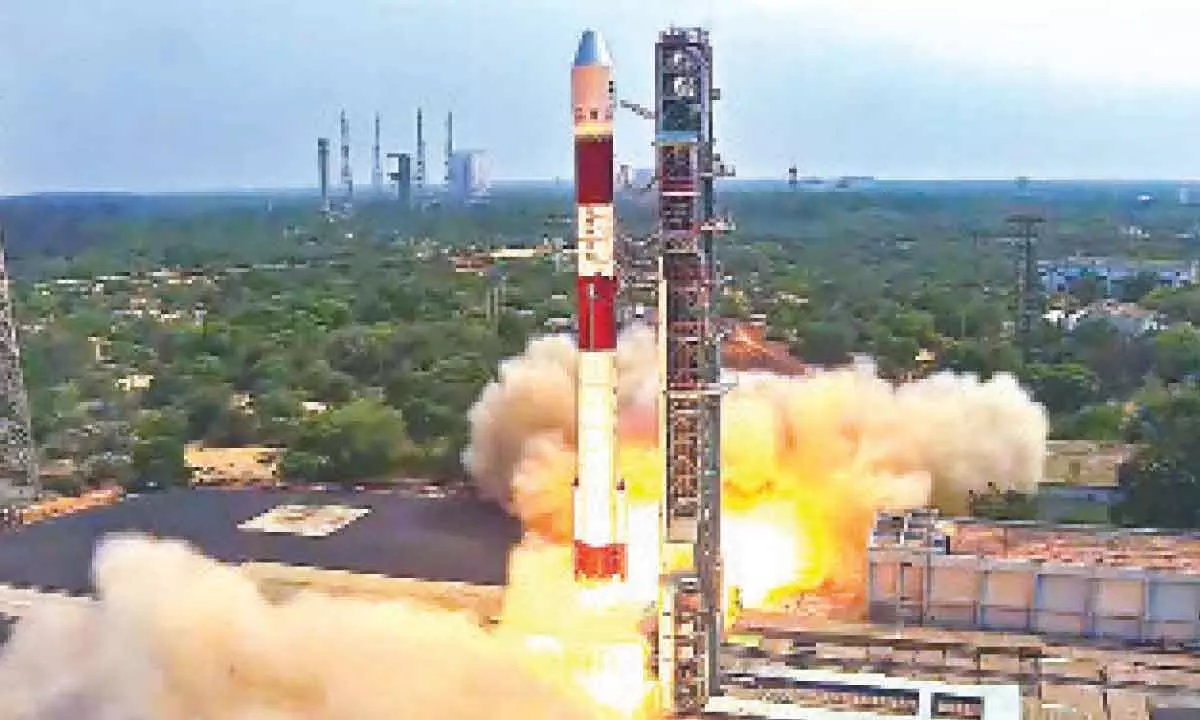
- It is ISRO’s indigenously built, third-generation, expendable (single-use rocket) launch system designed mainly to place remote-sensing and Earth-observation satellites into Sun-Synchronous Polar Orbits (SSO) and also to launch payloads into LEO (Low Earth Orbit) , Sub-GTO and GTO (Geostationary Transfer Orbit).
- It is called India’s “workhorse” because since its first success in October 1994, it has carried out more than 50 successful missions by 2025, launching IRS, Cartosat, Oceansat, NavIC, Astrosat, Chandrayaan-1, Mars Orbiter, and hundreds of foreign satellites.
- Key Features: High reliability, precision orbit insertion, multi-satellite capability & low cost
Q3. Explain the design & working of PSLV (Four-stage architecture – solid & liquid propulsion).
It has a four-stage design with alternating solid and liquid engines, giving both power and control, and each stage is dropped once its fuel is used to cut weight.
- First Stage (PS1): It uses a large solid rocket motor (S139) with solid strap on boosters to provide the required thrust needed to overcome gravity and atmospheric drag. It burns for about 2 minutes and then detaches.
- Second Stage (PS2): It used Vikas engine with liquid propellants that can be stored at room temperature. Liquid propulsion allows better control and efficiency.
- Third Stage (PS3): It is a solid motor that gives rocket a strong push after it leaves the thick atmosphere
- Fourth Stage (PS4): It uses 2 liquid engines to precisely insert satellites into their designated orbits and can be restarted multiple times, allowing batch deployment of many satellites in different orbits.
After satellite deployment, PS4 can be used as POEM (PSLV Orbital Experimental Module), a small platform with solar panels and a lithium-ion battery that runs experiments in space.
Q4. What are the 5 different variants of PSLV (PSLV-G, PSLV-CA, PSLV-XL, PSLV-Ql, PSLV-DL)?
- PSLV‑G (Standard): 6 strap‑on boosters, 4 stages; first successful flight in 1994.
- PSLV‑XL (Extended): 6 larger strap‑ons with extra propellant; payload ~1750 kg; used for Chandrayaan‑1, Mars Orbiter, Aditya‑L1.
- PSLV‑CA (Core Alone): No strap‑ons; lightest version; payload ~1019 kg; used for TeLEOS‑2 and DS‑SAR satellites.
- PSLV‑QL (Quick Launch): 4 strap‑ons, 48 tonnes propellant; payload ~1523 kg.
- PSLV‑DL (Dual Launch): 2 strap‑ons, 12 tonnes propellant; designed for dual satellite launches (e.g., XPoSat).
Q5. Discuss the major achievements of PSLV (Chandrayaan-1, Mars Orbiter Mission, etc).
- Chandrayaan-1 (2008) was launched by PSLV-XL, which led to the discovery of water molecules on the Moon.
- Mars Orbiter Mission (2013) was launched by PSLV, making India the first country to reach Mars in its first attempt.
- PSLV-C37 (2017) set a world record by placing 104 satellites into orbit in one mission, including 88 foreign satellites.
- PSLV also launched AstroSat, India’s first space observatory, and a long series of IRS, Cartosat, Oceansat and NavIC satellites.
- PSLV has launched hundreds of foreign satellites for governments and private companies, making it a major revenue earner for ISRO and strengthening India’s position in the global launch market.
Q6. How is PSLV different from GSLV (Geosynchronous Satellite Launch Vehicle)?
| Aspect | PSLV | GSLV |
| 1. Generation | Third-generation launch vehicle | Fourth-generation launch vehicle |
| 2. Stages | Four stages (PS1, PS2, PS3, PS4) | Three stages (GS1, GS2, Cryogenic Upper Stage) |
| Type of fuel | Mix of solid and liquid propellants | Uses cryogenic fuel (liquid oxygen and liquid hydrogen) |
| 3. Main purpose | Designed mainly for Earth- observation, navigation and scientific satellites | Designed mainly for communication satellites |
| 4. Primary orbit served | LEO, Sun-Synchronous Orbit (SSO), Sub-GTO and GTO | Geostationary Transfer Orbit (GTO) |
| 5. Payload capacity | Up to 1,750 kg to SSPO (600 km) | About 2,250 kg to GTO |
Q7. What is the significance of PSLV-C62 failure (January 2026)?
- PSLV-C62, launched in January 2026, carried 16 satellites, including EOS-N1, a strategic Earth-observation satellite built by DRDO, and several foreign satellites.
- It also carried AayulSAT, India’s first on-orbit satellite refuelling demonstrator, intended to test propellant-transfer technologies and MIRA telescope, India’s lightest space telescope.
- It was the first launch of 2026, meant to re-affirm PSLV’s reliability after the failure of PSLV‑C61 (May 2025). But the mission became the second consecutive failure.
- This was serious because PSLV had been ISRO’s most trusted launcher for more than three decades.
- It also raised concerns about ISRO’s commercial credibility because PSLV is the main revenue–earning rocket through foreign satellite launches.
Q8. What went wrong in the third stage of PSLV (C61 and C62) and how did it affect the success and reliability of the missions?
- Both PSLV-C61 (2025) and PSLV-C62 (2026) faced problems in the third stage (PS3) of the rocket.
- Data from the rocket showed a sudden drop in pressure inside the combustion chamber, which could have been caused by a manufacturing defect, fuel leakage, casing crack, or nozzle damage.
- When pressure drops, the engine produces less thrust, so the rocket cannot reach the high speed needed to stay in orbit, leading to mission failure.
- During PSLV-C62, ISRO reported a “roll rate disturbance”, which means the rocket started rotating uncontrollably.
- Since PS3 does not have its own stabilising thrusters, a sideways leak of gas could create a twisting force stronger than the stabilising system of the fourth stage (PS4).
- The Failure Analysis Committee (FAC) report of PSLV-C61 was not made public, which created doubts about transparency, quality control, and the reliability of PSLV for commercial launches.
- The failure also risks national security (loss of EOS‑N1), hyperspectral imaging capability (identifying material composition from space), and in‑orbit servicing (AayulSAT), while repeated PSLV failures erode global market share, raise insurance costs, block startups from proving their tech work, and undermine Space Policy 2023’s goal of capturing 8% of the global space economy.
Q9. What is the future relevance of PSLV in India’s space programme, especially with the rise of GSLV, SSLV, and private sector participation?
- PSLV will remain the mainstay for Earth-observation, navigation, scientific and commercial missions.
- GSLV will handle heavy communication satellites and human spaceflight, while SSLV will serve the small-satellite market.
- PSLV will act as the reliable medium-lift launcher for NSIL, Indian startups, and international customers.
- POEM, which uses the spent PS4 stage, adds a new role for PSLV in low-cost in-orbit scientific experiments.
| Key Terms:
1. Sun‑Synchronous Orbit (SSO): A near‑polar orbit where a satellite passes the same place at the same local solar time every day, ensuring consistent sunlight for Earth observation. 2. GTO (Geostationary Transfer Orbit): A highly elliptical orbit used as an intermediate step to reach geostationary orbit. 3. Sub‑GTO: A lower‑energy transfer orbit similar to GTO but with reduced apogee (the farthest point from Earth), used when payloads or rockets cannot reach full GTO. |