Context
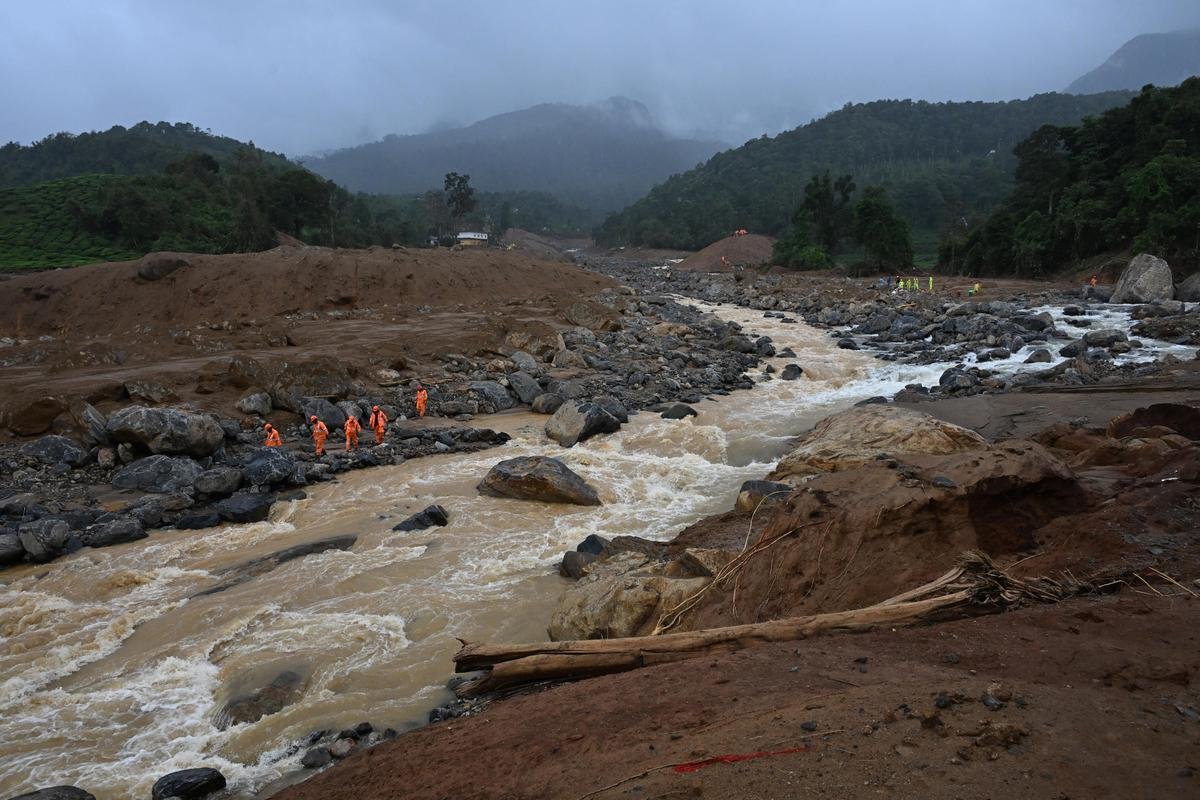
- In July 2024, severe landslides in Wayanad, Kerala killed nearly 300 people and destroyed thousands of homes.
- Kerala estimated losses of around ₹1,200 crore and sought ₹2,200 crore for recovery.
- The Union government approved only ₹260 crore (about 11% of the demand).
- This mismatch revived concerns about Centre–State imbalance in disaster financing and the health of cooperative federalism.
What is India’s Disaster Financing Framework?
India’s framework is mainly based on the Disaster Management Act, 2005 and Finance Commission recommendations.
- Two-Tier Funding Structure
- State Disaster Response Fund (SDRF)
- Main fund for immediate relief: food, shelter, clothing, medical care, basic compensation.
- Funded by:
- Centre: 75%, State: 25%
- For Himalayan & North-Eastern States: Centre 90%, State 10%
- State Disaster Response Fund (SDRF)
- Used for:
- Ex-gratia for deaths
- House damage
- Crop loss
- Basic relief items
- Cannot be freely used for large-scale reconstruction or long-term livelihood restoration.
- National Disaster Response Fund (NDRF)
- Fully funded by the Union government.
- Used when a disaster is classified as a “severe calamity”.
- Supplements SDRF when State capacity is inadequate.
- Role of the Finance Commission
- Decides how much money is set aside for each State for disaster response.
- Uses indicators like:
- Population
- Geographical area
- Poverty levels
- These are used as proxies for vulnerability, but not always aligned with actual hazard risk (e.g., floods, landslides, cyclones).
Why is the System Under Strain?
Several structural and procedural problems have emerged over time.
- Outdated and Rigid Relief Norms
- Compensation amounts are very low compared to current costs:
- ₹4 lakh per life lost.
- ₹1.2 lakh for a fully damaged house.
- These may help with subsistence, but not with real reconstruction or restoring livelihoods.
- Compensation amounts are very low compared to current costs:
- Ambiguity in “Severe” Disaster Classification
- The Disaster Management Act does not clearly define what is a “severe” disaster.
- This gives the Centre wide discretion in deciding:
- Which disasters qualify for NDRF support.
- How much to approve and when.
- Aid is Not Automatic
- There are no objective triggers like:
- Rainfall intensity
- Number of deaths per million
- There are no objective triggers like:
- Loss as a percentage of GSDP
- Instead, funds flow through long procedures:
- State sends a memorandum
- Central team assesses
- High-level approvals follow
- This causes delays precisely when States need fast support.
- Weak Criteria for Allocations
- Using population and area as major criteria is too broad.
- Vulnerability is often proxied by poverty, not by scientific disaster risk indices.
- This can lead to misaligned allocations, not matching real exposure to floods, landslides, cyclones, etc.
How the Wayanad Case Shows a Drift from Cooperative to Conditional Federalism?
The Wayanad landslides bring out several deeper issues:
- The Numbers
- Loss estimated: about ₹1,200 crore; assistance sought: ₹2,200 crore.
- Approved by Centre: ₹260 crore — about 11% of demand.
- Centre’s Justification
- The Union government pointed to:
- Kerala’s unspent SDRF balance of about ₹780 crore.
- An earlier interest-free loan of ₹529 crore under the Capital Investment Scheme.
- Problems with This View
- SDRF balances often include committed works, not idle cash.
- SDRF instalments often arrive late in the financial year, while disasters are seasonal → temporary balances are normal.
- SDRF cannot easily be used for long-term reconstruction, so States keep reserves.
- Delays in classifying Wayanad as a “severe disaster” limited Kerala’s access to NDRF.
- Unequal Treatment Across States
- Other States like Himachal Pradesh, Uttarakhand, Assam have received larger packages for comparable disasters.
- Similar under-funding has been noted for:
- Cyclone Gaja (Tamil Nadu, 2018)
- Karnataka floods (2019)
- This pattern suggests negotiation and discretion, not a transparent, rule-based system.
- The Union government pointed to:
All this gives an impression that cooperative federalism is weakening, and the Centre holds dominant control over disaster funds.
How Do Other Countries Handle Disaster Financing? (Global Practices)
Many countries are moving towards data-driven, automatic, and transparent systems:
- United States (FEMA)
- Uses per capita damage thresholds to decide federal aid.
- Mexico (FONDEN – earlier)
- Automatically released funds if rainfall or wind speed crossed certain levels.
- Philippines
- Uses rainfall and fatality indices to trigger quick-response funds.
- African & Caribbean regional insurance mechanisms
- Use satellite data on rainfall or drought to trigger payouts.
- Australia
- Links federal aid to how much a State has already spent on relief relative to its revenue.
Common feature:
→ Objective triggers, clear rules, less discretion, faster and more predictable support.
Implications
- Fiscal Stress on States
- States are left to bridge huge gaps between losses and approved funds, often by taking loans or diverting other budget heads.
- Erosion of Trust in Federalism
- Disaster relief appears like charity or negotiation, not a constitutional guarantee.
- Poor Climate Adaptation
- With rising climate-related disasters, weak and delayed funding slows resilience building (embankments, slope stabilisation, early warning systems, etc.).
- Social and Political Tension
- Perceived unequal treatment of States can trigger political mistrust and deepen regional grievances.
- Weak Long-Term Planning
- Without predictable funding, States cannot plan risk reduction and resilient infrastructure
Challenges & Way Forward
| Challenges | Way Forward |
| Outdated, low compensation norms that do not match current costs | Revise norms to reflect real reconstruction and livelihood costs |
| No clear definition of “severe disaster” leading to discretion | Legally define severity thresholds using scientific criteria |
| Disaster aid depends on procedural approvals, not objective triggers | Introduce automatic triggers (rainfall, fatalities, loss-to-GSDP ratio) |
| Finance Commission criteria not aligned with real hazard risk | Use a national vulnerability index based on hazard, exposure, sensitivity |
| Central dominance in releasing and controlling funds | Give States greater operational autonomy, with post-audit monitoring |
| Rising climate risks but limited grant-based support | Ensure disaster aid is grant-based, not loan-heavy |
| Perception of unequal treatment across States | Publish transparent data on damage, requests, and approved amounts |
Conclusion
India’s disaster financing system is being tested by frequent, intense climate shocks. To uphold true cooperative federalism, the country needs a transparent, rules-based, and vulnerability-driven approach to Centre–State disaster transfers. Moving from ad hoc negotiation to guaranteed, timely support will strengthen both State capacity and public trust before the next crisis strikes.
| EnsureIAS Mains Question
Q. “Disasters in India are becoming fiscal stress tests for States and a test of the spirit of cooperative federalism.” Discuss this statement in the context of the existing disaster financing framework and suggest key reforms. (250 words) |
| Prelims Practice Question
Q. With reference to disaster financing in India, consider the following statements: 1. The State Disaster Response Fund (SDRF) is shared between the Union and the States in a 75:25 ratio for all States. 2. The National Disaster Response Fund (NDRF) is entirely funded by the Union government. 3. The Disaster Management Act, 2005 clearly defines what qualifies as a “severe” disaster for NDRF support. 4. Current relief norms under SDRF are widely criticised for being outdated and inadequate for reconstruction. Which of the statements given above are correct? (a) 2 and 4 only Answer: (a) 2 and 4 only Explanation: Statement 1 is Incorrect: The SDRF is shared 75:25 for most States, BUT it is 90:10 for Himalayan States and North-Eastern States. Statement 2 is Correct: NDRF is a 100% Union-funded national-level fund used for major disasters classified as “severe”. States do not contribute to it. Statement 4 is Correct: Compensation norms (e.g., ₹4 lakh per death, ₹1.2 lakh for a fully damaged house) have barely changed in a decade. These norms support only basic relief, not reconstruction or livelihood restoration. |