Context
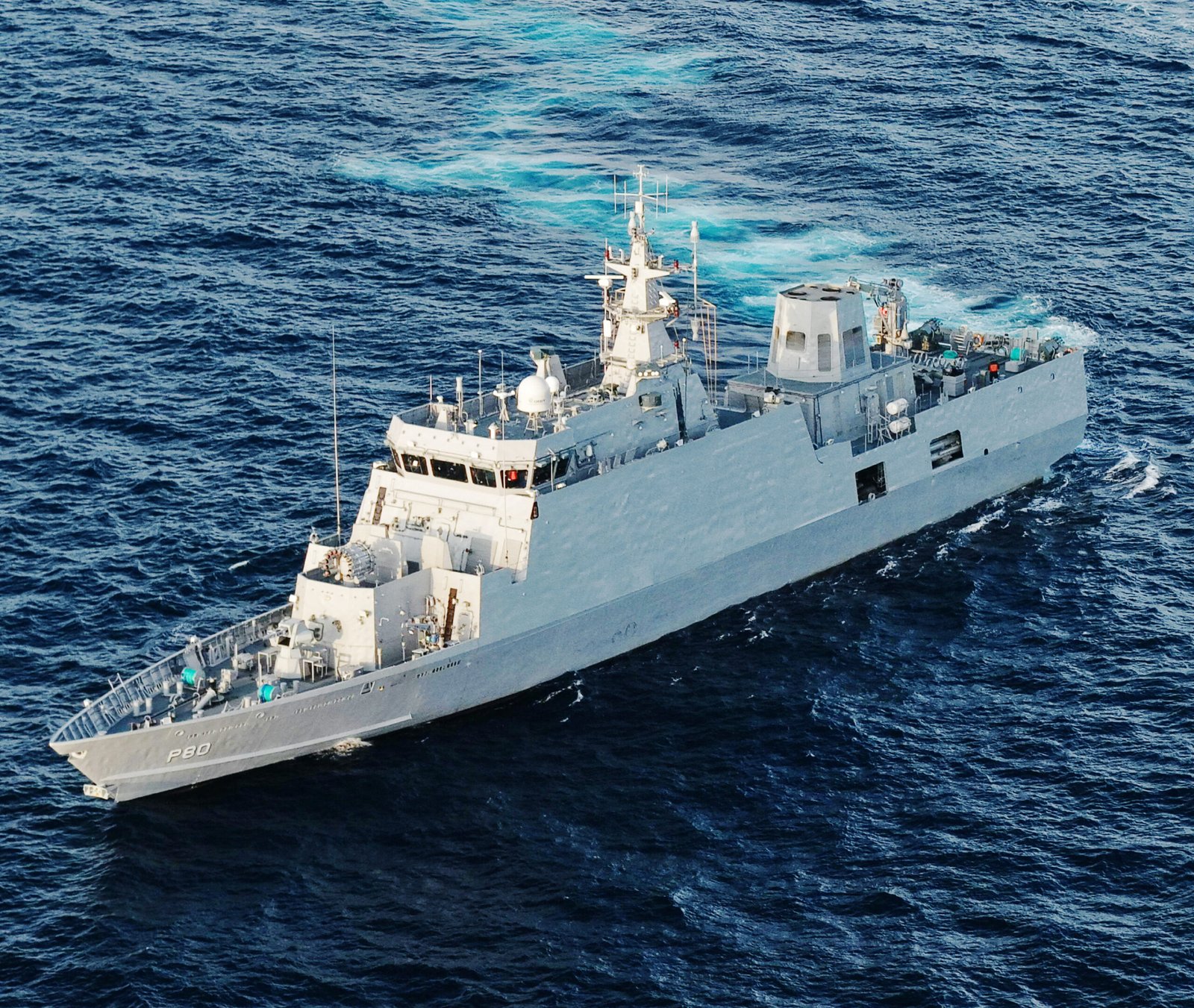
The Indian Navy has commissioned INS Mahe, the first ship of the indigenously- built Mahe-class Anti-Submarine Warfare Shallow Water Craft (ASW-SWC). The Navy is inducting 16 such vessels to strengthen coastal defence and underwater surveillance capability along India’s extensive coastline and island territories.
What is INS Mahe?
- INS Mahe is an indigenously designed and built ASW-Shallow Water Craft by Cochin Shipyard Limited (CSL).
- It is the lead ship in a class of eight Mahe-class vessels.
- Designed to operate in shallow coastal waters, where large warships cannot manoeuvre effectively.
- 80% indigenous content – major participation from BEL, L&T Defence, Mahindra Defence, NPOL and 20+ MSMEs.
- Crest symbol: Urumi sword (Kalaripayattu) depicting agility and
- Mascot: Cheetah symbolising speed and
- Motto: “Silent Hunters”.
What is an Anti-Submarine Warfare Shallow Water Craft (ASW-SWC)?
- An ASW-Shallow Water Craft is a specialised naval vessel designed to detect, track, and neutralise enemy submarines operating in shallow coastal waters, where larger warships cannot operate effectively due to depth limitations.
- It is equipped with advanced SONAR systems, underwater weapons, high manoeuvrability, and low draught, enabling it to conduct surveillance, mine-laying, and coastal defence operations.
Key Features of Mahe-class Ships
- Length: 78 metres
- Width:36 metres
- Draught:7 metres (ideal for shallow waters)
- Displacement: 896 tonnes
- Speed: 25 knots
- Endurance: 1800 nautical miles
Technological and operational features
- Propelled by diesel engine-waterjet combination (largest Indian Navy warships with such propulsion).
- Equipped with advanced SONARs, hull and towed-array systems for underwater surveillance.
- ASW warfare capability + mine-laying capability.
- Low Intensity Maritime Operations (LIMO) and Search & Rescue
- Fitted with state-of-the-art weapons, sensors, communication systems, and integrated control machinery.
Why is the Navy Inducting 16 ASW-SWCs?
Background
- Earlier the Indian Navy used Abhay-class corvettes (Soviet Pauk-II class) for coastal anti-submarine patrols.
- These were decommissioned between 2017-2025.
- In 2013, DAC approved 16 new ASW-SWCs worth ₹13,000 crore.
Ship Production
| Shipbuilder | Class | Status |
| CSL, Kochi | Mahe-class | 8 ships (INS Mahe commissioned; 7 upcoming) |
| GRSE, Kolkata | Arnala-class | 8 ships (INS Arnala, Androth commissioned; 6 upcoming) |
- All 16 ships planned to be inducted within 2-3 years.
Strategic Significance
- Fills a critical capability gap created after decommissioning older corvettes.
- Detects and counters stealthy diesel-electric submarines operating close to the coast.
- Protects harbour approaches, major shipping lanes, ports, offshore oil and gas infrastructure, and naval bases.
- Low draught and high manoeuvrability make them ideal for littoral warfare.
- Creates a structured shallow-water ASW defensive wall along the coastline.
- Frees larger warships for blue-water (open ocean) operations.
- Strengthens deterrence posture in the Indian Ocean Region (IOR).
- Enhances real-time surveillance through integration with radar chains, patrol aircraft and underwater sensors.
Implications
- Boosts coastal and maritime security amid rising submarine activity in the Indian Ocean.
- Reinforces India’s Atmanirbhar Bharat and defence manufacturing ecosystem.
- Improves inter-operability and naval readiness for multi-domain maritime threats.
- Enhances India’s role as a net security provider in the Indian Ocean.
Challenges and Way Forward
| Challenges | Way Forward |
| Increasing deployment of advanced submarines by adversaries in the IOR | Strengthen multi-layered ASW network integrating satellites, UAVs, P-8I aircraft and seabed sensors |
| Huge coastal area (7,516 km coastline + 1,197 islands) needing constant monitoring | Deploy ASW-SWCs in tiered defence structure + expand coastal radar chain |
| Need for faster induction timelines | Accelerate ship-building; reduce procurement delays |
| High demand for underwater domain awareness | Invest in indigenous sonar R&D and AI-based threat-tracking systems |
Conclusion
The commissioning of INS Mahe marks a significant upgrade in India’s coastal defence and underwater surveillance capability. With the induction of 16 ASW-Shallow Water Craft, India is building a robust anti-submarine security shield, strengthening maritime dominance, securing strategically important littorals, and enhancing indigenous naval power in the Indian Ocean Region.
| Ensure IAS Mains Question
Q. Explain the strategic significance of the Indian Navy’s induction of the Mahe-class ASW-Shallow Water Craft. How does it enhance India’s maritime security architecture? (250 words) |
| Ensure IAS Prelims Question
Q. Consider the following statements about Anti-Submarine Warfare Shallow Water Craft (ASW-SWC): 1. They are designed to detect and counter submarines operating in shallow coastal waters. 2. ASW-SWCs are equipped with advanced sonar and mine-laying systems. 3. They are primarily used for blue-water (deep ocean) naval operations. Which of the above statements is/are correct? a) 1 and 2 only b) 2 and 3 only c) 1 and 3 only d) 1, 2 and 3 Answer: a) 1 and 2 only Explanation Statement 1 is correct: ASW-SWCs are specifically built for shallow coastal waters, where they detect and counter submarines close to the shore. Statement 2 is correct: They are equipped with advanced sonar systems, sensors and mine-laying capability for underwater threat neutralisation. Statement 3 is incorrect: They are not designed for deep-sea (blue-water) operations, which are handled by larger warships such as destroyers and frigates. |