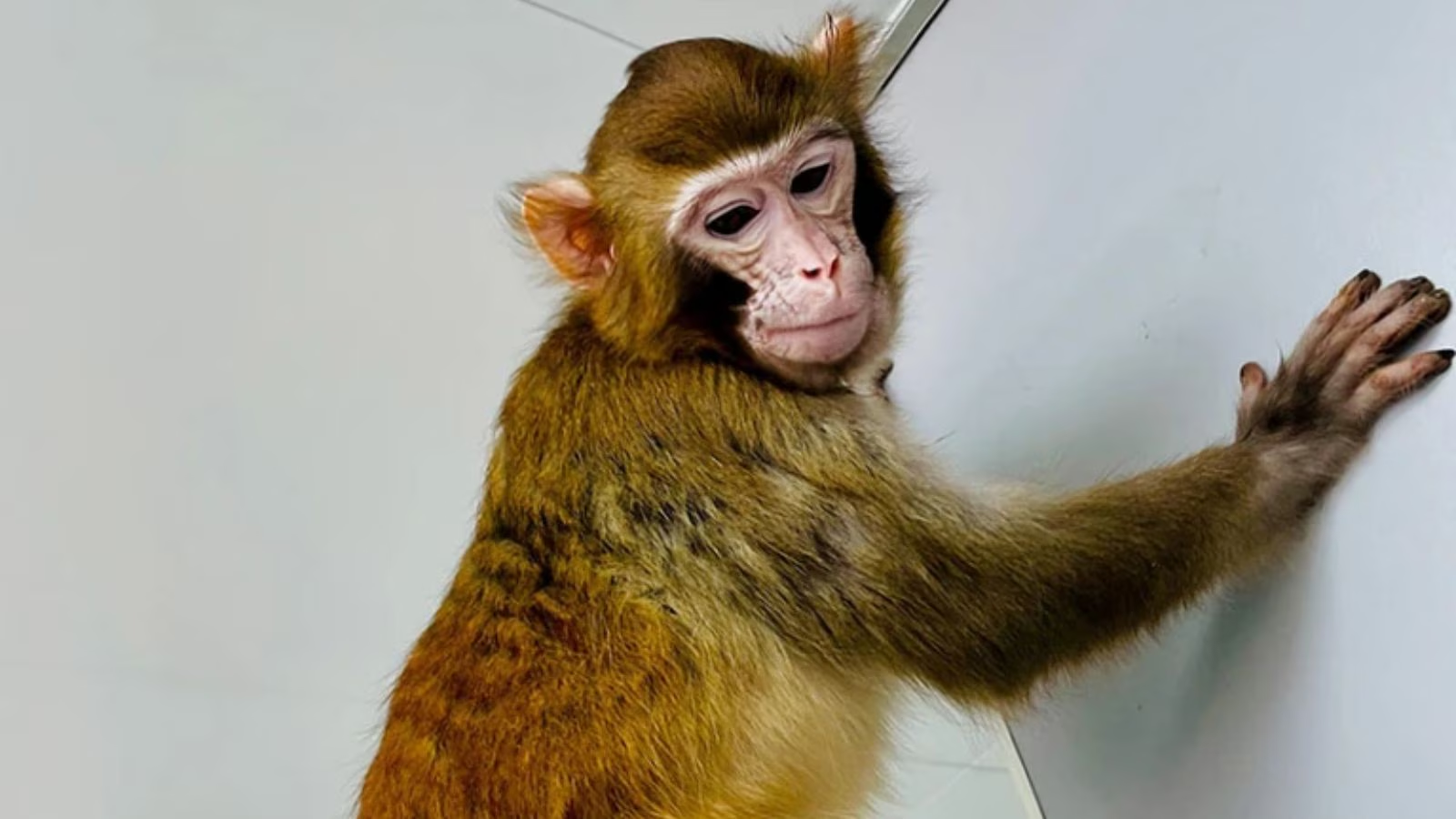
Why in the News?
The Standing Committee of the National Board for Wildlife (SC-NBWL), chaired by the Union Environment Minister, has recommended reinstating the Rhesus Macaque under Schedule II of the Wildlife (Protection) Act, 1972 to restore statutory protection.
Key Highlights
- Stakeholder inputs and inter‑governmental consultation
- The Animal Welfare Board of India and the Federation of Indian Animal Protection Organisations formally requested the restoration to prevent cruelty and exploitation.
- The ministry circulated a questionnaire to Chief Wildlife Wardens of all states and UTs to collect reasoned positions; six states supported and several opposed, reflecting divergent local realities.
- State positions and reasons
- States supporting reinstatement (Madhya Pradesh, Gujarat, Uttarakhand, West Bengal, Himachal Pradesh, Arunachal Pradesh) cited protection, cruelty prevention and ecological reasons.
- States opposing (Assam, Rajasthan, Meghalaya, Uttar Pradesh, Punjab, Jammu & Kashmir, Andhra Pradesh) argued that the species is not threatened and that Schedule II listing may hamper conflict management and local control.
- Operational directives and management planning
- Union Minister directed divisional forest officers and deputy conservators to prepare site‑specific conservation and management plans for the species.
- States were asked to develop detailed mitigation plans categorising conflict areas and to establish rescue and rehabilitation infrastructure.
- Technical support and baseline study
- The panel recommended a baseline study drawing on Wildlife Institute of India research to inform site prioritisation, conflict categorisation and management strategies.
- The recommendation had backing from Member Secretaries of the Central Zoo Authority and the National Tiger Conservation Authority, signalling institutional support.
About the Wildlife Protection Act, 1972
- Overview: Landmark Central legislation protecting wild animals, birds, plants through Schedules, protected areas, and hunting regulations.
- Centralized Control: Powers like declaring vermin, creating sanctuaries, and enforcing penalties are mainly with the Union Government, limiting state flexibility.
- Key Provisions of 1972 Act:
- Definition of Wildlife: Includes terrestrial and aquatic animals, plants, insects, fish, and vegetation forming part of habitats.
- Wildlife Advisory Boards: State-level boards advise on management of Sanctuaries and National Parks, conservation policies for wildlife and plants and harmonizing tribal/community needs with conservation goals
- Schedules of the WPA: Flora and fauna classified into six Schedules:
- Schedule I & II: Endangered species; absolute protection; highest penalties
- Schedule III & IV: Species not endangered; lesser protection
- Schedule V: Vermin species that can be hunted with license. Example: Crows, Rats.
- Schedule VI: Regulates cultivation and trade of certain plants.
- Wildlife Protection (Amendment) Act, 2021:
- CITES Implementation: Expanded protection for species under international trade regulations.
- Rationalized Schedules: Reduced from six to four for clarity and better enforcement:
- Schedule I: Species with highest protection
- Schedule II: Species with slightly lower risk but still protected
- Schedule III: Protected plants; trade and cultivation regulated to prevent depletion.
- Schedule IV: CITES-listed species under international trade restrictions.
- Regulation of Invasive Alien Species: The Central government can prohibit or control invasive species affecting native biodiversity.
- Voluntary Surrender: Captive animals and trophies can be surrendered without compensation.
Implications
- Legal Enforcement
- Restoring Schedule II status would reintroduce legal safeguards, enabling stronger action against illegal capture, trafficking, and cruelty. Courts and enforcement agencies would gain clearer authority to prosecute violations.
- Research Oversight
- Scientific use of macaques would require permits and adherence to welfare standards. Institutions may need alternative models or stricter ethical reviews to comply with tighter regulations.
- Welfare Infrastructure
- Mandating rescue and rehabilitation centers could improve care for injured or captured macaques. Success depends on adequate resources—poor infrastructure could lead to welfare gaps.
- Conflict Management
- Site-specific mitigation and community involvement could ease human–macaque tensions. However, stricter protection without local flexibility may hinder conflict resolution efforts.
- Administrative Coordination
- States have powers under Section 11 to manage wildlife conflicts. Reinstatement must balance central protection with state-level authority, requiring clear coordination and role clarity.
Challenges and Way Forward
| Challenges | Way Forward |
| Divergent state positions | Form a central–state technical working group to align threat criteria and draft a unified roadmap. |
| Human–wildlife conflict | Create rapid response teams, deploy non-lethal deterrents, offer compensation, and set clear SOPs. |
| Insufficient rescue & rehab capacity | Fund and accredit regional centers, train staff, and build a national registry of rehab resources. |
| Research and biomedical needs | Gradually enforce permit systems, promote in vitro and digital models, and support ethical shifts. |
| Enforcement and illegal trade | Boost intelligence-led enforcement, enhance interagency data sharing, and run targeted awareness campaigns. |
Conclusion
The SC‑NBWL recommendation to reinstate the Rhesus Macaque under Schedule II aims to balance animal welfare, legal protection and scientific oversight with pragmatic conflict management. Success will depend on evidence‑based decision making, state‑centre coordination, investment in rescue and mitigation infrastructure, and policies that protect animals while addressing local livelihoods and safety concerns.
| EnsureIAS Mains Question
Q. Examine the implications of reinstating the Rhesus Macaque under Schedule II of the Wildlife (Protection) Act, 1972 for wildlife governance and human–wildlife conflict management in India. Suggest measures to ensure policy coherence between central statutory protection and state‑level conflict responses. (250 Words) |
| EnsureIAS Prelims Question
Q. Consider the following statements regarding the Wildlife (Protection) Act, 1972 and management of species listed under its schedules: 1. Section 11 of the Wildlife (Protection) Act, 1972 empowers State Governments to make rules for handling wildlife in their territories, including provisions for species in conflict. 2. Schedule II of the Act provides statutory protection to listed species and imposes penalties for hunting, capture or trade, unless permitted by the authorities. Which of the statements given above is/are correct? A. 1 only Answer: C Explanation: Statement 1 is correct: Section 11 allows State Governments to make rules for the purpose of providing for the better conservation of wild animals and to regulate activities within their territories. It is commonly interpreted to give states powers to manage conflict situations through state rules and measures, while remaining subject to the Act and central oversight. Statement 2 is correct: Schedule II lists species that are afforded statutory protection under the Act. Hunting, capture, trade or cruelty towards animals listed under the schedules is generally prohibited except under specific permits and provisions; penalties apply for contraventions under the Act. |