Why in the News?
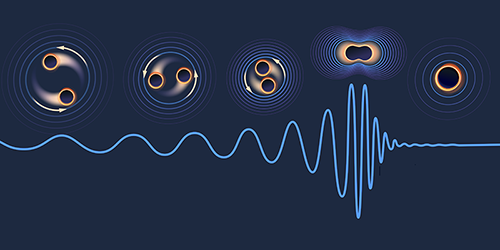
- On 14 January 2025, the global network of detectors (LIGO, Virgo, KAGRA) recorded the clearest gravitational-wave signal so far from two merging black holes.
- Because the signal was unusually clean, researchers used it to test deep predictions of general relativity i.e., Hawking’s black-hole area theorem and the behaviour of rotating (Kerr) black holes.
Key Highlights
- Background: gravitational waves and LIGO
- Einstein’s general relativity predicts that accelerating massive objects produce ripples in spacetime called gravitational waves.
- In 2015, LIGO (two 4-km laser interferometers in the U.S.) made the first direct detection, confirming a 100-year-old prediction. LIGO’s founders later won the Nobel Prize (2017).
- What GW250114 is and how it was detected
- GW250114 is the gravitational wave from two black holes merging about 3 billion light-years away.
- The signal was picked up by LIGO, and also analysed jointly with Virgo (Italy) and KAGRA (Japan), improving confidence in the detection.
- How interferometers ‘hear’ gravitational waves (simple physics)
- LIGO/Virgo/KAGRA split a laser beam along two long, perpendicular arms. A passing wave slightly stretches one arm and compresses the other.
- That tiny change shifts the laser interference pattern and produces a measurable flicker — the gravitational-wave signal.
- Why GW250114 is special
- It is the clearest / highest signal-to-noise black-hole merger recorded to date, thanks to improved detector sensitivity (better lasers, mirrors, noise reduction).
- The clarity let scientists analyse different parts of the signal separately (before merger and after merger) and measure physical quantities precisely.
- What scientists tested with the signal
- Black-hole area theorem (Hawking, 1971): the total area of event horizons of black holes should not decrease after processes like mergers. Using early and late segments of GW250114, researchers measured the initial two horizon areas and the final remnant’s area and found the total increased, supporting the theorem.
- Kerr black-hole solution (Roy Kerr, 1963): ringdown frequencies (the “vibrations” of the new black hole) matched expectations for a rotating black hole described by Kerr’s solution.
- Wider scientific value
- The observation strengthens confidence in general relativity in extreme conditions, refines models of how black holes form and merge, and enlarges a growing catalogue of mergers used for future tests.
What are the possible applications of this finding?
- Deeper Understanding of Gravity and Spacetime
- The finding confirms Einstein’s General Theory of Relativity even under the most extreme conditions — near black holes.
- It allows physicists to test fundamental laws of physics in environments that can’t be recreated on Earth, improving our understanding of spacetime curvature, energy, and motion.
- Advancement in Astrophysics and Cosmology
- By detecting and studying gravitational waves, scientists can observe cosmic events invisible to light-based telescopes (e.g., black hole mergers, neutron star collisions).
- This opens a new “gravitational-wave astronomy,” complementing optical and radio astronomy.
- It helps estimate black hole populations, their distribution, and their role in galaxy evolution.
- Refining Black Hole Models
- The study provided the strongest evidence for Hawking’s black hole area theorem, which states that the total surface area of black holes never decreases.
- It also verified the Kerr solution, confirming how rotating black holes behave.
- These validations refine our theoretical models of how mass, energy, and angular momentum evolve in extreme cosmic events.
- Improved Detector Technology and Precision Measurement
- Enhancing sensitivity of LIGO, Virgo, and KAGRA required cutting-edge innovations in lasers, mirrors, and vibration control.
- These technologies have spin-off benefits in precision engineering, optical communication, seismology, and quantum sensing.
- New Insights into the Early Universe
- Gravitational waves travel almost undisturbed across spacetime, unlike light that can be absorbed or scattered.
- Future detections may help us trace events closer to the Big Bang, providing clues about the universe’s birth, expansion, and structure.
- Catalyst for Global Scientific Collaboration
- The joint analysis by LIGO (USA), Virgo (Italy), and KAGRA (Japan) demonstrates how international cooperation can accelerate scientific progress.
- This global data-sharing model can inspire similar frameworks in climate research, AI ethics, and quantum computing.
- Potential Future Applications (Speculative but Promising)
- Gravitational wave mapping could one day help detect dark matter or understand cosmic inflation.
- Advanced wave detection systems might even contribute to spacecraft navigation or deep-space communication by analyzing spacetime distortions.
Key Terms
- Gravitational Waves: Gravitational waves are ripples in the fabric of spacetime caused by the acceleration of massive celestial bodies like colliding black holes, neutron stars, or supernovae. Predicted by Albert Einstein in 1916 under his General Theory of Relativity, which describes gravity as the curvature of spacetime due to mass and energy.
- Interferometer: An interferometer is a scientific instrument that uses light waves (usually lasers) to measure very tiny changes in distance — even smaller than the width of an atom! This flicker tells scientists that something changed the distance between mirrors — like a passing gravitational wave or vibration.
- Kerr Black Hole: A Kerr black hole is a type of rotating black hole, named after Roy Kerr, the New Zealand mathematician who described it in 1963. Unlike a normal (non-rotating) black hole, a Kerr black hole spins around its axis — just like the Earth or a spinning top. This rotation changes the shape and behavior of space around it.
Challenges and Way Forward
| Challenges | Way Forward |
| Detector noise & limited sensitivity restrict detection range and the number of clear events. | Continue hardware upgrades (lasers, mirrors, cryogenics), and develop next-generation detectors (e.g., Einstein Telescope, Cosmic Explorer). |
| Localization & multimessenger follow-up — black-hole mergers emit no light, making host identification hard. | Improve network geometry (more detectors worldwide) to triangulate sources; coordinate rapid alerts for telescopes. |
| Data analysis complexity — separating signal from noise and model-dependence. | Advance model-agnostic (burst) and model-dependent pipelines; invest in high-performance computing and open data sharing. |
| Systematic errors and calibration can bias tests of theories. | Rigorously calibrate instruments, cross-check with independent methods, and publish uncertainty budgets. |
| Testing new physics requires many events for statistical power. | Build larger catalogues via longer observations and planned detectors; combine data across collaborations. |
Conclusion
GW250114 is a landmark gravitational-wave detection: its clarity let scientists perform precise checks of ideas first proposed decades ago — the black-hole area theorem and the Kerr solution — thereby strengthening our understanding of gravity at its most extreme. Continued detector improvements and expanded global networks will make such decisive tests more frequent, deepening both astrophysics and fundamental physics.
| EnsureIAS Mains Question
Q. Discuss how gravitational-wave observations (like GW250114) have transformed tests of general relativity and our understanding of black holes. In your answer, outline current technical challenges and suggest policy measures India could adopt to participate more deeply in gravitational-wave science. (250 Words) |
| EnsureIAS Prelims Question
Q. Consider the following statements: 1. GW250114 was detected by the international network of LIGO, Virgo and KAGRA detectors and provided evidence supporting Hawking’s black-hole area theorem. 2. The black-hole area theorem states that the total surface area of black-hole event horizons can decrease in mergers if gravitational radiation is emitted. 3. Ringdown frequencies observed after a merger help identify whether the remnant is a rotating (Kerr) black hole. How many of the following statements are correct? Answer: c) 1 and 3 only Explanation: Statement 1 is correct: GW250114 (detected 14 Jan 2025) was recorded by the LIGO network and jointly analysed with Virgo and KAGRA. Because the signal was exceptionally clean, researchers tested and reported observational support for theoretical predictions such as Hawking’s black-hole area theorem. Statement 2 is incorrect: The black-hole area theorem (Hawking, 1971) predicts that the total event-horizon area cannot decrease in classical processes like mergers; it should stay the same or increase. Radiated energy reduces mass/energy, but horizon area still does not shrink for classical black holes. Statement 3 is correct: The ringdown phase is the remnant black hole’s “vibration” after merger. Its frequencies and damping times depend on mass and spin; matching observed ringdown modes with theory confirms whether the remnant behaves like a Kerr (rotating) black hole. |