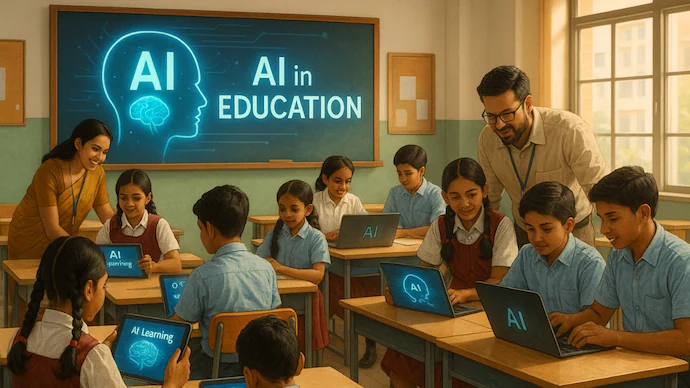
Why in the News?
- The Government is preparing to introduce formal AI teaching into school education starting from class 3 from academic year 2026–27, aligning with NEP-2020’s emphasis on technology and 21st-century skills.
- There is rapid uptake of generative and adaptive AI tools in educational institutions, prompting urgent action on teacher training, equity of access, assessment reforms and ethics.
Key Highlights
- Policy direction and timeline
- India is moving to mainstream AI education in kindergarten to class 12 (K–12), with pilot projects already under way and a formal roll-out targeted from 2026–27.
- The initiative is being shaped to align with NEP-2020 aims: foundational literacy/numeracy, experiential learning, critical thinking and technology integration.
- Government agencies are collaborating with industry and research institutes for curriculum design and teacher training modules.
- Teacher capacity and implementation strategy
- Large-scale teacher upskilling is the central implementation challenge: training more than a crore teachers requires modular courses, blended training, and local language materials.
- Pilot projects with industry partners (Intel, IBM, NIELIT) show scalable models: teacher workshops, train-the-trainer cascades, and classroom trials for lesson design and AI tool use.
- Effective rollout needs continuous support (mentoring, resource repositories, in-service credit) and assessment of classroom readiness.
- Pedagogical shift — personalization and assessment
- AI enables adaptive learning: systems that track individual pace, misconceptions and present tailored exercises or remedial content.
- Generative AI can create practice items, explanatory resources and simulated dialogues, reducing routine teacher workload.
- Assessment will shift from only summative exams to formative, real-time feedback driven by analytics; this requires rethinking evaluation rubrics and teacher roles.
- Inclusivity, language, and the human dimension
- AI has strong potential to improve inclusion: language processing and accessibility tools can assist non-native speakers and learners with disabilities.
- Yet language learning and other socio-emotional competencies rely on human interaction like empathy, nuance, humour are areas where AI remains an assistant, not a substitute.
- Cultural and community contexts matter: transmitted meanings and pragmatic uses of language cannot be fully automated.
| 1. National Education Policy (NEP) 2020
1. NEP 2020 is India’s comprehensive framework for school and higher education reform, emphasizing multidisciplinary learning and critical thinking. 2. It promotes experiential learning, foundational literacy/numeracy, and integration of vocational and digital skills. 3. NEP encourages use of technology for personalized learning, teacher training and governance, but implementation is state-led. 4. It advocates regulatory simplification and autonomy for institutions and strengthened teacher preparation. 2. Generative AI 1. AI models that produce novel content (text, images, code) from learned patterns in large datasets (e.g., large language models). 2. Applications in education include auto-generated explanations, practice items, summaries and simulated dialogues. 3. Risks: hallucinations (incorrect outputs), copyright/data provenance issues, and potential bias. 4. Requires human review, curriculum alignment and clear usage guidelines. 5. Raises questions of assessment integrity and academic honesty. |
Implications
- Skills and employability: Early AI exposure can build adaptable, computational and problem-solving skills, making future cohorts more employable in a digital economy.
- Assessment reform: Real-time analytics will push education systems to value formative assessment, competency mapping and continuous remediation.
- Equity risks and opportunities: If implemented thoughtfully, AI can reduce learning gaps (language, disability); if poorly resourced, it will deepen the digital divide.
- Governance and regulation: New frameworks are required for student data protection, algorithmic transparency, teacher accountability and content moderation.
- Human capital reorientation: Teachers’ roles will shift toward facilitation, socio-emotional mentoring and higher-order skill development; large scale reskilling and incentives are necessary.
- Economic and ethical implications:
- Studies cited (e.g., NITI Aayog projections) indicate simultaneous job disruption and creation — automation in some tasks, new roles in AI development, deployment and governance.
- Ethical concerns include bias in training data, privacy of student data, surveillance risks, and unequal access that could widen existing educational divides.
- Policy responses must balance innovation with safeguards: data protection, transparent algorithms, and regulatory oversight.
Challenges and Way Forward
| Challenges | Way Forward |
| 1. Teacher Training at Scale – Over one crore teachers need AI literacy and digital pedagogy skills; uneven capacity across states. | Develop modular national training programmes (online + regional hubs), continuous mentoring, incentives for certification, and peer-learning networks. |
| 2. Infrastructure and Access Gaps – Rural and low-income schools face lack of devices, power, and internet connectivity. | Expand device provisioning schemes, create community digital labs, promote offline-compatible AI tools, and subsidise internet access through public–private partnerships. |
| 3. Curriculum and Pedagogical Alignment – Risk of superficial AI adoption without integration into core subjects. | Revise NCERT/SCERT curricula with clear learning outcomes, introduce project-based AI modules, and ensure contextual, age-appropriate content from early classes. |
| 4. Data Privacy and Ethical Concerns – Student data vulnerability, algorithmic bias, and opaque AI models. | Enforce strong data protection rules, establish consent protocols, audit AI tools for bias, and promote algorithmic transparency in education technology. |
| 5. Language and Cultural Sensitivity – AI systems may not perform well for Indian languages or local cultural contexts. | Develop multilingual datasets, support regional language NLP research, and involve local educators and communities in model testing. |
| 6. Equity and Digital Divide – Unequal access to AI tools risks widening existing socio-economic learning gaps. | Provide targeted subsidies, CSR-funded access programmes, and inclusive design for learners with disabilities or language barriers. |
Conclusion
India’s introduction of AI into school education is a transformational move that combines opportunity with responsibility. Properly designed, it can personalise learning, improve inclusion and prepare students for a changing job market. Success depends on large-scale teacher empowerment, reliable infrastructure, robust privacy and ethical safeguards, and curricula that keep the human dimension — empathy, judgment and communication — at the centre.
| EnsureIAS Mains Question
Q. Critically examine the opportunities and challenges of integrating Artificial Intelligence into school education in India. Suggest policy measures to ensure equitable access, teacher readiness, and ethical safeguards. (250 Words) |
| EnsureIAS Prelims Question
Which of the following statements about AI in school education are correct? Choose the correct Option: Answer: B (2 and 4 only) Explanation: Statement 2 is correct: Generative AI models can produce practice items, explanations, quizzes, and personalised study notes tailored to a learner’s level. These tools can accelerate content creation and adapt materials to difficulty and language, making them useful pedagogical assistants when quality and alignment to learning outcomes are ensured. Statement 3 is incorrect: Adaptive systems support personalised drill and feedback, but socio-emotional learning, cultural nuance and empathetic correction require human judgement and relational interactions. AI augments teaching but cannot fully replicate human mentoring, classroom community building or nuanced language pragmatics. Statement 4 is correct: Government and think-tank projections indicate AI will cause displacement in some roles while creating new jobs in AI development, data annotation, pedagogy design and support services. The net effect depends on policy, reskilling and sectoral absorption of new roles. |