Why in the News?
A research team built a wave flume on a microscopic chip using a few-nanometre film of superfluid helium and observed extreme nonlinear wave behaviour which was previously inaccessible in laboratory tanks.
What is a Wave?
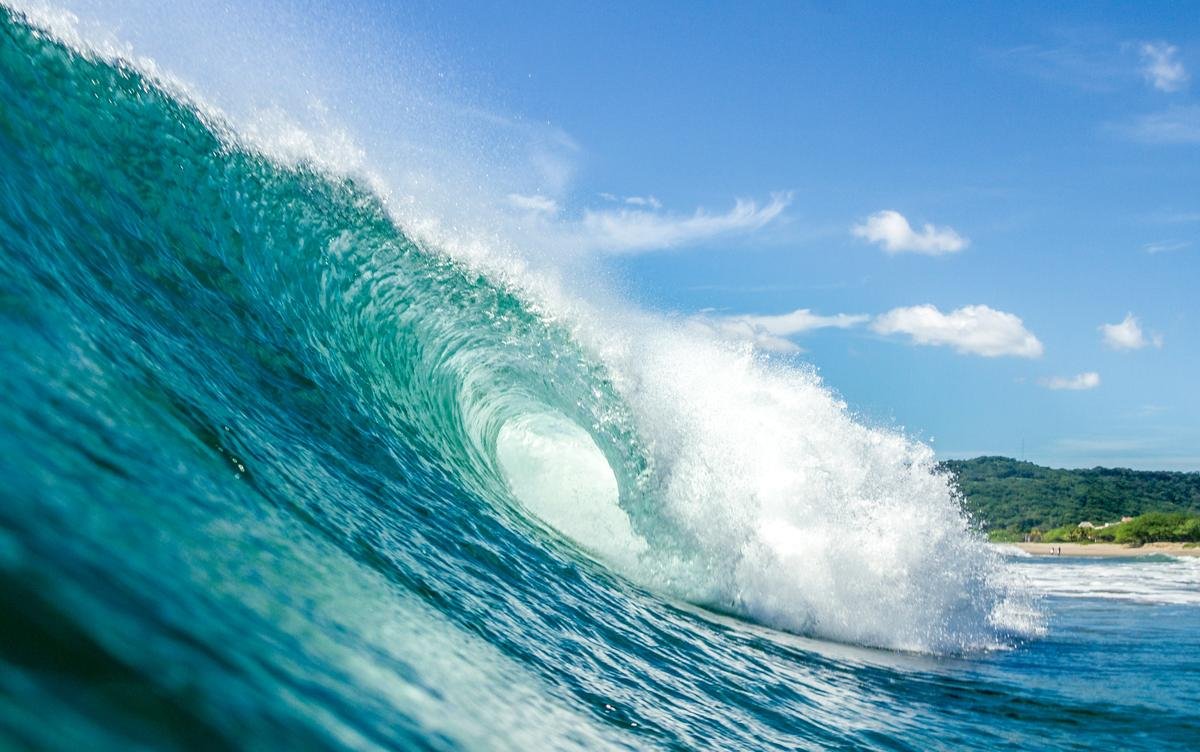
- A wave is a disturbance or vibration that transfers energy from one place to another without transferring matter.
Example: When you drop a stone in a pond, ripples move outward — the water itself doesn’t travel, only the wave energy does. - Main Characteristics of Waves:
- Crest: The highest point of a wave.
- Trough: The lowest point of a wave.
- Amplitude: The maximum displacement of particles from their rest position. It represents the wave’s energy.
- Wavelength: The distance between two consecutive crests or troughs.
- Frequency: The number of waves passing a point per second (measured in Hertz).
- Velocity: The speed at which the wave travels.
What are the different types of Waves based on Energy Behaviour?
| Type | Description | Example |
| Linear Waves | Energy and amplitude are small, so wave behaviour is simple and predictable. | Small ripples in water |
| Nonlinear Waves | Energy is high, causing complex effects — wave height and speed change unpredictably. | Tsunamis, shock waves, solitons |
Why do scientists study nonlinear waves?
- Large natural events like tsunamis and extreme tides are governed by nonlinear physics, where small changes can produce large, surprising effects. Therefore, it is important to study nonlinear waves.
- The study of how fluids move has fascinated scientists for centuries because hydrodynamics governs everything from ocean waves and the swirl of hurricanes to the flow of blood and air through our bodies.
What made scientists study nonlinear waves on a microscopic level?
- Traditional large water tanks which were used to study nonlinear waves cannot reach the extreme conditions needed to study the most intense nonlinear waves found in nature.
- Researchers therefore sought a new experimental route to explore full nonlinear behaviour under controlled conditions.
About the Experiment
- Objective of the study: Scientists wanted to create powerful waves on a tiny scale to explore the physics behind wave motion and turbulence, which affect oceans, weather, and even blood flow.
- They created a wave flume on a microscopic chip and used a unique kind of fluid (helium) to generate more powerful waves (relative to their size) than anything ever seen on the earth.
- This setup allowed them to study fluid dynamics at an ultra-small scale with high precision.
- They used helium, which became superfluid when cooled to just a few degrees above absolute zero (−273°C). In this state, helium flows without friction or viscosity, making it ideal for observing pure wave motion.
- The team then fabricated a silicon beam about the width of a human hair on the chip. When cooled, a 7-nm deep film of superfluid helium could naturally coat this beam, creating a perfect wave channel.
- Outcome of the setup: The researchers successfully produced a microscopic environment capable of generating and studying extremely powerful nonlinear waves (relative to their size).
How were waves driven and seen on the chip?
- The researchers used a photonic crystal cavity and a laser to heat the superfluid locally; the superfluid’s fountain effect caused it to flow — acting as a tiny, light-powered paddle.
- By monitoring the light exiting the cavity, the team measured wave height and shape in real time.
What they observed — exotic nonlinear phenomena
- The team saw backward steepening: troughs moved faster than crests, causing the wave to lean backward before breaking. This is the reverse of normal water waves behaviour.
- They produced near-vertical shock fronts by increasing drive power.
- They observed soliton fission: one powerful pulse split into a train of solitary waves (up to 12), specifically “hot solitons” that were troughs slightly warmer than the surrounding fluid.
- A Soliton is a solitary wave that holds its shape and speed over incredibly long distances. They are examples of nonlinear wave dynamics.
Implications of this Research in the Real World
- Better understanding of extreme waves: The findings improve theoretical understanding of how large nonlinear waves form and break, which helps modelling tsunamis and coastal hazards.
- New laboratory platform: A compact, controllable waves-on-a-chip system allows rapid, repeatable experiments that would take hours in big tanks, accelerating discovery.
- Communications & optics: Insights into soliton dynamics are relevant to optical fibre communications and information-carrying solitary pulses that resist dispersion.
- Advanced sensing and metrology: The optomechanical measurement technique points to ultra-sensitive sensors for surface waves, thin films and small-scale fluid problems.
- Cross-disciplinary innovation: The platform links quantum fluids, nonlinear dynamics, and optomechanics, creating opportunities in materials science, microfluidics and fundamental physics.
Challenges and Way Forward
| Challenge | Way Forward |
| Scaling results to real oceans | Use theoretical scaling (matching dimensionless numbers) and targeted field/large-flume tests to validate which chip results apply to macroscales. |
| Different governing forces (van der Waals vs gravity) | Map parameter ranges where KdV-like dynamics hold; run comparative experiments across fluids and depths to delineate limits of equivalence. |
| Need for specialized conditions (superfluid helium, cryogenics) | Develop alternative fluids or engineered surfaces that mimic key nondimensional behaviours at more practical temperatures. |
| Complex data interpretation & modelling | Invest in joint experimental–theory programs, build open datasets, and develop validated computational solvers for nonlinear regimes. |
| Translation to engineering applications | Create translational projects with communications, coastal engineering and sensor companies to test applied use-cases (optical solitons, early-warning algorithms). |
Conclusion
The chip-scale superfluid experiment is a major step in making the most extreme nonlinear wave physics experimentally accessible. By combining precise optical control with an exotic fluid, researchers observed phenomena predicted by theory but never before seen directly. The platform is not a miniature ocean — rather, it is a powerful mathematical analogue that lets scientists probe, validate and eventually apply nonlinear-wave ideas across physics and engineering.
| EnsureIAS Mains Question
Q. Explain how chip-scale experiments using superfluid helium contribute to our understanding of nonlinear wave dynamics. Assess the strengths and limitations of using microscopic analogues to model large-scale geophysical waves. (250 words) |
| EnsureIAS Prelims Question
Q. Consider the following statements: 1. The chip-scale experiment using superfluid helium reproduced the exact physical forces (including gravity) that drive tsunamis in the ocean. 2. The experiment demonstrated soliton fission, where a large wave pulse splits into a train of solitary waves. 3. The same Korteweg–de Vries (KdV) equation can describe shallow-water nonlinear waves even if the dominant restoring force is gravity or van der Waals attraction, provided key dimensionless parameters match. How many/ Which of the following statements are correct? Answer: b) 2 and 3 only Explanation: Statement 1 is incorrect: The chip experiment does not reproduce the same physical forces as the ocean. It uses van der Waals acceleration and quantum superfluid dynamics, not gravity; the experiment is a mathematical analogue, not a literal miniature of tsunamis. Statement 2 is correct: The team directly observed soliton fission, where a single intense pulse divided into a sequence of solitary waves (a soliton train), confirming a classic nonlinear prediction. Statement 3 is correct: The KdV equation governs shallow-water nonlinear wave evolution in form. If two systems share the same dimensionless parameters (Ursell number, aspect ratio, dispersion scaling), the KdV framework can describe their dynamics even when the dominant restoring force differs. |