Why in the News?
- The latest Index of Industrial Production (IIP) data for September 2025 provides a crucial snapshot of India’s industrial health during the first half (April-September) of FY 2025-26.
- While there are some signs of recovery, the overall industrial growth has been uneven and sluggish, raising concerns about employment generation and consumer demand.
What Does the Data Show?
| Period | Industrial Growth (IIP) | Key Trend |
| April-September 2025 (H1) | 3% | Slowest half-yearly growth in 5 years |
| Q1 (Apr-Jun 2025) | 2% | Weak momentum |
| Q2 (Jul-Sep 2025) | 4.1% | Signs of recovery |
| Manufacturing Growth (Q2) | 4.9% | Strongest since Dec 2023 |
| Mining Sector | Contraction | Poor performance despite post-monsoon recovery expectation |
Key Observations
- Growth Not Broad-Based
- Of the 23 manufacturing sub-sectors, more than half contracted in Q2 2025-26.
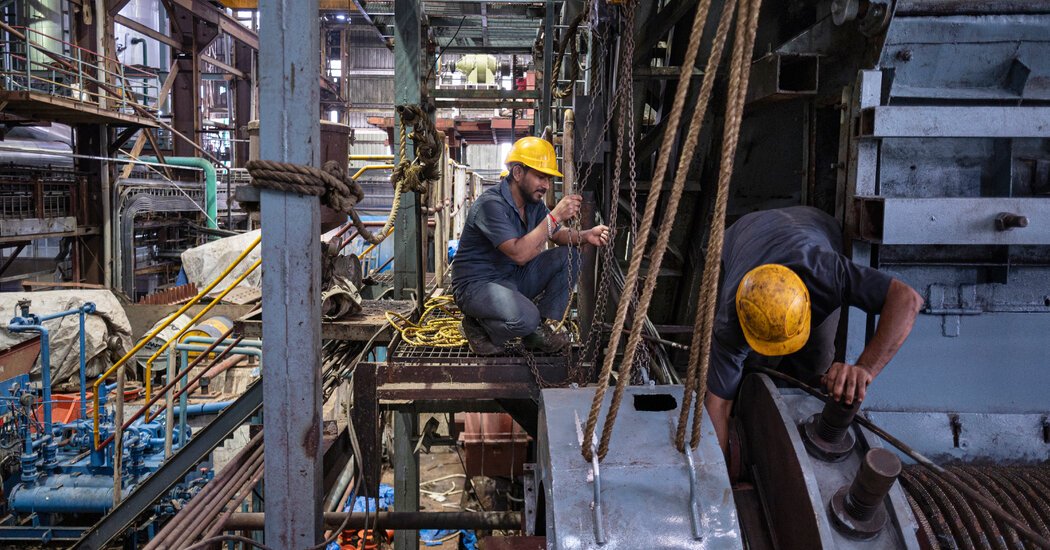
- Labour-intensive sectors (like textiles, leather, rubber, and plastics) shrank.
- Growth is driven mainly by capital-intensive sectors like metals, fabricated products, and mineral products.
- Weak Consumer Demand
- The consumer non-durables category has contracted for six consecutive quarters, showing sustained demand weakness.
- Indicates stress in household spending, especially in rural areas.
- Mining Sector Weakness
- Performance hit by monsoon disruptions and structural inefficiencies.
- Has implications for energy and mineral security, vital for industries like steel and power.
Implications of Uneven Growth
- Jobless Growth: Labour-intensive sectors shrinking means fewer employment opportunities.
- Demand Deficiency: Lower incomes → weak consumption → reduced industrial output → vicious cycle of slowdown.
- Energy Dependence: Mining sector weakness threatens strategic self-reliance.
- Regional Imbalance: States dependent on small industries (e.g., textiles, leather) face greater distress.
Challenges and Way Forward
| Challenges | Way Forward |
| 1. Concentrated growth: Limited to capital-intensive industries. | Diversify growth through incentives for labour-intensive manufacturing and MSMEs. |
| 2. Weak consumer demand: Declining sales in consumer goods and essentials. | Boost rural incomes via MGNREGS support, PM-KISAN, and urban job programs. |
| 3. Contraction in the mining sector: Affects energy and raw material supply. | Strengthen domestic mineral exploration, streamline clearances, promote sustainable mining. |
| 4. Low private investment: Companies hesitant due to demand uncertainty. | Encourage private capex via tax incentives, ease of doing business, and credit support. |
| 5. Skill and employment mismatch: Industrial recovery not translating into jobs. | Focus on skill development, local manufacturing clusters, and value-chain integration. |
Policy Significance
- The data highlights the dual challenge of reviving industrial growth and stimulating demand.
- Fiscal and monetary policies must focus not just on production, but on income generation and job creation.
- Structural reforms, such as logistics efficiency, MSME credit flow, and ease of labour compliance, are vital for sustained industrial growth.
Conclusion
India’s industrial recovery remains uneven and fragile. While headline figures show moderate improvement, the underlying weakness in labour-intensive sectors and consumer demand signals deeper structural concerns. A durable recovery demands inclusive growth, one that creates jobs, raises incomes, and expands purchasing power, to build a sustainable cycle of production and demand.
| Ensure IAS Mains Question
Q. India’s recent industrial growth appears uneven, with capital-intensive sectors expanding while labour-intensive industries lag behind. Discuss the implications of such a growth pattern for employment and demand generation in the economy. Suggest policy measures to ensure more inclusive industrial growth. (250 words) |
| Ensure IAS Prelims Question
Q. Consider the following statements about the recent Index of Industrial Production (IIP) trends in India: 1. The IIP data for April-September 2025 showed India’s fastest half-yearly industrial growth in the last five years. 2. Labour-intensive sectors such as textiles and leather have shown robust expansion during 2025. 3. Consumer non-durable goods output has been contracting for multiple consecutive quarters, indicating weak household demand. How many of the statements given above is/are correct? a) Only One b) Only two c) All three d) None Answer: a) Only one Explanation: Statement 1 is incorrect: Industrial growth in April-September 2025 was the slowest in five years (around 3%). Statement 2 is incorrect: Labour-intensive sectors such as textiles, leather, and rubber contracted in the September quarter. Statement 3 is correct: The consumer non-durables category has contracted for six consecutive quarters, reflecting persistent demand weakness. |