Why in the News?
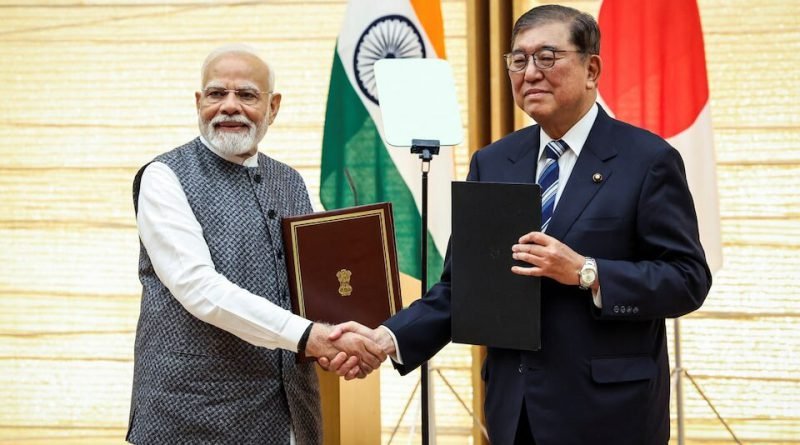
- Prime Minister Narendra Modi held a 25-minute phone call with Japan’s new Prime Minister Sanae Takaichi shortly after she took office.
- Both leaders reaffirmed cooperation on the Quad, economic & defence ties, and mobility of professionals, and expressed the desire to open a “new golden chapter” in the India–Japan Special Strategic & Global Partnership.
Key Highlights
- What were the major areas of discussion between the heads of both countries?
- Quad & Indo-Pacific
- Both leaders emphasised the importance of a Free and Open Indo-Pacific, and Tokyo reaffirmed Quad cooperation (Japan–Australia–India–U.S.).
- Japan described India and Japan as sharing fundamental values and strategic interests, making the Quad a central plank of their agenda.
- Economic security, defence and talent mobility
- India and Japan agreed to prioritise economic security (supply chains, critical tech), deepen defence cooperation (exercises, logistics) and ease mobility of professionals (talent & short-term exchanges).
- The conversation referenced initiatives and agreements signed during PM Modi’s August visit to Japan and the Japan-India Joint Vision for the Next Decade.
- People-to-people and investment ties
- Both sides stressed investment, innovation, and people-to-people exchanges as essential pillars.
- Tokyo and Delhi signalled intent to translate political goodwill into concrete projects, investment flows, and academic/skills mobility.
- Next steps and diplomatic choreography
- Officials flagged the possibility of a meeting on the sidelines of G20 in South Africa in November, showing intent to follow up multilaterally.
- Japan’s outreach to many Indo-Pacific partners (ASEAN, APEC) indicates a broader diplomatic push in which India is a key partner.
- Quad & Indo-Pacific
Key Terms
- Quad (Quadrilateral Security Dialogue)
- The Quad is an informal strategic forum comprising Japan, India, Australia and the United States.
- It focuses on maritime security, infrastructure, technology and disaster response in the Indo-Pacific.
- The grouping is not a formal military alliance but operates via meetings, joint exercises and collaborative projects.
- Quad initiatives aim to provide public-goods alternatives (ports, digital infrastructure) to unilateral influence.
- Its effectiveness depends on political will, operational interoperability and alignment on norms such as freedom of navigation.
- Special Strategic and Global Partnership (India–Japan)
- This is a high-level bilateral framework that elevates India–Japan ties beyond routine diplomacy to strategic cooperation.
- It covers defence, economic security, connectivity, technology and cultural ties.
- The partnership rests on long-term joint visions and annual summits, backed by institutional working groups.
- A partnership is meaningful only if it includes deliverables, funding commitments and implementation machinery.
- It helps both countries coordinate policy in multilateral fora and align on Indo-Pacific norms.
- Free and Open Indo-Pacific (FOIP)
- FOIP is a strategic vision advocating open trade routes, rule-based order and respect for sovereignty in the Indo-Pacific region.
- It emphasises maritime security, infrastructure standards, connectivity and norms of behaviour.
- FOIP aims to provide cooperative alternatives to coercive or zero-sum regional strategies.
- Critics caution that FOIP must be inclusive and avoid bloc formation that escalates tensions.
Implications of a Strong India–Japan Partnership
- Regional stability: A closer India–Japan partnership strengthens the Quad and contributes to deterrence and balance in the Indo-Pacific.
- Resilient supply chains: Cooperation on economic security can diversify critical supply chains away from strategic chokepoints.
- Defence interoperability: Deeper defence ties increase maritime security, logistics cooperation, and combined response capability.
- Human capital & innovation: Easier talent mobility enhances research collaboration, tech transfer and capacity building in advanced sectors.
- Geopolitical signalling: The partnership sends a clear signal of shared norms (rule-of-law, open seas), influencing other regional actors and multilateral forums.
Challenges and Way Forward
| Challenge | Way Forward (practical steps) |
| Translating rhetoric into projects | Create a joint implementation roadmap with timelines for defence logistics, semiconductor/value-chain projects, and people-mobility pilots. |
| Regulatory & visa hurdles for talent mobility | Negotiate fast-track visa lanes, mutual recognition of professional credentials, and pilot exchange fellowships for STEM & start-ups. |
| Economic-security trade-offs (supply-chain shifts) | Coordinate strategic industrial partnerships (critical minerals, semiconductors) with joint investments and risk-sharing mechanisms. |
| Defence interoperability & logistics access | Expand joint exercises, sign logistics and information-sharing protocols, and institutionalise defence-technology collaboration. |
| Domestic political volatility and continuity | Establish bureau-level working groups to preserve continuity across leadership changes and to operationalise the Joint Vision. |
| Balancing ties with other powers (China, US) | Maintain strategic autonomy by promoting multilateral frameworks and transparent cooperation that avoids exclusive blocs. |
Conclusion
The swift outreach between Prime Minister Modi and PM Takaichi signals a determined effort to consolidate the India–Japan Special Strategic and Global Partnership. Moving from words to deliverables will require clear roadmaps on economic security, defence interoperability, and talent mobility, plus procedural fixes (visas, standards, procurement). If implemented well, the partnership can deepen regional stability, bolster critical supply chains, and accelerate technology and people exchanges across the Indo-Pacific.
| EnsureIAS Mains Question
Q. Discuss the strategic significance of deepening India–Japan ties for the Indo-Pacific. Suggest practical institutional and policy measures India should adopt to operationalise cooperation in defence, economic security and talent mobility. (250 words) |
| EnsureIAS Prelims Question
Q. Consider the following statements regarding India–Japan relations: 1. The India–Japan Special Strategic and Global Partnership primarily focuses only on defence and maritime cooperation. 2. The Act East Policy of India complements Japan’s Free and Open Indo-Pacific (FOIP) vision. 3. Japan is a member of the Quadrilateral Security Dialogue (Quad) along with India, Australia, and the United States. Which of the statements given above is/are correct? Answer: b) 2 and 3 only Explanation: Statement 1 is incorrect: The India–Japan Special Strategic and Global Partnership is a multi-dimensional relationship, not limited to defence. It includes economic security, technology cooperation, infrastructure investment, innovation, and people-to-people ties, along with defence and maritime collaboration. Statement 2 is correct: India’s Act East Policy aims to enhance connectivity and cooperation with East and Southeast Asia. This aligns with Japan’s Free and Open Indo-Pacific (FOIP) vision, both promoting peace, stability, and rule of law in the Indo-Pacific region. Statement 3 is correct: Japan, along with India, the U.S., and Australia, forms the Quadrilateral Security Dialogue (Quad)—an informal grouping focused on ensuring a free, open, and inclusive Indo-Pacific through strategic and economic cooperation. |