Why in the News?
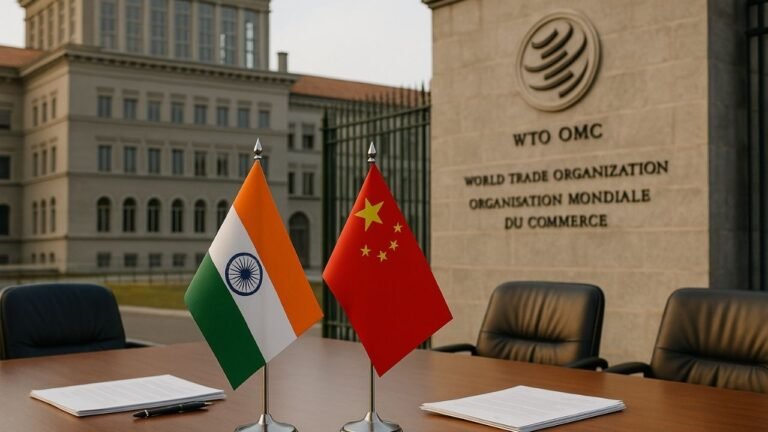
- China has filed a complaint at the World Trade Organization (WTO) against India, alleging that India’s Production-Linked Incentive (PLI) schemes for certain sectors provide illegal subsidies that violate WTO rules.
- This marks the first WTO dispute between India and China, highlighting growing friction in trade policy amidst global supply chain realignments.
What is the PLI Scheme?
- Launched in 2020, the Production-Linked Incentive (PLI) scheme aims to:
- Boost domestic manufacturing capacity and export competitiveness.
- Provide financial incentives (based on incremental sales) to select strategic industries.
- Integrate Micro, Small, and Medium Enterprises (MSMEs) into larger value chains.
- Reduce dependence on imports and strengthen India’s role in global value chains (GVCs).
- So far, PLI schemes cover 14 key sectors such as electronics, auto, telecom, semiconductors, solar modules, and pharmaceuticals, with a total outlay of over ₹1.97 lakh crore.
Which PLI Schemes Has China Challenged?
China has objected to three specific PLIs that it claims violate WTO’s subsidy rules:
- PLI for Advanced Chemistry Cell (ACC) Batteries:
- Encourages giga-scale manufacturing of lithium-ion batteries and energy storage systems.
- Mandates a 25% Domestic Value Addition (DVA)
- PLI for the Automobile and Auto Component Industry:
- Promotes Advanced Automotive Technology (AAT) vehicles and components.
- Requires 50% Domestic Value Addition (DVA) for eligibility.
- PLI for Electric Vehicles (EVs):
- Aims to attract global EV manufacturers and establish an indigenous supply chain.
- Rewards domestic sourcing and production.
What Is China’s Complaint?
China argues that:
- India’s DVA requirements in these schemes encourage domestic sourcing over imports.
- This allegedly discriminates against imported (especially Chinese) goods, violating WTO’s non-discrimination principles.
- Such conditions amount to Import Substitution (IS) subsidies, prohibited under WTO rules.
WTO Rules on Subsidies
- Under WTO law, countries can give subsidies, but they must not distort global trade.
- The legal framework is governed by the Agreement on Subsidies and Countervailing Measures (SCM Agreement).
- Article 1 of SCM Agreement defines a subsidy as:A financial contribution by a government or public body that confers a benefit and is specific to an enterprise or industry.
- Subsidies are classified as:
| Type | Nature | WTO Status |
| Prohibited Subsidies | a) Export subsidies contingent on export performance
b) Import Substitution subsidies contingent on using domestic goods over imported goods. |
Illegal per se. |
| Actionable Subsidies | Cause adverse effects to other WTO members (e.g., injury to domestic industry). | Can be challenged. |
| Non-actionable Subsidies | For research, regional development, environmental protection (rare). | Permitted. |
- Hence, if a subsidy requires use of domestic goods instead of imported ones, it becomes prohibited.
Related WTO Provisions Also Violated (as per China)
China also cites breaches of two other key WTO agreements:
| WTO Agreement | Provision | Implication |
| GATT (General Agreement on Tariffs and Trade), Article III:4 | National Treatment Obligation | Imported goods must be treated “no less favourably” than domestic goods. |
| TRIMs (Trade-Related Investment Measures) Agreement, Article 2.1 | Local Content Prohibition | Bans investment measures that require use of local inputs. |
Thus, China argues that India’s DVA-linked incentives indirectly force local content usage, violating both GATT and TRIMs.
India’s Likely Defence
India maintains that:
- The PLI scheme rewards performance, not sourcing.
- Domestic Value Addition (DVA) can occur through design, assembly, R&D, labour, or services, not necessarily through domestic goods.
- Hence, DVA ≠ Local Content Requirement.
- The scheme is WTO-consistent and aimed at industrial competitiveness, not import discrimination.
- Many countries (including S., EU, South Korea) offer similar green industrial incentives under their Inflation Reduction Act (IRA) or Green Deal.
WTO Dispute Process: What Happens Next?
- Consultation Phase: India and China first attempt bilateral consultations (within 60 days).
- Panel Phase: If unresolved, a three-member WTO Panel is established to adjudicate.
- Appeal: Either side can appeal to the Appellate Body, but since it has been non-functional since 2019, appeals remain pending indefinitely.
- Implication: If the case reaches the appeal stage, it will remain unresolved for years, meaning status quo continues, and India can keep its PLI schemes operational.
Broader Implications
| Dimension | Impact |
| Economic | Could affect investor confidence if WTO rules against India. However, domestic industrial push continues under Make in India and Atmanirbhar Bharat. |
| Strategic | Reflects China’s discomfort with India’s emerging self-reliance in EVs and batteries — sectors where China dominates. |
| Legal | May test the boundaries of WTO law on green subsidies and industrial policy. |
| Global Context | Several countries (e.g., USA’s IRA) are also facing scrutiny for similar domestic incentives, showing a shifting global consensus toward “strategic protectionism.” |
Conclusion
China’s complaint is part of the evolving battle over green industrial policy and global manufacturing dominance. While WTO law discourages Import Substitution subsidies, India’s PLI schemes are structured around performance-based incentives, not explicit local content rules.
| Ensure IAS Mains Question
Q. Examine the nature of China’s complaint against India’s Production-Linked Incentive (PLI) schemes at the World Trade Organization (WTO). Discuss whether such schemes are compatible with WTO’s subsidy rules and India’s industrial policy objectives. (250 words) |
| Ensure IAS Prelims Question
Q. Consider the following statements: 1. Under the Agreement on Subsidies and Countervailing Measures (SCM), subsidies contingent upon the use of domestic goods over imported goods are prohibited. 2. The Trade-Related Investment Measures (TRIMs) Agreement allows investment incentives linked to local content requirements if they promote technology transfer. 3. The Production-Linked Incentive (PLI) scheme of India is an example of a performance-based subsidy aimed at enhancing domestic manufacturing competitiveness. Which of the statements given above is/are correct? a) 1 and 3 only b) 2 and 3 only c) 1 only d) 1, 2 and 3 Answer: a) 1 and 3 only Explanation: Statement 1 is correct: WTO’s SCM Agreement prohibits Import Substitution (IS) subsidies that require use of domestic goods over imported goods (Article 3.1(b)). Statement 2 is incorrect: TRIMs Agreement prohibits, not allows, investment measures contingent on local content requirements. Statement 3 is correct: PLI is a performance-linked, not export- or content-linked, subsidy designed to promote competitiveness and value addition. |