Why in the News?
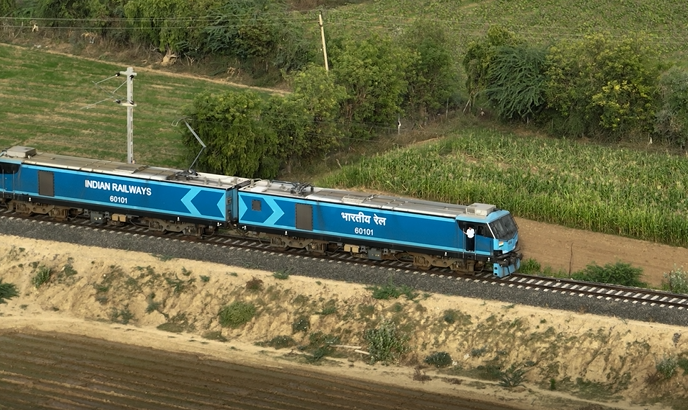
- In July 2025, India successfully tested its first hydrogen-powered train coach at the Integral Coach Factory (ICF).
- This marks a major milestone in Indian Railways’ journey toward net-zero carbon emissions by 2030, a goal that’s four decades ahead of India’s overall national target (net-zero carbon emissions by 2070).
- The initiative reflects a broader transformation in infrastructure, energy use, and financing, making Indian Railways a key player in India’s climate strategy.
What Is a Green Transition?
- A green transition refers to shifting from fossil fuel-based systems to clean, renewable, and sustainable alternatives.
- For Indian Railways, this means:
- Reducing diesel use
- Electrifying tracks
- Using solar and wind energy
- Introducing hydrogen-powered trains
- Improving energy efficiency
Why Indian Railways Matters?
- One of the largest rail networks
- Moves 24 million passengers and 3 million tonnes of freight
- Decarbonising rail transport directly supports India’s climate goals and reduces pollution.
Key Initiatives Taken:
- Electrification
- 45,000 km of broad gauge tracks electrified in the last 10 years.
- Now, 98% of the broad gauge network runs on electricity.
- Renewable Energy Integration
- Installed capacity:
- 553 MW solar
- 103 MW wind
- Installed capacity:
- 100 MW hybrid
- Over 2,000 stations and buildings powered by solar energy.
- Some buildings are certified as net-zero by the Bureau of Energy Efficiency.
- Hydrogen Trains
- First hydrogen-powered coach tested.
- Part of the “Hydrogen for Heritage” plan to deploy 35 hydrogen trains.
- Freight Shift
- Goal: Increase rail’s share in freight transport to 45% by 2030.
- Dedicated Freight Corridors expected to cut 457 million tonnes of CO₂ over 30 years.
Climate Finance and Funding
- Sovereign Green Bonds
- ₹58,000 crore issued since FY2023
- ₹42,000 crore allocated to electric locomotives and metro expansion
- Role of IRFC (Indian Railway Finance Corporation)
- Raised $500 million via green bonds in 2017
- Recently gave ₹7,500 crore loan to NTPC Green Energy for renewable projects
- Multilateral Support
- World Bank loan of $245 million for Rail Logistics Project (2022)
- Aims to improve freight infrastructure and reduce emissions
Areas That Need Improvement
- Clean Electricity
- Electrification must use renewable energy, not coal-based power.
- Long-term contracts with solar/wind producers are needed.
- Last-Mile Connectivity
- Stations should become green mobility hubs with:
- Electric buses
- Bicycle-sharing
- Stations should become green mobility hubs with:
- Pedestrian-friendly design.
- Freight should use clean vehicles for first and last-mile delivery.
- Rolling Stock Innovation must keep pace with global benchmarks.
- Use hydrogen fuel cell trains on non-electrified routes
- Adopt lightweight coaches, aerodynamic designs, and AI-based energy systems
- Public Awareness
- Promote green certification for trains.
- Use carbon labels on freight services.
- Run campaigns to make passengers climate-conscious.
Impact and Benefits
- If net-zero is achieved by 2030:
- 60 million tonnes of CO₂ emissions will be avoided annually.
- Equivalent to removing 13 million cars from roads.
- ₹1 lakh crore in fuel savings projected by 2030.
Challenges and Way Forward
| Challenges | Way Forward |
| Dependence on coal-based electricity generation | Shift traction power sourcing to solar and wind energy. |
| Poor last-mile and station connectivity | Promote electric buses, hydrogen vehicles, and bicycle-sharing. |
| High capital and infrastructure investment needs | Expand green bonds, PPPs, and global climate financing. |
| Slow adoption of new green technologies | Strengthen R&D and tie up with global innovators. |
| Limited renewable energy grid integration | Develop hybrid solar-wind projects with energy storage. |
| Low public and staff climate awareness | Launch awareness drives and green certification programs. |
Conclusion
Indian Railways is undergoing a historic green transformation, aiming to become a climate-positive transport system by 2030. With strong policy support, innovative financing, and public participation, it can set a global example of how large public transport systems can decarbonise without compromising efficiency or fiscal discipline.
| Ensure IAS Mains Question
Q. “Indian Railways’ green transformation is not merely about electrification, but about redefining mobility, energy use, and climate finance in India.” Examine how the green transition of Indian Railways reflects the broader challenges and opportunities of India’s low-carbon development pathway. (250 words) |
| Ensure IAS Prelims Question
Q. Consider the following statements regarding the Green Transition of Indian Railways: 1. The adoption of hydrogen-powered trains helps decarbonise non-electrified routes. 2. Electrification of railway tracks automatically ensures zero carbon emissions. 3. The use of Sovereign Green Bonds supports financing of low-carbon transport projects. Which of the statements given above is/are correct? a) 1 and 3 only b) 2 and 3 only c) 1 only d) 1, 2 and 3 Answer: a) 1 and 3 only Explanation: Statement 1 is correct: Hydrogen-powered trains use fuel cells to generate electricity without direct emissions, making them ideal for non-electrified routes. This reduces dependence on diesel and aids in decarbonising remote sections of the railway network. Statement 2 is incorrect: Electrification itself doesn’t ensure zero emissions if the electricity used is generated from coal-based power plants. True decarbonisation requires sourcing traction power from renewable energy such as solar and wind. Statement 3 is correct: Sovereign Green Bonds fund environmentally sustainable infrastructure, including electric locomotives, metro projects, and renewable energy integration in Indian Railways, thus promoting low-carbon transport development. |