Why in the News?
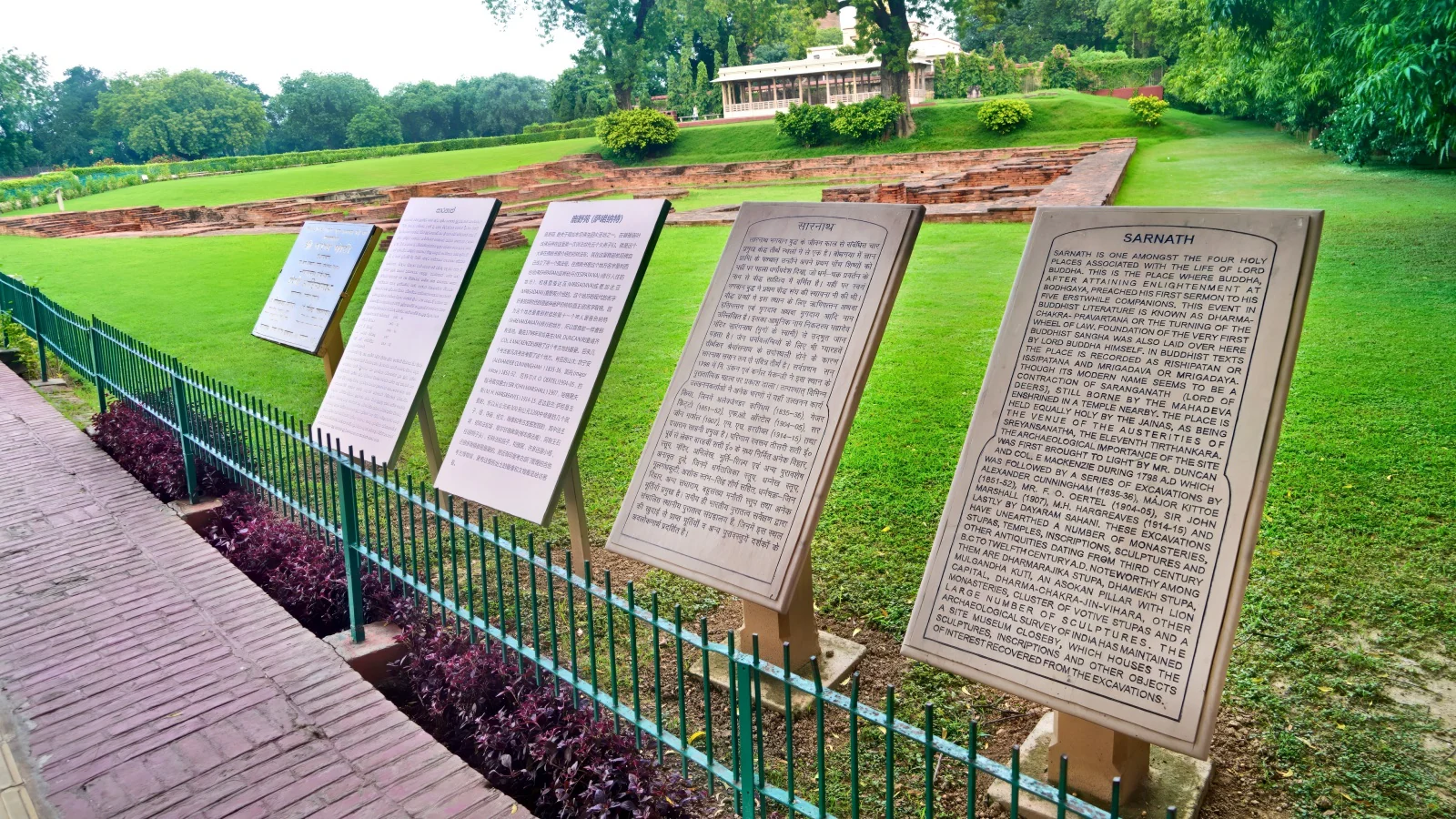
- The Archaeological Survey of India (ASI) is set to install a revised plaque at Sarnath, crediting Babu Jagat Singh’s family for its initial discovery and preservation, challenging the previous British-centric narrative.
- The revision coincides with India nominating Sarnath for the UNESCO World Heritage List for the 2025-26 cycle, highlighting its global and historical importance.
- The decision reflects efforts to update historical records and acknowledge indigenous contributions based on new research and family proposals.
Key Highlights
- Discovery and Early Excavations by Jagat Singh (1787-88)
- Jagat Singh, a descendant of the erstwhile Benares ruler Chait Singh, ordered digging at Sarnath to procure materials for nearby construction.
- During this exercise, Buddhist relics were discovered, parts of which are now preserved in the Asiatic Society, Kolkata.
- This predates the formal involvement of British officers such as Mr Duncan and Col E Mackenzie, who are credited in historical plaques with excavations in 1798.
- British Archaeological Interventions (1798 – Early 20th Century)
- The British formalized excavations and documentation at Sarnath: Alexander Cunningham (1835-36), Major Kittoe (1851-52), O. Oertel (1904-5), Sir John Marshall (1907), M.H. Hargreaves (1914-15), and Dayaram Sahni contributed to further research and preservation.
- Earlier plaques at Sarnath credited these British officers for exposing the site’s significance, creating a perception that archaeological preservation began with colonial intervention.
- Correction of Historical Narrative by ASI (Recent Developments)
- Following a proposal from the descendants of Jagat Singh, the ASI confirmed that plaques at Sarnath would be revised to acknowledge Jagat Singh’s role in revealing the site in 1787-88.
- Previous misrepresentations, such as referring to Jagat Singh as a “diwan” or “destroyer” of Dharmarajika Stupa, have been corrected to state that the structure came to light due to him.
- The revised plaque may also include details from R. Mani’s 2013-14 excavations, which explored activities at Sarnath in the nearly 300 years between Buddha and Ashoka.
- Archaeological Insights and Significance
- Evidence indicates that Buddhist activities continued at Sarnath for over a century before Ashoka, challenging the perception that the site’s significance started only during the Mauryan period.
- Sarnath houses Buddhist structures from the 3rd century BC to the 11th century AD, making it one of the most expansive Buddhist ruins in India.
- The site is also associated with Jainism, and the Ashoka Pillar, found here, forms the basis of India’s national emblem.
- UNESCO Nomination and Global Context
- India officially nominated Sarnath for the UNESCO World Heritage List in 2025-26 after it spent 27 years on the tentative list.
- Plaques at Sarnath are multilingual, including Japanese, to cater to international tourists, reflecting its global religious and cultural significance.
- India’s move aligns with efforts to promote itself as the land of Buddha and protect Buddhist relics, including legal actions to prevent the auction of artifacts abroad.
- Public Engagement and Institutional Collaboration
- The descendants of Jagat Singh are actively collaborating with the ASI to revise plaques and cultural notice boards to reflect accurate historical facts.
- This initiative demonstrates the importance of correcting colonial-era narratives and acknowledging local contributions to India’s heritage.
| What are Plaques?
1. Plaques are inscribed boards or tablets installed at heritage or archaeological sites to provide visitors with historical, cultural, and contextual information about the monument. 2. They usually contain brief descriptions of the site’s discovery, excavation history, significance, and associated personalities, making them an important medium for public education. 3. At sites like Sarnath, plaques serve as the official narrative endorsed by the Archaeological Survey of India (ASI) and are often written in multiple languages to cater to international tourists. 4. Since plaques shape popular perception and collective memory, any inaccuracies, such as over-crediting British officers while ignoring local contributions, can distort historical understanding. 5. Updating or correcting plaques, as in the case of Jagat Singh’s recognition at Sarnath, ensures that the representation of history is accurate, inclusive, and evidence-based. |
Key Terms
- Buddhism
- A religious and philosophical tradition founded in the 6th century BCE by Siddhartha Gautama (Buddha) in India.
- Based on the Four Noble Truths and the Eightfold Path, emphasizing the cessation of suffering (nirvana).
- Spread widely across Asia, particularly in Sri Lanka, Southeast Asia, Tibet, and East Asia, through royal patronage and missionary activities.
- Divided into different schools like Theravāda, Mahayāna, and Vajrayāna, each with unique doctrines and practices.
- Promotes values of compassion, non-violence (ahimsa), and mindfulness as a way of life.
- Its heritage sites in India, including Sarnath, Bodh Gaya, and Kushinagar, are part of the global Buddhist circuit.
- Archaeological Survey of India (ASI)
- Established in 1861 by the British archaeologist Alexander Cunningham.
- Functions under the Ministry of Culture, Government of India.
- Responsible for the conservation, preservation, and excavation of ancient monuments and archaeological sites.
- Maintains museums across heritage sites, including the one at Sarnath.
- Plays a crucial role in UNESCO World Heritage nominations from India.
- Continuously updates historical narratives based on new findings and corrections.
- Dharmarajika Stupa
- A significant Buddhist stupa located at Sarnath, associated with relic worship.
- Originally constructed during the Mauryan period, with later additions in the Kushan and Gupta periods.
- Earlier plaques incorrectly described Jagat Singh as its destroyer; revised inscriptions credit him with bringing it to light.
- Serves as an example of how misrepresentations in colonial records are being corrected.
- Provides archaeological evidence of early Buddhist activities at Sarnath.
- Integral to the Buddhist heritage circuit in Uttar Pradesh.
- UNESCO World Heritage List
- Created under the 1972 UNESCO World Heritage Convention to protect sites of cultural and natural importance.
- Inclusion enhances a site’s global visibility, tourism potential, and international funding for preservation.
- India has over 40 sites inscribed, including Ajanta Caves, Hampi, and Jaipur City.
- Requires strict adherence to authenticity and integrity standards.
- Sarnath has been on the tentative list for 27 years and is now officially nominated for 2025-26.
- Recognition will strengthen India’s image as the land of Buddha.
- Jainism
- An ancient Indian religion traditionally traced to Mahavira (6th century BCE), though earlier Tirthankaras are also revered.
- Emphasizes ahimsa (non-violence), aparigraha (non-attachment), and anekantavada (pluralism of viewpoints).
- Believes in a cycle of karma and rebirth, with liberation (moksha) as the ultimate goal.
- Promotes asceticism, meditation, and strict ethical conduct.
- It has rich heritage in India, including temples at Palitana, Mount Abu, and Shravanabelagola.
- At Sarnath, Jain texts record that it was also an important center for their religious activities, highlighting the site’s multi-religious significance.
Implications
- Historical Accuracy and Decolonization
- Correcting plaques ensures that historical narratives reflect indigenous contributions
- Challenges the colonial perception that heritage preservation began only with British officers.
- Encourages reassessment of historical records at other monuments across India.
- Cultural and Educational Impact
- Visitors gain an accurate understanding of Sarnath’s history.
- Highlights the role of local rulers in heritage preservation.
- Promotes interest in India’s pre-colonial archaeological efforts.
- Tourism and UNESCO Status
- Accurate plaques strengthen India’s case for UNESCO recognition.
- Enhances the site’s credibility and global appeal.
- Multilingual plaques facilitate understanding for international tourists.
- Archaeological Research
- Supports new excavations and research on Sarnath’s pre-Ashokan period.
- Provides insights into continuous Buddhist activity before the Mauryan empire.
- Encourages scholarly reassessment of Indian archaeological timelines.
- Policy and Governance
- ASI’s revisions demonstrate institutional flexibility and commitment to historical accuracy.
- Strengthens collaboration between government agencies and descendants of historical figures.
- Sets a precedent for evidence-based corrections in heritage preservation.
Challenges and Way Forward
| Challenge | Explanation | Proposed Way Forward |
| Colonial narrative bias | Plaques disproportionately credited British officers | Conduct a nationwide review and update plaques based on evidence |
| Verification of historical claims | Conflicting records about Jagat Singh’s role | Cross-reference archival records, inscriptions, and contemporary sources |
| Public perception | Visitors accustomed to British-centric narratives | Conduct awareness campaigns and update guidebooks |
| Archaeological evidence gaps | Limited documentation before ASI establishment in 1861 | Encourage new excavations and publish findings |
| Multilingual communication | Ensuring accurate translations across languages | Standardize plaques with vetted content in multiple languages |
Conclusion
The ASI’s initiative to revise Sarnath’s plaques reflects the importance of accurately representing history and acknowledging indigenous contributions. Recognizing Jagat Singh’s role enhances India’s cultural identity and strengthens its global heritage narrative. As UNESCO evaluation approaches, evidence-based corrections ensure credibility, awareness, and educational impact for visitors and scholars alike.
| Ensure IAS Mains Question
Q. Critically examine the role of local rulers like Jagat Singh in preserving India’s heritage sites and discuss the importance of decolonizing historical narratives in post-independence India. (250 words) |
| Ensure IAS Prelims Question
Q. Consider the following statements about Sarnath: 1. The archaeological importance of Sarnath was first brought to light by Jagat Singh of the Benares royal family in 1787-88. 2. British officers such as Mr Duncan and Col E Mackenzie conducted formal excavations at Sarnath in 1798. Which of the statements given above is/are correct? a) 1 only b) 2 only c) Both 1 and 2 d) Neither 1 nor 2 Answer: c) Both 1 and 2 Explanation: Statement 1 is correct: Jagat Singh’s excavations in 1787-88 led to the discovery of Sarnath’s archaeological importance. Statement 2 is correct: British officers conducted formal excavations in 1798. Both contributions are historically accurate but occurred in chronologically distinct phases. |