Recent Context
- The Reserve Bank of India (RBI) recently released the list of Non-Banking Finance Companies (NBFCs) in the upper layer segment for the year 2024-25,
- It included NBFCs such as Tata Sons Private Ltd, Bajaj Finance Ltd, LIC Housing Finance Ltd and Aditya Birla Finance Ltd.
- The list as per the Scale Based Regulation (SBR) framework for NBFCs issued by the RBI.
What are the key highlights of the list?
- Tata Sons continues to be in the NBFC upper layer (UL) list despite its proposal to deregister as a non-banking finance company.
- Piramal Enterprises has not been included in the current list of NBFC-UL in due to ongoing reorganisation in the business group despite being qualified under NBFC-UL.
- Reorganisation in business refers to the process of making significant changes to a company’s structure, operations, or ownership with the goal of improving efficiency, profitability, or adapting to market shifts.
What is a Non-Banking Financial Company (NBFC)?
- A NBFC is a company registered under the Companies Act, 1956,
-
Engaged in the business of:
- loans and advances,
- the acquisition of shares/stocks/bonds/debentures/securities issued by the Government or local authority or other marketable securities,
- leasing, hire-purchase, insurance business, chit business.
-
It excludes institutions mainly involved in:
- Agriculture
- Industrial activity
- Trading goods (except securities)
- Providing any services and sale/purchase/construction of immovable property.
-
Types of NBFCs (based on financial services)
- Asset Finance Companies (AFCs)
- Infrastructure Finance Companies (IFCs): e.g. IL&FS
- Micro Finance Institutions (NBFC-MFIs)
- Core Investment Companies: They invest in shares and bonds of other companies
- Housing Finance Companies etc.
-
How are NBFCs different from banks?
| Aspect | Banks | NBFCs |
| Accept Demand Deposits | Yes | No |
| Part of Settlement or Payment Framework | Yes | No |
| Issue Cheques | Yes | No |
| Offer Deposit Insurance Facility | Yes | No |
| Deposit Insurance Coverage | Up to ₹5 lakh per depositor per bank
[Provided by the DICGC (Deposit Insurance and Credit Guarantee Corporation); applicable to Commercial banks, Co-operative banks, Regional Rural banks and Local Area banks] |
N/A |
What is Scale Based Regulation (SBR) framework?
- The Reserve Bank had issued the Scale Based Regulation (SBR): A Revised Regulatory Framework for NBFCs on October 22, 2021.
- Purpose: SBR aims to align regulations with the changing risk profiles of NBFCs, ensuring that regulatory requirements are proportional to the potential risks they pose.
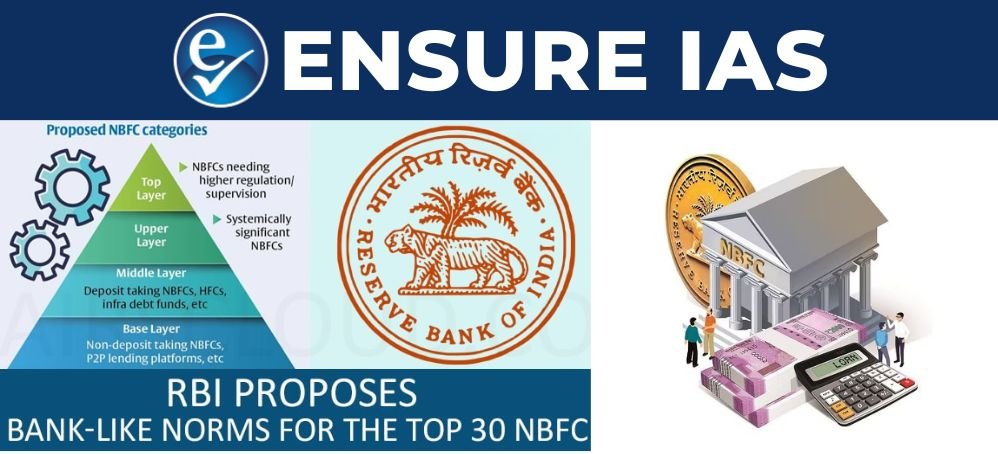
- The regulatory structure for NBFCs shall comprise of four layers based on their size, activity, and perceived riskiness.
- The layers and the methodology followed are as follows:
- Base Layer (NBFC-BL)
- Non-deposit taking NBFCs below the asset size of ₹1000 crore
- NBFC-Peer to Peer Lending Platform (NBFC-P2P)
- NBFC-Account Aggregator (NBFC-AA) etc.
- Account Aggregator acts as an intermediary that facilitates the seamless and secure transmission of financial data between different financial institutions.
- Middle Layer (NBFC-ML)
- All deposit taking NBFCs (NBFC-Ds), irrespective of asset size
- Non-deposit taking NBFCs with asset size of ₹1000 crore and above
- Standalone Primary Dealers (SPDs), Infrastructure Debt Fund NBFCs, Core Investment Companies (CICs), Housing Finance Companies (HFCs) and Infrastructure Finance Companies (NBFC-IFCs).
- Upper Layer (NBFC-UL)
- NBFCs identified by RBI based on specific parameters and scoring methodology.
- The parameters include size and leverage, interconnectedness, complexity, liabilities etc.
- Some key regulatory implications include: Stricter Capital Requirements, Increased Disclosure Obligations, Corporate Governance Enhancements, Systemic Risk Management.
- The top ten eligible NBFCs in terms of their asset size shall always reside in the upper layer, irrespective of any other factor.
- Once an NBFC is classified as NBFC-UL, it shall be subject to enhanced regulatory requirement, at least for a period of five years, even if it may not meet the parameters in the subsequent years.
- Top Layer (NBFC-TL)
- It will ideally remain empty.
- The NBFCs from the Upper Layer may be moved to the Top Layer if in the opinion of RBI there is potential systemic risk from specific NBFCs.
- Base Layer (NBFC-BL)
What are the positive impacts of RBI’s Scale Based Regulation on the NBFC Sector?
- Greater Financial Stability: By identifying systemically important NBFCs, RBI aims to prevent contagion risks in the financial system.
- Boosts Investor and Customer Confidence: Stricter regulations enhance trust in the NBFC sector, attracting more investments from institutional and retail investors
- Better Liquidity management: Minimum liquidity requirements for NBFCs ensures that they maintain sufficient high-quality liquid assets, reducing liquidity mismatches.
- Operational Resilience: Stricter norms encourage NBFCs to strengthen their internal controls and operational efficiencies.