Why in the News?
- After over 60 years in service, MiG-21s, once the backbone of the Indian Air Force (IAF), are scheduled to be formally retired in September 2025.
- Their retirement will reduce the IAF’s strength from 31 to 29 squadrons, significantly below the sanctioned strength of 42 squadrons, impacting operational readiness.
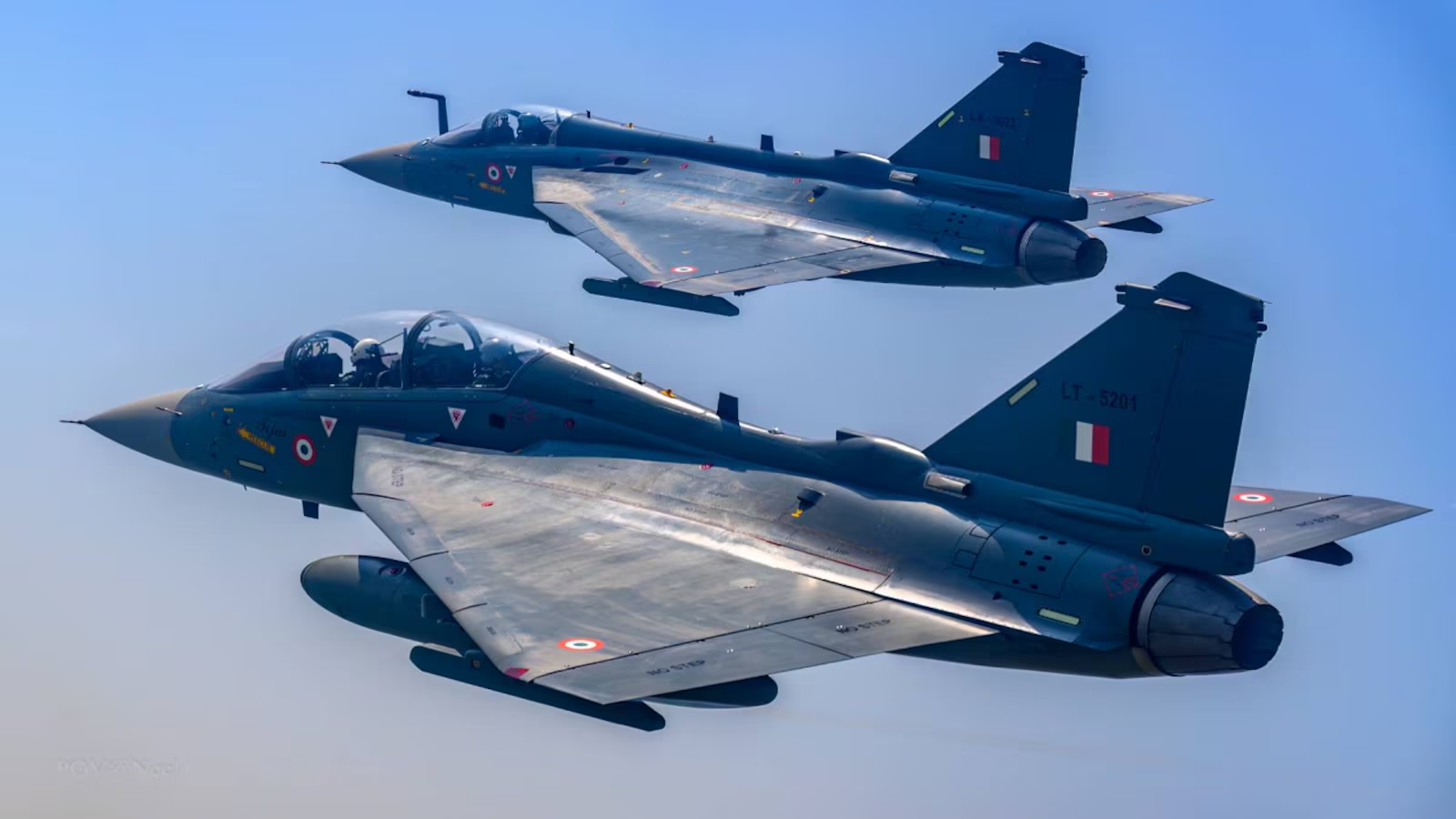
- The LCA-Mk1A induction, crucial to replace ageing fleets, has been delayed due to supply chain issues with GE Aerospace and slow production.
Key Highlights
- Legacy and Retirement of MiG-21s
- Introduced in 1963, MiG-21s were India’s first supersonic and non-Western jets.
- Played key roles in the 1965, 1971, Kargil War, and 2019 Balakot aerial engagement.
- Dubbed “flying coffins” due to over 450 crashes in 60 years, often blamed on ageing platforms and lack of advanced trainers.
- Final squadrons (No. 3 Cobras and No. 23 Panthers) to be decommissioned by Sept 2025.
- Current Status of IAF Fleet
- Existing fleets of Jaguars, MiG-29s, Mirage-2000s will start retiring by 2030.
- Presently operational: Su-30MKIs, two squadrons of LCA Mk1, and some upgraded Russian fighters.
- Contract for 83 LCA Mk1A jets worth ₹48,000 crore signed, but no deliveries yet due to GE engine delays.
- Only two GE F404 engines delivered as of mid-2025; supply of 12 engines expected this fiscal.
- Future Procurement & Upgrades
- Over 600 new fighter jets are planned over the next two decades, including:
- 180 LCA-Mk1A
- 120+ LCA-Mk2
- Over 600 new fighter jets are planned over the next two decades, including:
- 114 MRFA (Medium Role Fighter Aircraft)
- 120 AMCA (Advanced Medium Combat Aircraft)
- ₹13,500 crore contract signed in 2024 for 12 new Su-30MKIs to replace crash losses.
- 84 Su-30MKIs to undergo major upgrades.
- Delays and Strategic Concerns
- The LCA-Mk1A programme is running behind schedule, while LCA-Mk2’s first flight is expected only in 2026.
- AMCA (India’s 5th-gen stealth aircraft) is under development in two phases:
- Mk1 with GE-F414 engines (interim imported tech)
- Mk2 with indigenously co-developed 110KN engine (talks underway with foreign partner)
- HAL will have to compete in open bidding for AMCA production—signalling a shift from nominated orders.
- Interim Options and External Factors
- Due to urgent capability needs, India may import a limited number of fifth-generation fighters.
- Options under sensitive negotiation: Russian SU-57 or American F-35.
- Meanwhile, China’s air power is rapidly expanding with over 1,900 combat aircraft, including fifth-gen and stealth fighters.
- China is also likely to supply 40 J-35 stealth jets to Pakistan, increasing regional pressure on IAF.
Implications
- Operational Readiness Gap
- IAF will operate at 30% below its sanctioned squadron strength, affecting its two-front war readiness against Pakistan and China.
- Urgent need to induct 35–40 fighters annually to bridge the gap.
- Dependence on Foreign Suppliers
- Delays from GE Aerospace expose India’s vulnerability to external supply chain shocks.
- Continued reliance on Russian-origin platforms amid geopolitical tensions is risky.
- Strategic Shift Towards Indigenous Capability
- The LCA and AMCA projects are crucial for Atmanirbhar Bharat in defence.
- HAL’s increased role and the Aeronautical Development Agency’s (ADA) call for private sector participation is a step toward self-reliance and competitiveness.
- Economic and Defence Industrial Impact
- The fighter jet procurements represent over ₹2.5 lakh crore in capital spending.
- If managed well, this could boost domestic aerospace, job creation, and high-tech R&D.
- Geopolitical Significance
- India’s air power directly affects regional stability and deterrence.
- A capable IAF is essential to counter China’s air superiority and Pakistan’s stealth imports.
- Any delays in AMCA or MRFA could diminish India’s strategic clout in the Indo-Pacific.
Challenges and Way Forward
| Challenges | Way Forward |
| Delay in LCA-Mk1A deliveries due to engine bottlenecks | Fast-track GE F404/F414 engine deliveries and enhance HAL’s production lines |
| Under-strength fighter squadrons (29 vs 42 needed) | Expedite LCA Mk1A, Mk2, and AMCA induction with time-bound milestones |
| Uncertainty around MRFA procurement process | Finalise MRFA through a transparent and time-bound global tendering process |
| Lack of indigenous engine for 5th-gen fighters | Fast-track co-development of 110KN engine with a foreign partner |
| Low private sector involvement in aerospace R&D | Encourage competitive bidding for AMCA and other fighter production |
Conclusion
India stands at a crucial juncture in its defence aviation journey. While the MiG-21’s retirement marks the end of an era, the road ahead depends on the timely induction of indigenous platforms like LCA-Mk1A, Mk2, and AMCA. Addressing delays, ensuring engine availability, and fostering public-private collaboration are essential to build a capable, self-reliant, and modern Indian Air Force. With strategic threats rising, especially from China and Pakistan, the next decade will define India’s air power status in the global order.
| Ensure IAS Mains Question
Q. Discuss the key structural and strategic challenges facing the Indian Air Force (IAF) in maintaining optimal fighter strength. Suggest policy and industrial reforms to enhance indigenisation and combat readiness in the next two decades. (250 words) |
| Ensure IAS Prelims Question
Q. With reference to the Light Combat Aircraft (LCA) Mk-1A programme, consider the following statements: 1. LCA Mk-1A is powered by an engine developed indigenously by HAL. 2. The induction of LCA Mk-1A was delayed primarily due to supply chain issues faced by General Electric (GE) Aerospace. 3. LCA Mk-1A is being developed as a replacement for Su-30MKI jets. Which of the statements given above is/are correct? a) 1 and 2 only b) 2 only c) 1 and 3 only d) 2 and 3 only Answer: b) 2 only Explanation: Statement 1 is incorrect: The LCA Mk-1A is powered by the F404 engine, developed by General Electric (GE), USA. HAL has only procured and integrated these engines, not developed them. Indigenous engine development for LCA is still under R&D (e.g., Kaveri project), but not used in Mk-1A. Statement 2 is correct: HAL signed a contract with GE for 99 F404 engines in 2021. The first engine arrived only in April 2025, 18 months late, due to global supply chain disruptions. This directly delayed LCA Mk-1A deliveries, even though production was planned for March 2024 onward. Statement 3 is incorrect: The Mk-1A is intended to replace MiG-21s and eventually supplement other retiring aircraft like Jaguars and MiG-29s. The Su-30MKI is a twin-engine heavy fighter, while LCA is a single-engine light fighter, with very different operational roles. There is no plan to replace Su-30MKIs with LCA Mk-1A. |