Why in the News?
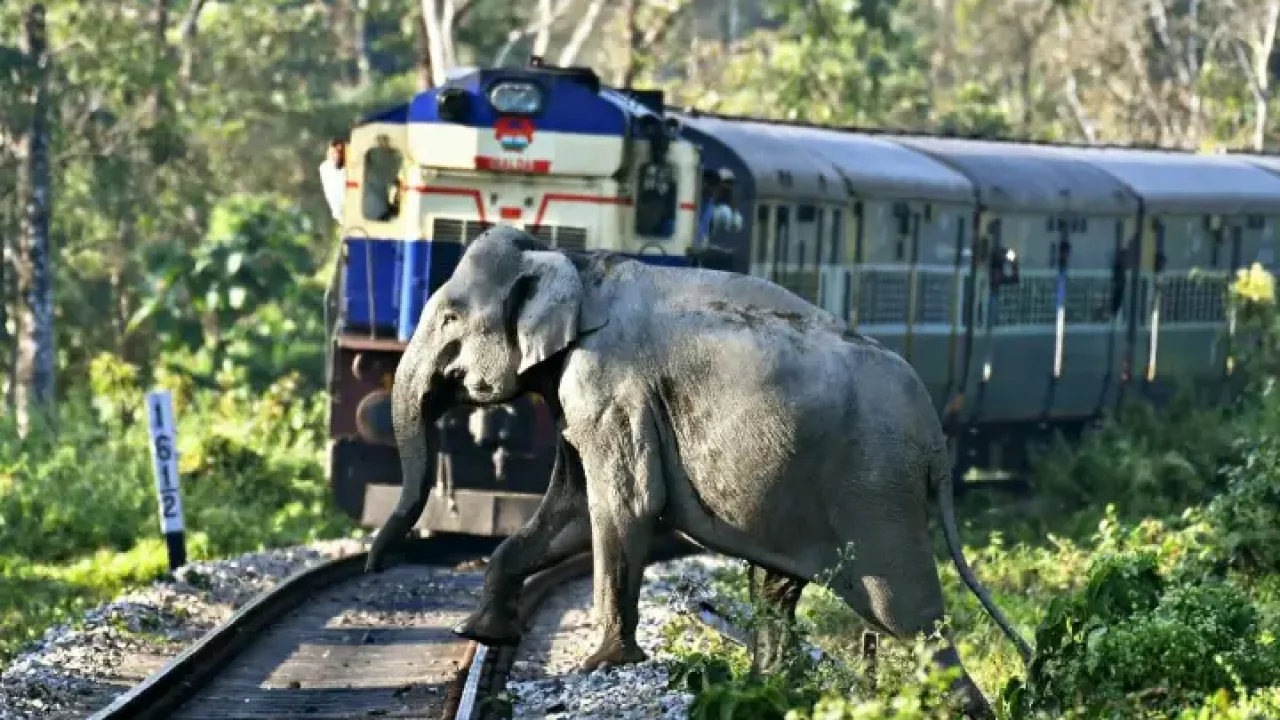
- A first-of-its-kind joint survey by the Union Environment Ministry, Ministry of Railways, and state forest departments has been conducted across 3,452 km of railway tracks in 14 Indian states to curb elephant deaths on tracks.
- The initiative follows a concerning statistic: 186 elephants were killed in train collisions between 2009 and 2024.
- The survey proposes scientifically-backed solutions to mitigate elephant-train collisions, focusing on areas where wildlife frequently crosses railway lines.
Key Highlights
- Scale and Scope of Survey
- Covered 172 railway stretches across 14 states.
- Totaling 3,452 km, with 77 stretches identified as vulnerable.
- Based on inspections, wildlife movement and conflict zones were identified.
- Findings from the Joint Survey
- Identified elephant hotspots: Assam, West Bengal, Jharkhand, Odisha, Kerala, Karnataka, etc.
- Detected railway stretches intersecting animal corridors, particularly elephant and tiger movement paths.
- 20 underpasses and 22 overpasses recommended at critical crossings.
- Reasons for Collisions
- Railway tracks cut through forests and migration routes.
- Lack of underpasses, drainage systems, and poor visibility.
- Nighttime train operations, increased train speed, and lack of monitoring.
- Recommendations Proposed
- Building underpasses/overpasses in sensitive areas.
- Use of artificial intelligence via Intrusion Detection Systems (IDS) for early detection.
- Reduction of train speed, better signage, and increased patrolling.
- Technology-Driven Solutions
- IDS piloted 141 km of tracks in Northeast Frontier Railway using AI to track elephant movement.
- Data-driven mapping and predictive alerts to warn train operators.
- Use of remote sensing to prepare a consolidated mitigation framework.
Implications
- Improved Wildlife Safety
- Reduced elephant fatalities will protect the endangered Asian elephant species.
- Reduced human-wildlife conflict along forested railway stretches.
- Enhanced Policy Coordination
- Strengthens inter-agency coordination between railways, forest departments, and central ministries.
- Aids in data-driven decision-making and planning.
- Technology Adoption
- Encourages AI-based monitoring systems.
- Establishes real-time tracking and alerts for train operators.
- Helps build India’s technological capacity in wildlife conservation.
- Infrastructure Modernisation
- New standards for wildlife-sensitive railway construction.
- Promotes eco-friendly infrastructure
- Global Recognition and Replicability
- Model for other biodiversity-rich nations facing similar railway-wildlife conflict.
- Contributes to India’s climate and conservation goals.
Initiatives Taken by Indian Government for Elephant Conservation
- Project Elephant (1992)
- Launched by the Ministry of Environment, Forest and Climate Change (MoEFCC).
- Objectives:
- Protect elephants, their habitat and corridors.
- Address human-elephant conflict.
- Ensure welfare of domesticated elephants.
- Provides financial and technical support to states.
- Elephant Reserves
- India has established 33 Elephant Reserves across 14 states (as of 2023).
- These are notified areas aimed at elephant conservation.
- Examples: Singhbhum (Jharkhand), Mayurbhanj (Odisha), Periyar (Kerala).
- Monitoring of Illegal Killing of Elephants (MIKE) Programme
- An international initiative under CITES (Convention on International Trade in Endangered Species of Wild Fauna and Flora).
- India is a signatory and participates to monitor illegal elephant poaching.
- 10 MIKE sites in India (e.g., Kaziranga, Corbett, Wayanad).
- Gaj Yatra Campaign
- Launched in 2017 by MoEFCC and Wildlife Trust of India.
- A nationwide awareness campaign to celebrate elephants and conserve corridors.
- Includes youth engagement, art, and local participation.
- Elephant Corridors
- 101 elephant corridors identified by Wildlife Trust of India and MoEFCC.
- The ‘Right of Passage’ report has helped states take action to protect and restore these corridors.
- Declaration of Elephant as National Heritage Animal (2010)
- Declared by the Government of India to underline the cultural and ecological significance of elephants.
- It led to greater focus on their conservation.
Challenges and Way Forward
| Challenges | Way Forward |
| High cost and time involved in constructing underpasses and overpasses | Prioritise high-risk zones using phased construction with targeted funding |
| Limited awareness and training among railway personnel | Regular workshops and inclusion of wildlife protection in operational manuals |
| Inconsistent coordination between forest and railway departments | Establish a permanent wildlife-railway coordination cell |
| Resistance to speed restrictions by railway operators due to schedule impact | Use AI-based dynamic speed regulation only in high-risk time windows |
| Technical limitations of AI systems like IDS in dense forests or night-time | Integrate thermal imaging, drones, and GPS-collared elephants for accuracy |
Conclusion
This joint initiative marks a significant step toward balancing infrastructure development with wildlife conservation. With increasing railway expansion into forested areas, such comprehensive surveys and action plans are vital to preventing animal fatalities, particularly elephants. The integration of science, policy, and technology, if sustained, could make India a global leader in wildlife-sensitive infrastructure planning.
| EnsureIAS Mains Question
Q. With increasing incidents of wildlife-train collisions in India, critically analyse the recent government survey across 14 states aimed at mitigating elephant deaths on railway tracks. What challenges exist in implementing the proposed measures and how can they be addressed? (250 Words) |
| EnsureIAS Prelims Question Q. With reference to recent government initiatives to curb elephant deaths on railway tracks in India, consider the following statements: 1. A joint survey by the Ministry of Environment and the Ministry of Railways was conducted across 14 states. 2. The survey recommended realignment of railway tracks to completely avoid forest areas. 3. The use of Artificial Intelligence (AI) systems like Intrusion Detection Systems (IDS) has been proposed to detect elephant movements. 4. The survey focused only on elephant corridors within national parks and sanctuaries. Which of the statements given above are correct? a. 1 and 3 only Answer: a. 1 and 3 only Explanation: |