Context
India is shifting Greater One-Horned Rhinoceros conservation from protecting existing populations to expanding suitable habitats and managing entire landscapes.
About the Greater One-Horned Rhinoceros
- Habitat: Found in floodplain grasslands, wetlands and riverine areas, especially in the Brahmaputra and Terai regions.
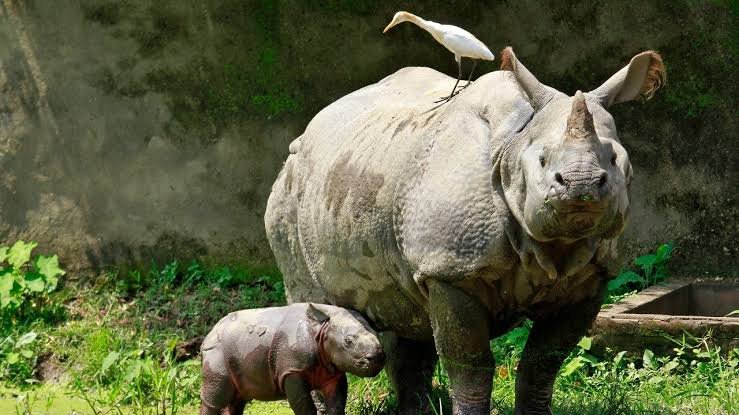
- Physical Features: Its horn is made of keratin, not bone, while its thick, folded skin gives it an armour-like appearance.
- Diet: Primarily a grazer, feeding mainly on grasses, along with leaves, fruits and aquatic plants.
- Behaviour: Generally solitary, a good swimmer and an important seed disperser.
- Historical Range: Once distributed along the Indus, Ganga and Brahmaputra river systems.
- Present Distribution: In India, major populations occur in Assam, Uttar Pradesh and West Bengal; it is also found in southern Nepal.
- Conservation Status: Classified as Vulnerable on the IUCN Red List and protected under Schedule I of the Wild Life (Protection) Act, 1972.
- CITES: Appendix I.
Key Protected Areas
- Assam: Kaziranga National Park — world’s largest Greater One-Horned Rhino population population; Pobitora Wildlife Sanctuary — world’s highest rhino density; Orang and Manas National Parks are other major rhino habitats.
- West Bengal: Jaldapara and Gorumara National Parks.
- Uttar Pradesh: Dudhwa National Park, where rhinos were reintroduced from Nepal.
- Bihar: Valmiki Tiger Reserve, which forms part of the India–Nepal Terai landscape and supports Greater One-Horned Rhinos.
Recent Developments
- Population Recovery: India’s Greater One-Horned Rhino population increased from about 1,500 to over 4,000 by September 2024.
- Rhino Conservation Programme: A ₹77.39-crore Phase I programme (2026–2031) covers Assam, Arunachal Pradesh, Bihar, Uttar Pradesh and West Bengal, focusing on monitoring, habitat management, translocation and community participation.
- Grassland Assessment: A separate ₹20.86-crore grassland assessment programme (2026–2031) involving the Wildlife Institute of India (WII), Indian Council of Forestry Research and Education (ICFRE) and Forest Survey of India (FSI) will assess grassland condition, biodiversity and degradation.
Conservation Strategy and Ecosystem Approach
- Indian Rhino Vision 2020 (2005): Aimed to increase rhino numbers and establish populations in additional protected areas through scientific translocation, including from Kaziranga to Manas.
- National Conservation Strategy (2019): Focuses on population recovery, habitat restoration, ecological connectivity, genetic security, planned translocation and climate resilience.
- Landscape Expansion: The 2026–2031 Phase I programme promotes scientific monitoring and habitat management in suitable areas, including Bihar and Arunachal Pradesh.
- Grassland Conservation: Protecting alluvial and Terai grasslands, wetlands and riverine habitats is essential for rhinos and other species such as swamp deer, wild buffalo and elephants. The grassland assessment will examine biodiversity, degradation, ecosystem services and carbon potential.
- Technology & Protection: DNA profiling can help identify individual rhinos and strengthen action against poaching and illegal wildlife trade.
- Regional Cooperation: The 2019 New Delhi Declaration promotes cooperation among India, Nepal, Bhutan, Indonesia and Malaysia for Asian rhino conservation.
Challenges
- Climate-Related Risks: Increasingly frequent and intense floods can threaten rhino survival and disrupt movement across floodplain habitats.
- Habitat Fragmentation: Roads, settlements and changing land use can break habitats and reduce ecological connectivity.
- Limited Suitable Habitat: Expanding rhino populations requires adequate long-term habitats with suitable food, water and safe movement routes.
- Human-Wildlife Conflict: Expansion into new areas may increase interactions with local communities and create conservation challenges.
- Genetic and Protection Risks: Poorly planned translocations can affect genetic diversity, while poaching and illegal wildlife trade remain persistent threats.
Way Forward
- Landscape Conservation: Protect connected grasslands, wetlands, rivers and wildlife corridors.
- Climate Resilience: Provide higher-ground refuges and safe dispersal routes during extreme floods.
- Technology & Capacity: Strengthen surveillance, spatial monitoring, veterinary and genetic tools along with trained frontline staff.
- Community Participation: Involve local communities in habitat protection and human-wildlife conflict management.
- Regional Cooperation: Strengthen cooperation among Asian rhino range states against illegal wildlife trade and for genetic conservation and ecological connectivity, guided by the 2019 New Delhi Declaration.
FAQs
Q1. What is the conservation status of the Greater One-Horned Rhinoceros?
Ans. It is Vulnerable on the IUCN Red List and protected under Schedule I of the Wild Life (Protection) Act, 1972.
Q2. What is the National Conservation Strategy for the Greater One-Horned Rhinoceros?
Ans. Launched in 2019, it focuses on population recovery, habitat restoration, connectivity, genetic security and climate resilience.
Q3. How can technology support rhino conservation?
Ans. Surveillance, spatial monitoring, veterinary diagnostics and genetic tools can improve rhino protection and conservation planning.
Q4. What was the New Delhi Declaration on Asian Rhino Conservation?
Ans. Adopted in 2019 by India, Bhutan, Indonesia, Malaysia and Nepal, it aims to strengthen regional cooperation for rhinoceros conservation.