Context
- Jharkhand’s traditional musical instrument Mandar has received a Geographical Indication (GI) tag and has been registered as “Mandar of Jharkhand.”
- The registration was granted by the Geographical Indications Registry, Chennai, formally recognising the instrument’s geographical and cultural association with Jharkhand.
- The GI application was filed on 24 September 2021 by Raidih Mandar Producer Company Limited, located in Gumla district, Jharkhand. The official GI database classifies it as a handicraft.
About Mandar
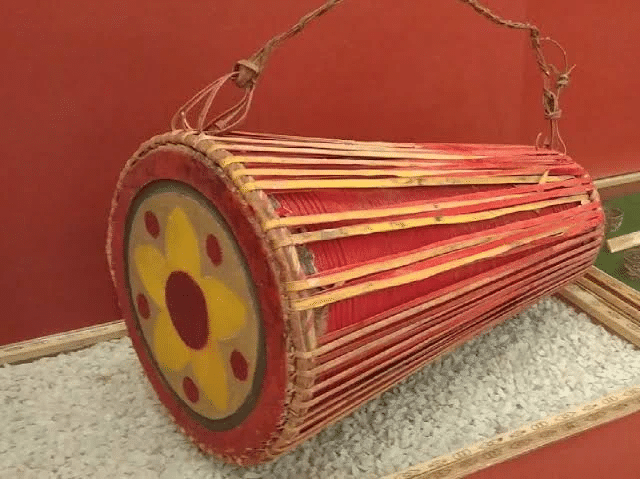
- Type: A traditional double-headed percussion instrument widely used in Jharkhand’s folk and tribal traditions.
- Body: Traditionally made from locally sourced red clay.
- Shape: It has a barrel-like or cylindrical structure with a slight bulge towards the centre.
- Drumheads: Leather is stretched over both ends of the instrument.
- Unequal openings: The right drumhead is smaller, while the left drumhead is comparatively broader.
- Tensioning system: The leather coverings are secured using braided cords, which maintain appropriate tension and tonal quality.
- Portability: It is generally carried using a rope or shoulder strap, enabling musicians to play while accompanying dancers.
What Gives Mandar Its Distinctive Sound?
- A special traditional coating called Kiran is applied to the smaller drumhead, contributing to Mandar’s characteristic resonance.
- The unequal drumheads produce contrasting pitches, creating a combination of higher and deeper rhythmic tones.
- During performances, the instrument is generally suspended from the shoulder using a rope or strap, allowing the musician to move rhythmically while playing.
Cultural Significance
- Mandar occupies an important place in the folk and tribal cultural traditions of Jharkhand.
- It is commonly played during:
- Traditional festivals
- Agricultural celebrations
- Marriage ceremonies
- Religious and cultural occasions
- Community gatherings and folk dances
- The instrument forms part of Jharkhand’s living cultural heritage, linking music with community participation and traditional performing practices.
Significance of the GI Recognition
- Geographical identity: The GI formally connects the authentic Mandar with the geographical area of Jharkhand.
- Craft recognition: It acknowledges the instrument’s distinctive combination of local raw materials, traditional manufacturing practices and acoustic characteristics.
- Artisan visibility: GI recognition can provide traditional Mandar makers with a stronger product identity and greater recognition in wider markets.
- Cultural preservation: Recognition can support the continuity of traditional Mandar-making skills and associated folk-performing traditions.
About Geographical Indication
- A Geographical Indication (GI) identifies goods whose quality, reputation or other characteristics are essentially attributable to their geographical origin.
- In India, GIs are protected under the Geographical Indications of Goods (Registration and Protection) Act, 1999.
- The Geographical Indications Registry is located in Chennai.
FAQs
Q1. What is Mandar?
Mandar is a traditional double-headed percussion instrument associated with Jharkhand’s folk and tribal culture.
Q2. Who applied for the GI tag for Mandar?
The application was filed by Raidih Mandar Producer Company Limited, Gumla district.
Q3. What is Kiran in a Mandar?
Kiran is a special coating applied to the smaller drumhead to contribute to its distinctive resonance.
Q4. In which category is Mandar of Jharkhand registered?
It is registered as a handicraft under the GI system.
Q5. Why is Mandar currently in the news?
It has received a GI tag and has been officially registered as “Mandar of Jharkhand.”