Context
- The Japan Coast Guard recently observed renewed signs of activity at Fukutoku-Oka-no-Ba, an active submarine volcano in the Pacific Ocean.
- In September 2026, discoloured seawater extending about 7 km was observed around the volcano, indicating continuing volcanic or hydrothermal activity.
About Fukutoku-Oka-no-Ba
- Location: It is an active submarine volcano in Japan’s Volcano Islands, around 5 km northeast of Minami-Ioto and about 1,300 km south of Tokyo.
- Volcanic arc: It belongs to the Izu-Bonin (Izu-Ogasawara) volcanic arc, which forms part of the wider Izu-Bonin-Mariana system.
- Tectonic setting: The arc is associated with the Pacific Plate subducting beneath the Philippine Sea Plate, producing magma and volcanic activity.
- Shallow summit: The shallowest part of the volcano lies only about 25–30 m below sea level, allowing magma to interact strongly with seawater during eruptions.
- Composition: Its erupted rocks are predominantly trachyandesitic, an intermediate volcanic composition.
- Activity: Fukutoku-Oka-no-Ba is known for explosive eruptions, floating pumice, discoloured seawater and temporary island formation.
Why Does Seawater Become Discoloured?
- Submarine volcanic and hydrothermal activity can release heated fluids, gases and volcanic material into the surrounding seawater.
- Their interaction with seawater may produce visible green, yellow, brown or whitish discolouration.
- Such discolouration is therefore an important surface indicator of underwater volcanic activity, which can otherwise be difficult to observe directly.
What is a Surtseyan Eruption?
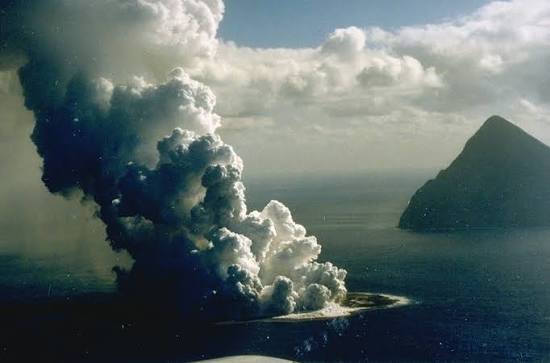
- A Surtseyan eruption occurs when rising magma interacts explosively with shallow seawater or lake water.
- Contact between hot magma and water causes rapid steam formation, producing phreatomagmatic explosions that fragment magma into ash and other volcanic material.
- The term derives from Surtsey, the volcanic island that emerged off Iceland during eruptions beginning in 1963.
- Continued accumulation of erupted material can create temporary volcanic islands or pyroclastic cones, which may later be eroded by waves.
The 2021 Eruption
- In August 2021, Fukutoku-Oka-no-Ba underwent a major explosive eruption, producing an ash plume reaching approximately 16 km altitude.
- It generated a temporary island and large quantities of floating pumice.
- Pumice rafts travelled over 1,000 km, eventually affecting parts of Japan and disrupting ports, vessels, fisheries and tourism.
Associated Hazards
- Maritime disruption: Floating pumice can clog vessel systems and interfere with shipping, ports and fishing activities.
- Aviation risk: Explosive eruptions can inject volcanic ash to high altitudes, creating hazards for aircraft.
- Changing seafloor: Submarine eruptions can temporarily create or alter islands and shallow marine features, requiring continued monitoring.
FAQs
Q1. Where is Fukutoku-Oka-no-Ba located?
It is an active submarine volcano in Japan’s Volcano Islands in the Pacific Ocean.
Q2. Which volcanic arc does it belong to?
It belongs to the Izu-Bonin volcanic arc.
Q3. Which plates are involved in its tectonic setting?
The Pacific Plate subducts beneath the Philippine Sea Plate.
Q4. What is a Surtseyan eruption?
It is an explosive eruption produced by interaction between magma and shallow water.
Q5. What was notable about its 2021 eruption?
It generated a temporary island and extensive pumice rafts that travelled more than 1,000 km.