Context
- The Visegrád Group (V4) has supported India’s candidature for permanent membership of the United Nations Security Council (UNSC).
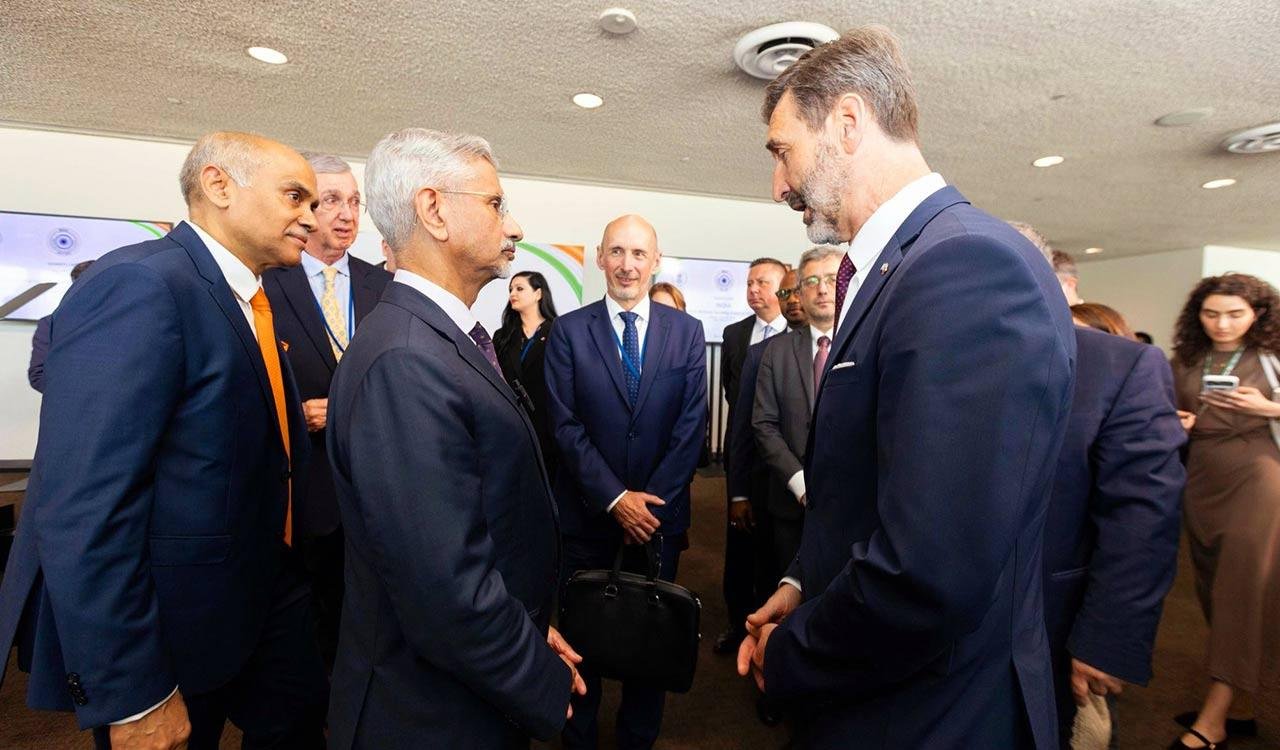
- The support was conveyed at the first V4–India foreign ministers’ meeting, with India represented by External Affairs Minister S. Jaishankar.
Visegrád Group
- The Visegrád Group, also called the Visegrád Four (V4), was established in 1991.
- Its members are Czech Republic, Hungary, Poland and Slovakia.
- The grouping began with Poland, Czechoslovakia and Hungary. After the dissolution of Czechoslovakia in 1993, the Czech Republic and Slovakia became separate members.
- It promotes cooperation in economic, cultural, energy and defence-related areas.
- The V4 is an informal intergovernmental forum and generally works through consensus.
- It has no permanent institutional structure. Its presidency rotates annually.
- It also engages other countries through “V4+” formats.
UNSC: Composition and Functions
- Established in 1945, the UNSC has 15 members.
- It comprises:
-
- Five permanent members (P5): United States, Russia, France, United Kingdom and China.
- Ten non-permanent members, elected for fixed terms.
- The P5 have veto power over substantive Council decisions.
- The Council is responsible for matters concerning international peace and security and can undertake measures including sanctions and authorisation of the use of force under the UN Charter.
India’s Case for Permanent Representation
- India has served as an elected non-permanent member of the UNSC on multiple occasions.
- Its demand for permanent membership is associated with its:
- Large population and economic weight.
- Role as a voice of the Global South.
- Growing importance in the Indo-Pacific.
- Contribution to UN peacekeeping.
- Permanent membership would provide India with continuous representation in the Council.
Charter Amendment Requirement
- A new permanent seat cannot be obtained through an ordinary election because no additional permanent seat currently exists.
- Expansion of permanent membership therefore requires amendment of the UN Charter.
- Article 108 of the UN Charter requires
-
- Adoption of the amendment by a two-thirds majority of the UN General Assembly.
- Ratification by two-thirds of UN members.
- Inclusion of all five permanent members among the states ratifying the amendment.
Wider Reform Proposals
India’s candidature forms part of a broader restructuring debate.
- G4
- The G4 consists of India, Brazil, Germany and Japan.
- The four countries support one another’s aspirations for permanent UNSC membership.
- African Union
- The African Union (AU) has sought enhanced representation in the Council.
- The source notes an African demand for two permanent seats and five non-permanent seats.
Key Areas of UNSC Reform
UNSC reform also involves decisions on:
- The number of additional permanent and non-permanent seats.
- Their regional distribution.
- The possible extension of veto power to new permanent members.
- The structure and functioning of an expanded Council.
Conclusion
- The V4 position gives India additional backing from a Central European regional grouping.
- It should not, however, be treated as an EU-wide position, since the V4 and European Union are separate entities.
- The development illustrates that India’s candidature is embedded in the larger process of reforming the international security architecture.
FAQs
Q1. What is the difference between a permanent and a non-permanent UNSC seat?
A permanent seat has no fixed electoral term, whereas a non-permanent seat is held for a limited elected term.
Q2. Why does UNSC reform involve more than increasing the number of seats?
Reform also requires decisions on regional representation, veto arrangements and the institutional structure of an expanded Council.
Q3. Why is India’s permanent membership linked to wider global governance reform?
India’s demand concerns the composition of the institution that takes major decisions on international peace and security, making it part of the broader debate over representation in multilateral institutions.
Q4. Why can the creation of a permanent seat affect the existing P5?
Expansion could alter the distribution of influence within the Council, particularly if new permanent members receive powers comparable to those of the existing P5.
Q5. What does the V4 format indicate about its mode of cooperation?
The V4 operates as an informal, consensus-based framework rather than as a supranational institution.
Q6. Why is consensus important for India’s UNSC reform effort?
Support from individual countries does not by itself alter the Council’s composition; successful reform requires wider agreement among UN members and completion of the Charter procedure.
Q7. What broader principle underlies demands for UNSC reform?
The reform debate centres on making the Council’s composition more responsive to contemporary geopolitical and regional realities.