Context
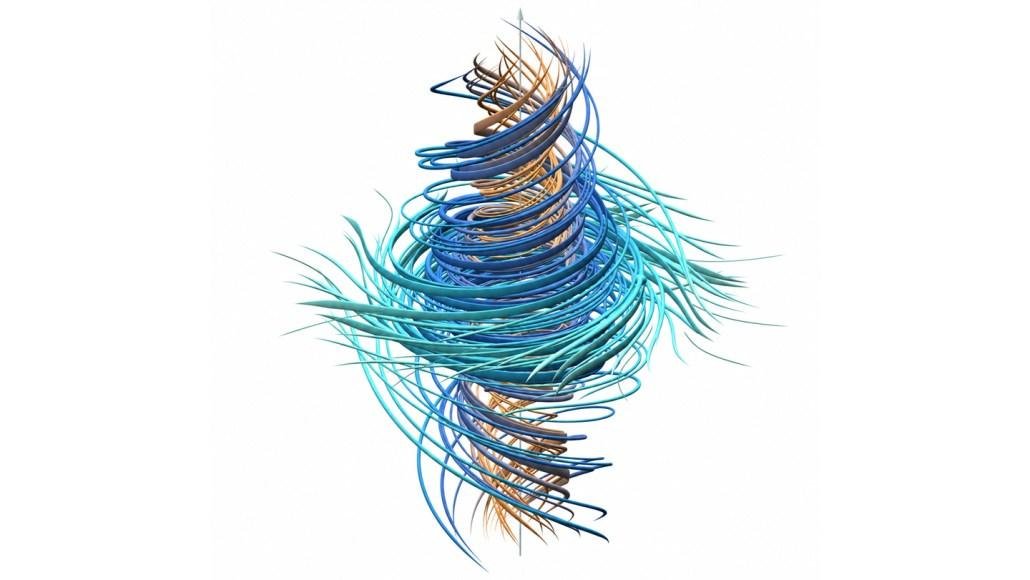
OpenAI has reportedly developed a solution approach for the Navier–Stokes problem, drawing attention because the equations represent a long-standing challenge in mathematics and the episode has also raised questions about data privacy and use of researchers’ work.
About Navier–Stokes Equations
- Navier–Stokes equations are a set of mathematical equations used to describe how fluids move.
- They apply to liquids and gases, such as water, air and petroleum.
- They help explain factors such as fluid velocity, pressure and forces during movement.
- In simple terms, Navier–Stokes equations help answer a basic question: “When a liquid or gas starts moving, how will it behave?”
- The equations are based on Newton’s Second Law of Motion, which relates force, mass and acceleration.
- Finding exact mathematical solutions to the Navier–Stokes equations is extremely difficult. In practical engineering, approximations and numerical solutions are therefore widely used to understand fluid behaviour and design systems.
- Major applications include:
- Weather forecasting and climate modelling – understanding atmospheric movement.
- Ocean studies – analysing the movement of ocean currents.
- Aerodynamics – studying airflow around aircraft and cars.
- Medicine – analysing blood flow through the human body.
- Marine engineering – studying water flow around ships and boats.
- Engineering design – applications in pipelines, turbines, dams and other fluid-based systems.
- Civil engineering – predicting phenomena such as eddies and water forces around structures like dams.
- Why is it important?
- Fluid movement is involved in numerous natural and human-made systems.
- Understanding this movement helps engineers predict forces, improve designs and make structures safer and more efficient.
AI-based Solution: A Rising Challenge
- AI can process vast amounts of research papers, mathematical literature and computational data to identify patterns and generate possible solutions to complex problems such as Navier–Stokes.
- The problem arises when an AI system uses unpublished research, private datasets or researchers’ interactions without adequate permission, raising concerns about consent, ownership and privacy.
- Attribution of intellectual contribution: If AI produces results similar to the work of researchers who were already pursuing the problem, it becomes difficult to determine who should receive credit for the underlying intellectual contribution.
- Transparency and accountability: Researchers may not always be able to understand how an AI system arrived at a particular result, creating concerns about the reliability, accountability and reproducibility of AI-assisted research.
- Impact on scientific collaboration: If researchers fear that their unpublished work may be used without permission, they may become reluctant to share early-stage findings, potentially weakening openness and collaboration in science.
Way Forward
- Establish clear rules requiring consent before research data is used for AI training.
- Ensure proper attribution and intellectual-property protection for researchers whose work contributes to AI-generated results.
- Maintain transparent records of the data, sources and methods used by AI systems.
- Ensure human oversight, with AI supporting scientific research while final validation remains with researchers.
- Develop common ethical standards for AI-assisted research to balance technological innovation with privacy, fairness and scientific integrity.
Conclusion
AI can accelerate scientific discovery, but its use must respect the rights and contributions of human researchers. A balance between innovation, data protection, transparency and human oversight is essential for responsible AI-driven science.
FAQs
Q1. What are the Navier–Stokes equations?
They are mathematical equations describing fluid motion, based on Newton’s Second Law.
Q2. Why are Navier–Stokes equations important?
They explain how liquids and gases behave, with applications in weather, oceans, aerodynamics, medicine, and engineering.
Q3. Why is solving Navier–Stokes equations difficult?
Exact solutions are extremely hard; engineers rely on approximations and numerical methods.
Q4. What role does AI play in solving problems like Navier–Stokes equations?
AI can process vast research data to suggest solution patterns, but raises concerns about privacy, attribution, and transparency.
Q5. What ethical issues arise with AI solutions to complex problems like Navier–Stokes equations?
Consent, ownership of research, proper attribution, and accountability in AI‑assisted discoveries.