Context
The 2026 BRICS Summit in New Delhi highlighted the New Development Bank (NDB) as a key platform for infrastructure and sustainable development financing.
About NDB
- Established: Through the Agreement on the New Development Bank, signed at the BRICS Summit in Fortaleza, Brazil, in 2014, and became operational in 2015 by Brazil, Russia, India, China and South Africa (BRICS).
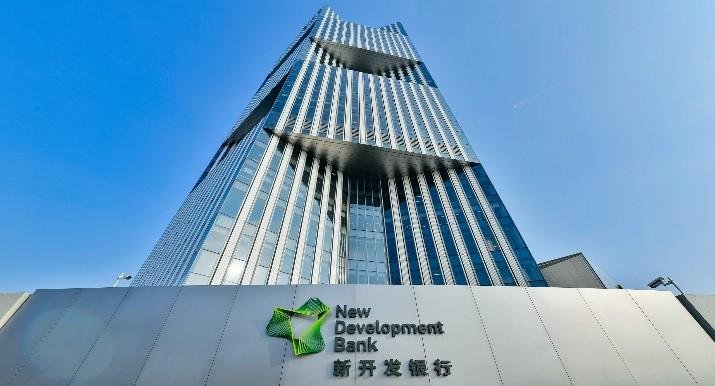
- Headquarters: Shanghai, China. It also has regional offices, including in South Africa and Brazil.
- Purpose: Finances infrastructure and sustainable development in BRICS and other developing economies.
- Major areas include clean energy, transport, water and sanitation, environmental protection, social infrastructure and digital infrastructure.
- Role: Provides an alternative source of multilateral development finance alongside institutions such as the World Bank and Asian Infrastructure Investment Bank (AIIB).
Capital and Membership
- NDB has an authorised capital of USD 100 billion with initial subscribed capital of USD 50 billion equally, giving each an equal initial stake.
- Membership is open to UN member countries, including both borrowing and non-borrowing members.
- Besides the founding BRICS members, NDB’s members include Bangladesh, UAE, Egypt, Algeria and Uzbekistan (joined 2026).
Uruguay, Colombia, Ethiopia, Angola and Zimbabwe are listed as prospective members by the NDB.
Governance and Voting
- The Board of Governors is the highest decision-making body, with one governor at the ministerial level from each member country.
- The Board of Directors handles the Bank’s general operations.
- Voting power is linked to subscribed shares. The founding members hold equal voting power, and no single founding member has veto power.
- The 55% Rule: The collective voting power of the original founding BRICS members (Brazil, Russia, India, China, South Africa) must remain at 55% or higher, even as new members join.
Key Facts
- BRICS: Accounts for nearly 40% of global GDP and 55% of world population, but only about 18% of IMF voting share.
- NDB: Approved 139 projects worth ~$43 billion, with around $20 billion disbursed.
- Credit Rating: NDB has an AA/AA+ rating, below AIIB’s AAA rating, and has a smaller membership and project portfolio.
- Portfolio: China and India account for about 51% of NDB’s active portfolio, with transport infrastructure receiving the largest share.
Significance for India
- Infrastructure Finance: NDB has committed nearly $10 billion across 32 Indian projects, including the Delhi–Ghaziabad–Meerut Regional Rapid Transit System (RRTS).
- Local-Currency Finance: Promotes lending in local currencies, reducing exchange-rate risks.
- Rupee Financing: A ₹25,000 crore rupee bond programme was launched in 2026 to mobilise funds over five years.
- Strategic Autonomy: Enables India to strengthen BRICS economic cooperation without aligning with an anti-Western or direct de-dollarisation agenda.
Challenges
- Capital Constraints: Equal voting shares among the five founders and Russia’s sanctions-related financial constraints limit NDB’s capital expansion.
- Limited Membership Influence: Founders must retain at least 55% of voting rights, restricting the influence of new members.
- Slow Disbursement: Only about $20 billion of the $43 billion approved has been disbursed, limiting effective lending.
- Financial Risks: NDB’s AA/AA+ rating, concentration of local-currency operations in the Chinese renminbi, and suspension of new loans to Russia since March 2022 constrain financial flexibility.
- Smaller Scale: NDB’s membership and lending capacity remain below those of major multilateral development banks.
Way Forward
- Strengthen Capital Base: Expand NDB’s capital while reducing geopolitical constraints on its financial capacity.
- Expand Membership: Include financially capable emerging economies to increase NDB’s resources and global reach.
- Promote Rupee Finance: Operationalise the ₹25,000 crore rupee bond programme and diversify local-currency financing beyond the Chinese renminbi.
- Improve Disbursement: Simplify procedures and strengthen project implementation for faster utilisation of approved funds.
- Preserve Strategic Autonomy: Keep NDB focused on development finance while strengthening India’s role in BRICS.
FAQs
Q1. What is the New Development Bank (NDB)?
Ans: NDB is a BRICS-led multilateral development bank established to finance infrastructure and sustainable development.
Q2. What is the significance of local-currency lending by NDB?
Ans: It can reduce borrowers’ exposure to exchange-rate risks and dependence on dollar-denominated financing without requiring the dollar to be replaced as the global currency.
Q3. What is the 55% rule of NDB?
Ans: The five founding BRICS members must collectively retain at least 55% of NDB’s voting power even after new members join.
Q4. What limits the NDB’s expansion?
Ans: Equal voting rights among the five founders, Russia’s sanctions-related constraints, limited capital expansion and slow loan disbursement restrict the bank’s growth.