Context
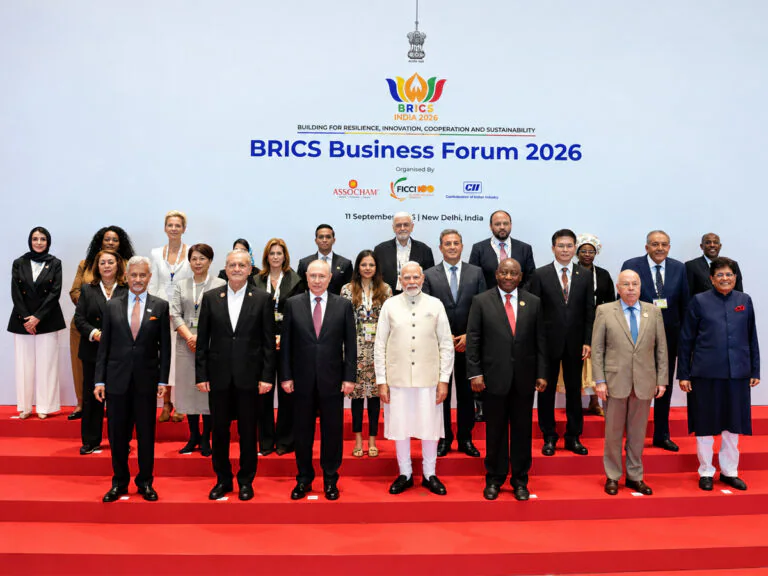
- The 18th BRICS Summit adopted the New Delhi Declaration after prolonged negotiations, particularly over references to the West Asia conflict.
- The outcome was notable because BRICS foreign ministers had failed to issue a joint statement in May.
- As Chair, India helped reconcile differences and secure the summit declaration.
Major Outcomes
- West Asia and Palestine
- BRICS adopted a non-attribution approach, emphasising restraint, de-escalation, dialogue, sovereignty and territorial integrity.
- It called for protection of civilians and civilian infrastructure and continuity of trade, supply chains and energy flows.
- It stressed nuclear safety and security, including protection of peaceful nuclear facilities under IAEA safeguards during armed conflicts.
- On Gaza and Palestine, BRICS supported:
- Continuation of the ceasefire and unhindered humanitarian access.
- Opposition to forced displacement and starvation as a method of warfare.
- Support for UNRWA.
- A two-state solution based on the 1967 borders, with East Jerusalem as the capital of Palestine.
- Palestinian self-determination, right of return and full UN membership.
- It also backed the Lebanon ceasefire, Israeli withdrawal from remaining Lebanese territory and an inclusive political transition in Syria.
- Counter-Terrorism
- BRICS condemned the April 2025 Pahalgam terrorist attack, in which 26 people were killed.
- It highlighted terror financing, safe havens, extremism and youth radicalisation.
- The declaration rejected double standards and opposed linking terrorism with any particular religion, nationality, civilisation or ethnic group.
- It recognised the BRICS Counter-Terrorism Working Group (CTWG).
- Trade and Protectionism
- BRICS opposed unilateral coercive measures inconsistent with international law, the UN Charter and WTO principles.
- It called for a fair, stable and predictable trading environment.
- It also opposed punitive or discriminatory Carbon Border Adjustment Mechanisms (CBAMs) when used as protectionist instruments.
- Financial Diversification
- BRICS did not announce a common currency.
- Instead, it focused on:
- Interoperable national payment systems
- Faster and cheaper cross-border payments
- Greater use of local currencies in trade and investment
- Technical work through the BRICS Payment Task Force
- Greater local-currency financing by the New Development Bank (NDB)
- A proposed New Investment Platform
- Exploration of India’s proposed BRICS Risk Lab at GIFT City
- AI Governance
- BRICS identified Artificial Intelligence (AI) as both an economic opportunity and a governance challenge.
- It emphasised inclusive access, safety, security, reliability, energy efficiency and trustworthy AI.
- It called for greater participation of developing countries in global AI governance.
- The grouping welcomed India’s hosting of the AI Impact Summit in February 2026.
6 India’s Initiatives
- Digital Public Infrastructure: A proposed BRICS repository and pilot projects could facilitate sharing of India’s DPI experience.
- Health: A BRICS Training Hub Network and Centres of Excellence on mental well-being are proposed, with NIMHANS, Bengaluru, as the coordinating centre.
- Industry 4.0: The proposed India Centre for BRICS Industrial Competencies will support manufacturing firms and small businesses in adopting advanced digital technologies.
- Development cooperation: Initiatives include the BRICS Task Force on Growth and Development, BRICS–NDB Knowledge Portal, infrastructure and PPP cooperation, and strengthening the BRICS insurance ecosystem.
- Significance for India
- Diplomatic positioning: India demonstrated its ability to bridge differences within a geopolitically diverse grouping.
- Strategic autonomy: Greater cooperation on financial and technological systems can expand India’s strategic and economic options.
- Global South engagement: BRICS provides India a platform to shape debates on international governance and development priorities.
Challenges and Way Forward
| Challenges | Way Forward |
| Divergent geopolitical interests can constrain consensus. | Promote issue-based cooperation and flexible consensus-building. |
| Implementation gaps can weaken the impact of declarations. | Strengthen institutions, follow-up systems and implementation mechanisms. |
| Different financial systems complicate deeper payment integration. | Improve payment interoperability and expand local-currency cooperation gradually. |
| Competing national priorities can limit collective action. | Concentrate on practical cooperation in trade, technology, health and development finance. |
Conclusion
The New Delhi Declaration shows that BRICS can reach common positions despite substantial internal differences. Its long-term effectiveness will depend on converting political consensus into institutional capacity, practical cooperation and measurable outcomes.
FAQs
Q1. What is meant by a non-attribution approach in multilateral diplomacy?
It allows countries to agree on common principles and actions without reaching agreement on which party is responsible for a conflict.
Q2. What is payment-system interoperability?
It refers to the ability of different national payment systems to connect and facilitate cross-border transactions.
Q3. What is the BRICS Payment Task Force?
It is a mechanism for technical work relating to cross-border payment arrangements among BRICS members.
Q4. What is a Carbon Border Adjustment Mechanism?
A CBAM can impose a carbon-related cost on imported goods based on the emissions associated with their production.
Q5. What is Industry 4.0?
It refers to the application of advanced digital technologies to manufacturing and production systems.
Q6. What is the role of the BRICS–NDB Knowledge Portal?
It is among the initiatives intended to facilitate knowledge sharing and development cooperation within the BRICS framework.
Q7. Why is BRICS important for the Global South?
It provides emerging and developing economies with a platform to coordinate positions and strengthen their voice in global governance.