Context
Article 142 empowers the Supreme Court to pass orders necessary to ensure “complete justice” in matters before it. Its wide scope enables exceptional remedies while raising questions about judicial discretion and separation of powers. The recent CJP case brings this constitutional power into focus.
Latest News
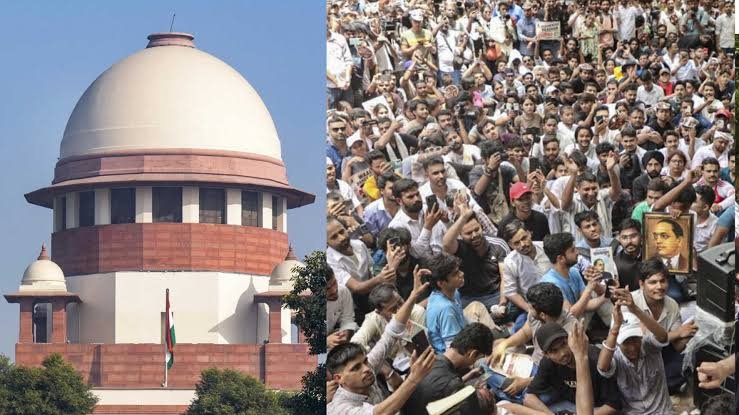
- In early September 2026, the Supreme Court invoked Article 142 to quash most FIRs arising from protests held across India in July 2026 over the NEET-UG 2026 examination controversy.
- A three-judge Bench headed by Chief Justice of India Surya Kant, along with Justices Joymalya Bagchi and V. Mohana, passed the order on applications moved by the Centre and concerned State authorities.
- It directed the Centre to formulate a pan-India compensation framework within three months for families of students who died by suicide in connection with the examination controversy.
Constitutional Basis of Article 142
Article 142(1) empowers the Supreme Court to pass any decree or order necessary for “doing complete justice” in a matter pending before it. Such orders are enforceable throughout India.
Key Features
- Extraordinary remedial power: Allows the Court to provide relief when ordinary legal remedies may be inadequate.
- Broad constitutional language: The Constitution does not exhaustively define “complete justice” or specify every situation in which the power may be exercised.
- Judicially developed scope: The meaning and limits of the provision have evolved through Supreme Court judgments.
- Historical background: Article 142 has been associated with Section 210 of the Government of India Act, 1935, which recognised principles of justice, equity and good conscience.
- In the Draft Constitution, it appeared as Article 118 and was adopted by the Constituent Assembly on 27 May 1949.
Major Applications of Article 142
The Supreme Court has exercised Article 142 in cases where conventional remedies were considered inadequate.
- Bhopal Gas Tragedy: Article 142 formed part of the constitutional basis for the Court’s comprehensive settlement of claims arising from the disaster.
- Ayodhya dispute: The Court invoked Article 142 while moulding final relief and directed allotment of five acres of land to the Sunni Central Waqf Board for a mosque.
- A.G. Perarivalan case (2022): The Court exercised Article 142 to order his release after considering the prolonged delay in the decision-making process.
- Matrimonial matters: The Court has used the power in exceptional cases to grant divorce where a marriage has become irretrievably broken.
- Environmental and public-interest matters: It has also been used to fashion remedies where existing legal mechanisms were considered insufficient.
An IIM Ahmedabad study covering 1950–2023 recorded 1,579 references to Article 142 or the concept of complete justice, including 791 direct invocations. Civil matters accounted for the largest share.
Judicially Recognised Limits
- Article 142 is broad, but it is not an unrestricted power.
- Prem Chand Garg v. State of Uttar Pradesh (1962)
- The Supreme Court held that an order under Article 142 cannot be inconsistent with Fundamental Rights or other constitutional limitations.
- Supreme Court Bar Association v. Union of India (1998)
The Court clarified that:
- Article 142 is a broad constitutional power and cannot simply be curtailed by an ordinary statute.
- The Court must nevertheless consider substantive statutory provisions and legislative policy while exercising the power.
- The Supreme Court can use Article 142 to fill gaps in existing law and provide an effective remedy, but it cannot replace, rewrite, or ignore the substantive law enacted by Parliament.
Thus, “complete justice” does not mean justice without legal limits.
Significance of the CJP Case
The case demonstrates how Article 142 can be used to address large-scale legal situations involving numerous proceedings.
- The Court adopted a broad remedial approach instead of requiring every affected person to seek separate relief.
- It excluded persons with serious criminal antecedents, indicating that the relief was not unconditional.
- The case highlights the constitutional question of how far the Supreme Court can provide collective relief when ordinary criminal law generally requires individual assessment.
Key Concerns
- Judicial overreach: Extensive use of Article 142 may raise concerns about the judiciary entering areas traditionally addressed by the legislature or executive.
- Individualised criminal justice: Collective quashing of criminal proceedings may conflict with the need to assess the conduct and role of individual accused persons.
- Separation of powers: Extraordinary judicial remedies should not effectively replace legislative policy or established statutory procedures.
- Consistency and predictability: The open-ended nature of “complete justice” requires careful and principled exercise of judicial discretion.
Way Forward
- Use Article 142 exceptionally, where ordinary remedies are genuinely inadequate.
- Ensure consistency with Fundamental Rights, constitutional principles and the rule of law.
- Respect the substantive legislative framework while addressing genuine remedial gaps.
- Provide clear and reasoned justification for extraordinary relief.
- Maintain a balance between judicial flexibility and institutional restraint.
Conclusion
Article 142 acts as a constitutional safety valve, allowing the Supreme Court to craft effective remedies in exceptional circumstances. Its flexibility, however, must operate within the boundaries of Fundamental Rights, statutory law, separation of powers and the rule of law. The CJP case illustrates this continuing balance between complete justice and judicial restraint.
UPSC-Oriented FAQs
- What is Article 142 of the Constitution?
It empowers the Supreme Court to pass orders necessary to do complete justice in matters pending before it. Such orders are enforceable throughout India. - Why is Article 142 considered an extraordinary power?
It allows the Supreme Court to craft remedies beyond conventional relief when ordinary legal mechanisms are inadequate. - Is the power under Article 142 unlimited?
No. It remains subject to Fundamental Rights, constitutional principles and the substantive legal framework. - What was established in Prem Chand Garg v. State of Uttar Pradesh?
The Court held that an order under Article 142 cannot violate Fundamental Rights or constitutional limitations. - What did Supreme Court Bar Association v. Union of India (1998) clarify?
It recognised the broad scope of Article 142 while holding that the Court cannot use it to supplant substantive law or disregard the statutory framework. - What is the significance of Article 142 in the CJP case?
It enabled the Supreme Court to provide collective relief in relation to protest-related FIRs while excluding persons with serious criminal antecedents. - What is the major constitutional concern surrounding Article 142?
The key concern is maintaining a balance between judicial discretion, separation of powers and the rule of law.