Context
A recent scientific study has identified a distinct community of marine-specific microorganisms in the highly saline water flowing from Blood Falls in Antarctica.
About Blood Falls
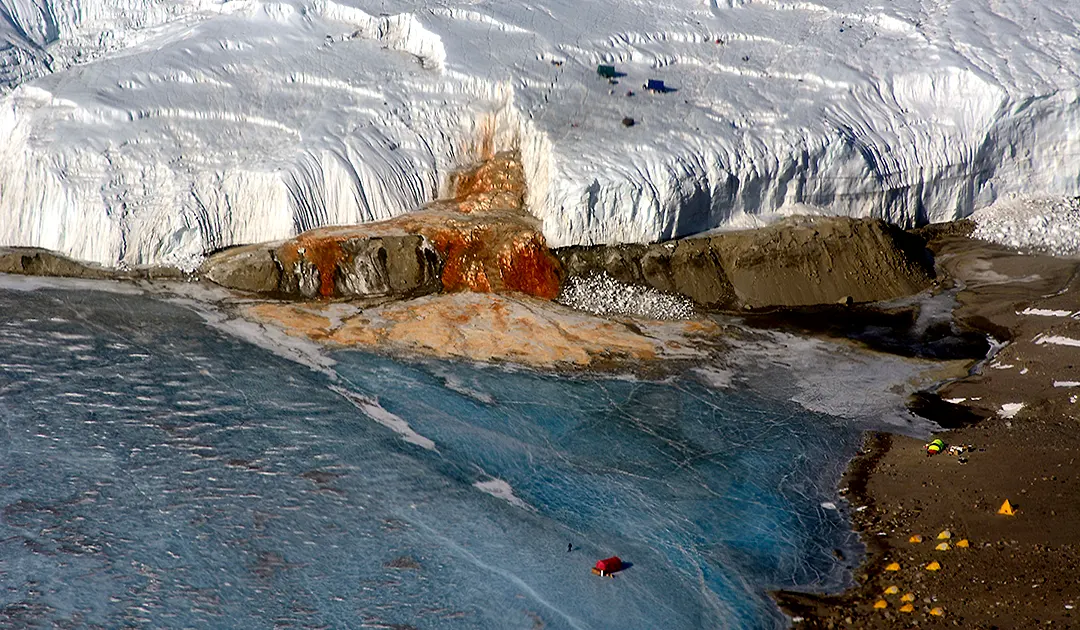
Blood Falls is a unique bright red subglacial waterfall located at the terminus of the Taylor Glacier in the McMurdo Dry Valleys, Victoria Land, East Antarctica. The reddish outflow emerging from the glacier resembles blood flowing over the ice, giving the phenomenon its name.
Formation and Characteristics
- Blood Falls is formed through a sequence of interconnected geological, hydrological and chemical processes beneath the Taylor Glacier.
- Beneath the glacier lies an underground reservoir of highly saline, iron-rich brine that has remained trapped for a prolonged period. The pressurised brine gradually rises to the surface through microscopic fractures within the glacier. As the iron-rich water comes into contact with atmospheric oxygen, the dissolved iron undergoes oxidation, producing iron oxide (rust) that gives Blood Falls its characteristic bright red colour.
- Despite Antarctica’s extremely low temperatures, the water remains liquid because its exceptionally high salt concentration significantly lowers the freezing point. The subglacial brine also supports specialised microorganisms that survive despite the absence of sunlight, extreme cold and limited oxygen, making Blood Falls an exceptional natural laboratory for studying life in extreme environments.
Recent Findings
Scientists have recently identified a distinct community of marine-specific microorganisms in the saline water emerging from Blood Falls. The presence of these microorganisms indicates that the underground brine most likely originated from ancient seawater that became trapped beneath the glacier when sea levels declined and the glacier advanced. Although the exact timing of this geological event remains uncertain, the findings strengthen evidence for the marine origin of the subglacial brine system and improve scientific understanding of Antarctica’s geological evolution, the origin of subglacial brine systems, and the long-term persistence of isolated microbial ecosystems beneath the ice.
Significance
- Geological Significance
- Provides evidence of an ancient marine environment preserved beneath the Antarctic ice sheet.
- Enhances understanding of subglacial hydrological systems, glacier evolution and historical sea-level changes.
- Improves knowledge of Antarctica’s long-term geological history.
- Biological Significance
- Demonstrates the survival of microorganisms in cold, highly saline and oxygen-limited environments.
- Helps scientists understand the adaptation of extremophiles to extreme environmental conditions.
- Provides insights into isolated subglacial microbial ecosystems.
- Environmental Significance
- Helps reconstruct Antarctica’s past environmental conditions.
- Improves understanding of long-term interactions between glaciers and subglacial groundwater.
- Contributes to studies on Antarctic climate history and ice-sheet dynamics.
- Astrobiological Significance
- Serves as an Earth-based analogue for environments that may exist beneath the icy surfaces of Mars and Jupiter’s moon Europa.
- Supports research on the possibility of life in similar extraterrestrial subglacial environments.
Question: What are Blood Falls?
Answer: Blood Falls is a bright red subglacial waterfall located at the terminus of the Taylor Glacier in the McMurdo Dry Valleys, Victoria Land, East Antarctica. It is fed by an underground reservoir of highly saline, iron-rich brine trapped beneath the glacier.
Question: Why is Blood Falls red in colour?
Answer: The subglacial brine contains dissolved iron, which reacts with atmospheric oxygen after reaching the surface. This process forms iron oxide (rust), giving Blood Falls its characteristic red colour.
Question: Why does the water remain liquid despite Antarctica’s freezing temperatures?
Answer: The underground brine contains an exceptionally high concentration of dissolved salts. This lowers its freezing point, allowing the water to remain liquid even under Antarctica’s extremely cold conditions.
Question: What is the source of the water flowing from Blood Falls?
Answer: The water originates from an underground reservoir of iron-rich, highly saline brine trapped beneath the Taylor Glacier. It reaches the surface through microscopic fractures within the glacier.
Question: What do the recent findings reveal about Blood Falls?
Answer: Scientists discovered marine-specific microorganisms in the subglacial brine, indicating that the underground water most likely originated from ancient seawater trapped beneath the glacier during past geological changes.
Question: Why are marine-specific microorganisms important?
Answer: Their presence provides strong evidence for the marine origin of the subglacial brine system and improves understanding of Antarctica’s geological evolution and long-term isolated microbial ecosystems.
Question: Why is Blood Falls scientifically important?
Answer: Blood Falls provides valuable insights into subglacial hydrology, glacier evolution, Antarctica’s geological and climatic history, microbial survival in extreme environments, and the possibility of life in similar icy environments beyond Earth.