Context
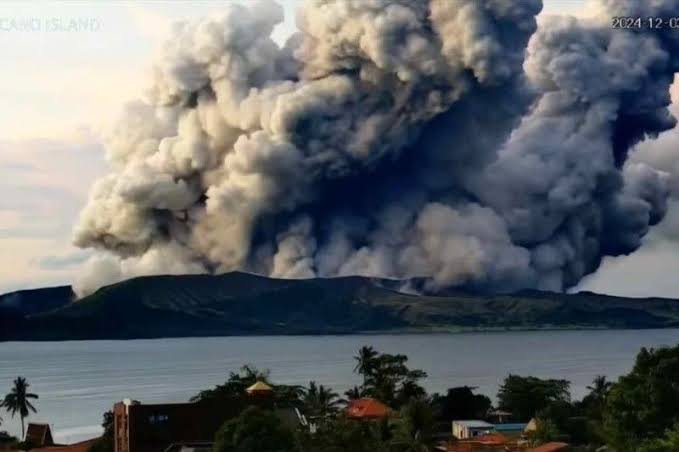
Recently, Taal Volcano in the Philippines witnessed a brief phreatomagmatic eruption, sending an ash plume about 450 metres above its crater following the interaction of magma and water.
About Taal Volcano
- Taal Volcano is an active stratovolcano situated in Batangas Province, about 70 km south of Manila, Philippines.
- The Philippine Institute of Volcanology and Seismology (PHIVOLCS) classifies it as a complex volcano because it consists of multiple volcanic cones, craters, and hills rather than a single volcanic edifice.
- It forms part of the Pacific Ring of Fire, a geologically active belt known for frequent earthquakes and volcanic eruptions.
- More than 38 eruptions have been recorded at Taal Volcano over the past 450 years, making it one of the most active volcanoes in the Philippines.
- A large caldera, formed by a series of prehistoric eruptions between 140,000 and 5,380 BCE, now contains Taal Lake, which covers about 265 sq. km and has an average depth of 100–150 metres.
- Volcano Island, located within Taal Lake, extends over about 24 sq. km and contains Crater Lake, which features the rocky islet Vulcan Point.
- The caldera rim is characterised by deeply eroded hills and steep cliffs.
Phreatomagmatic Eruption
- A phreatomagmatic eruption occurs when magma comes into contact with water, including groundwater, surface water, or water-saturated rocks.
- The intense heat rapidly converts water into steam, generating high pressure that triggers an explosive eruption.
- These eruptions eject volcanic ash, pyroclastic materials, and fragments of magma and surrounding rocks.