Context
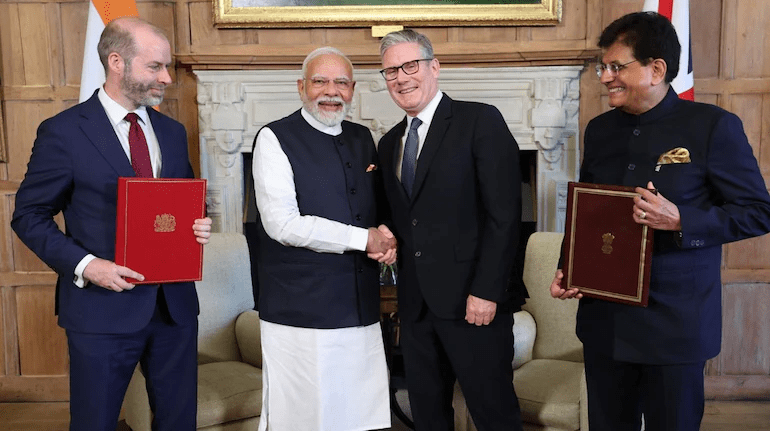
The India–UK Comprehensive Economic and Trade Agreement (CETA) and the Double Contribution Convention (DCC) came into force on 15th July 2026. It is India’s first comprehensive free trade agreement with a developed country and marks a significant milestone in its trade diplomacy, while also serving as an important reference for ongoing negotiations with the European Union.
Key Features
- The agreement comprises 30 chapters, covering trade in goods and services, investment, digital trade, government procurement, innovation, MSMEs, labour, environment, and gender.
- It addresses both tariff and non-tariff barriers, including Sanitary and Phytosanitary (SPS) Measures and Technical Barriers to Trade (TBT), to facilitate smoother market access.
- The agreement establishes a comprehensive framework for expanding bilateral trade, investment, and economic cooperation.
Market Access Commitments
- The United Kingdom has eliminated tariffs on 99% of Indian exports, providing near-complete duty-free access to its market.
- India will progressively reduce tariffs on around 90% of tariff lines through immediate tariff elimination, phased liberalisation, and tariff-rate quotas.
- The phased liberalisation seeks to expand bilateral trade while safeguarding sensitive domestic sectors.
Economic Benefits for India
- Duty-free access is expected to improve the competitiveness of textiles, footwear, gems and jewellery, and other labour-intensive industries.
- Better market access and tariff quotas are likely to boost iron and steel exports.
- Indian firms have secured greater access to the UK market in sectors such as computer services, consultancy, and environmental services, including the right to establish commercial operations.
- Indian suppliers have gained access to the UK Government procurement market, creating new business opportunities.
- The agreement’s non-binding labour and environment provisions reduce the possibility of these standards becoming barriers to Indian exports.
Double Contribution Convention (DCC)
- The DCC exempts eligible Indian professionals and their employers from paying UK social security contributions for up to five years, provided they continue contributing to India’s social security system.
- It is expected to benefit around 75,000 Indian professionals and more than 900 Indian companies operating in the UK.
- The arrangement reduces the burden of dual social security contributions, lowers employment costs for Indian businesses, and increases the take-home income of eligible professionals.
- The exemption applies only to employees deputed to the UK after the agreement came into force.
Economic Benefits for the UK
- Indian tariff reductions will improve market access for products such as automobiles, Scotch whisky, chocolates, cosmetics, sports goods, and medical devices.
- Tariffs on British automobiles and alcoholic beverages will be reduced in a phased manner under specified quota arrangements.
- UK firms have secured improved access to India’s accounting, auditing, financial, telecommunications, and environmental services sectors.
- The agreement also facilitates the recognition of professional qualifications in selected sectors, promoting greater mobility of skilled professionals.
Trade Facilitation Measures
- For the first time in an Indian free trade agreement, UK exporters are permitted to self-certify the origin of goods, replacing the conventional certification process.
- This measure is expected to simplify customs procedures, reduce transaction costs, and serve as a model for India’s future trade agreements with developed economies.
Challenges
- India did not obtain an exemption from the United Kingdom’s Carbon Border Adjustment Mechanism (CBAM), which is scheduled to take effect from 1 January 2027.
- The proposed carbon pricing mechanism could increase compliance costs and reduce the competitiveness of India’s carbon-intensive exports.
Significance
- The agreement strengthens India’s economic partnership with a major developed economy and diversifies its export markets.
- It is expected to promote exports, attract investment, improve services trade, and enhance the mobility of skilled professionals.
- CETA supports India’s integration into global value chains and reinforces the objectives of Make in India and Atmanirbhar Bharat.
- It also provides valuable experience for India’s ongoing and future free trade negotiations with advanced economies, particularly the European Union.
Conclusion
The India–UK Comprehensive Economic and Trade Agreement (CETA) marks a major step in India’s evolving trade strategy. By expanding market access, strengthening economic cooperation, and creating new opportunities for businesses and professionals, it deepens bilateral economic ties. Its long-term success, however, will depend on effective implementation, enhanced domestic competitiveness, and India’s ability to address emerging trade challenges such as carbon-related border measures.