Context
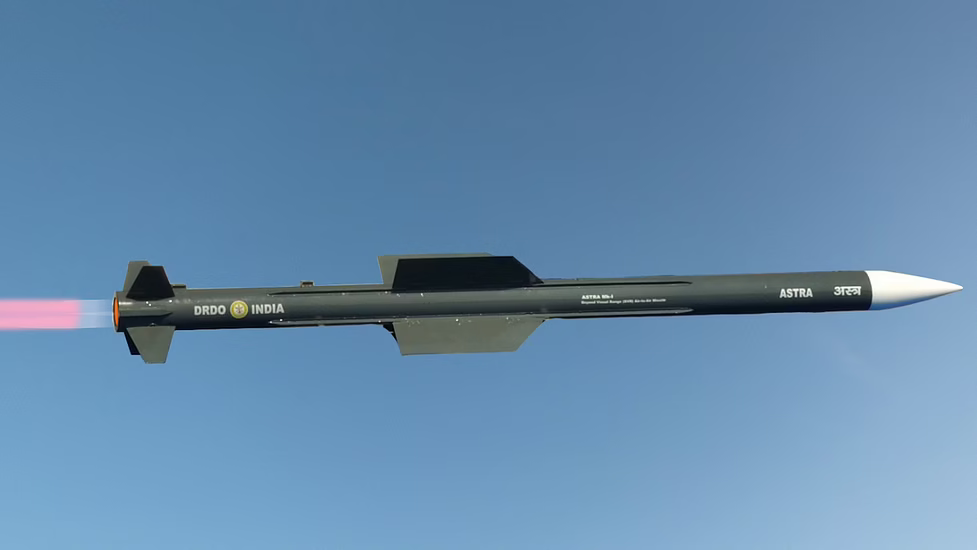
Recently, India and Indonesia signed an agreement for the supply of Astra Mk 1 missiles, marking a significant step in strengthening bilateral defence cooperation.
About Astra Mk 1 Missiles
- Astra Mk 1 is a Beyond Visual Range Air-to-Air Missile (BVRAAM) developed by the Defence Research and Development Organisation (DRDO).
- It is designed to engage hostile aircraft beyond the pilot’s visual range, significantly enhancing air combat capability.
- The missile has an operational range of 80–110 km, can engage targets at altitudes of up to 20 km, and attains a maximum speed of Mach 4.5.
- It is powered by a single-pulse smokeless solid-propellant rocket motor.
- Its guidance system combines inertial navigation, mid-course guidance updates, and terminal active radar homing for accurate target interception.
- Astra Mk 1 is integrated with the IAF’s Su-30MKI fighter aircraft and is planned for integration with the LCA Tejas Mk 1 and Rafale. It is also intended for deployment on compatible aircraft operated by the Indian Navy.
- The Astra Mk 2 variant is being developed with an extended engagement range of about 200 km, providing greater stand-off capability.
- Astra Mk 1 strengthens India’s beyond-visual-range air combat capability and supports the country’s drive towards self-reliance in defence technology.