Context
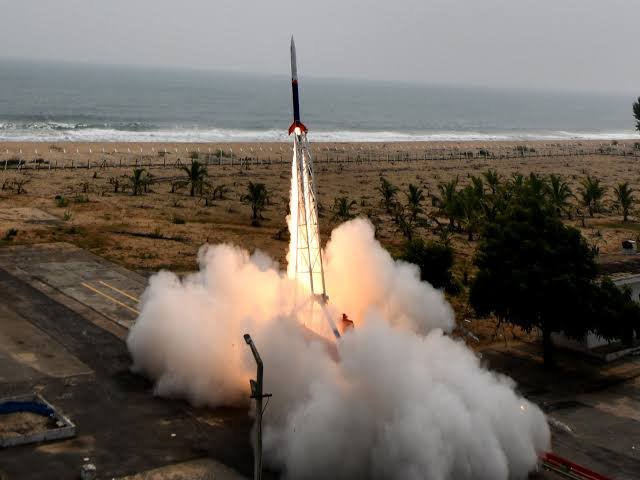
Recently, Vikram-1, India’s first privately developed orbital-class launch vehicle, was declared ready for its maiden launch, marking a major milestone in India’s private space sector.
About Vikram-1
- It is developed by Skyroot Aerospace and is a four-stage launch vehicle, with the first three stages powered by solid-fuel motors and the fourth stage using hypergolic liquid propulsion for precise orbital insertion.
- The fourth stage is powered by a cluster of four Raman engines that use Monomethylhydrazine (MMH) as fuel and Nitrogen Tetroxide (NTO) as the oxidiser. Being hypergolic, these propellants ignite automatically on contact, ensuring reliable engine ignition.
- The launch vehicle features an all-carbon composite structure and incorporates indigenously developed 3D-printed engines along with high-thrust solid rocket motors.
- It can carry payloads of up to 350 kg to Low Earth Orbit (LEO) and 260 kg to Sun-Synchronous Orbit (SSO).
- Designed for the small-satellite launch market, it is capable of deploying multiple satellites in a single mission.
- Its design emphasises simplicity, reliability, and rapid launch readiness, enabling launch within 24 hours from suitable launch locations.
- The rocket incorporates ultra-low-shock pneumatic separation systems and advanced avionics to ensure accurate guidance, navigation, and mission control.
The launch vehicle is designed to support the growing small-satellite launch market while expanding private sector participation in India’s space programme.