Context
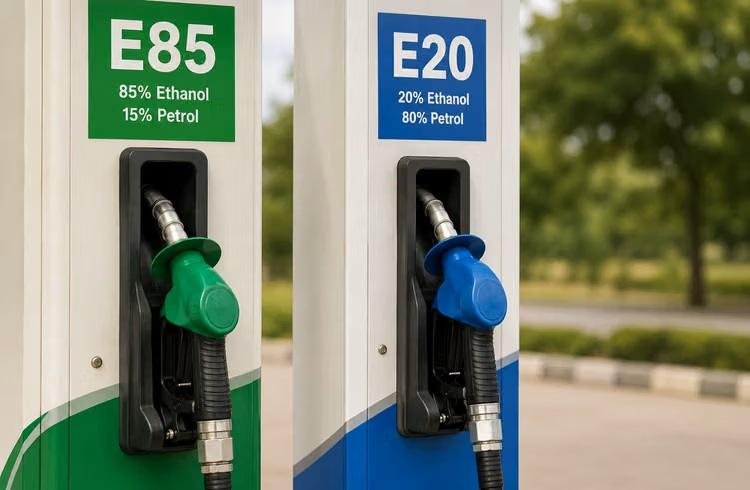
India achieved the target of 20% ethanol blending (E20) in petrol ahead of schedule. Recently, the Government launched E85 fuel (85% ethanol and 15% petrol) for flex-fuel vehicles, signalling the next phase of the Ethanol Blending Programme (EBP).
Ethanol Blending Programme (EBP)
- The National Policy on Biofuels, 2009 laid the foundation for ethanol blending in petrol to promote cleaner transport fuels. Subsequently, the programme was accelerated to achieve higher blending targets.
- India rapidly progressed from E10 to E20, achieving the revised blending target ahead of schedule.
- The programme aims to enhance energy security, reduce crude oil imports, lower vehicular emissions, and promote the use of domestically produced biofuels.
- It supports India’s energy transition, climate commitments, and the objective of reducing dependence on imported fossil fuels.
Benefits of Ethanol Blending
- Enhances energy security by reducing reliance on imported crude oil.
- Lowers greenhouse gas emissions by partially replacing fossil fuels with a renewable alternative.
- Creates a stable market for agricultural feedstocks such as sugarcane and maize, thereby strengthening farmers’ incomes and supporting the biofuel value chain.
- Ethanol’s high Research Octane Number (RON) improves combustion efficiency, reduces engine knocking, and offers better performance in engines designed for higher ethanol blends.
Key Challenges
- Lower Fuel Efficiency: Ethanol has a lower energy content than petrol, resulting in reduced mileage, particularly in vehicles not designed for higher ethanol blends.
- Engine and Material Compatibility: Higher ethanol blends may corrode fuel-system components and require engine modifications, especially in older vehicles.
- Cold-Start Performance: Ethanol’s combustion characteristics can reduce engine-starting efficiency under low-temperature conditions.
- Limited Consumer Choice: Consumers currently have limited options to choose between different ethanol blends at retail fuel outlets.
- Cost-effectiveness: Lower fuel efficiency may offset the price advantage of higher ethanol blends unless supported by appropriate pricing policies.
Properties of Ethanol as a Fuel
- Ethanol (C₂H₅OH) is a renewable, oxygen-rich fuel that burns more cleanly than petrol.
- Its high Research Octane Number (RON) improves combustion efficiency and reduces engine knocking.
- Its high latent heat of vaporisation enhances engine cooling and supports efficient combustion.
- Compared with petrol, ethanol has a lower carbon content, resulting in comparatively lower carbon dioxide emissions during combustion.
Way Forward
- Promote flex-fuel vehicles through phased policy support.
- Ensure vehicle compatibility, safety standards, and rigorous testing before expanding to higher ethanol blends such as E25.
- Strengthen fuel infrastructure, transparent pricing mechanisms, and consumer awareness to facilitate wider adoption.
- Encourage research and technological innovation to improve engine efficiency, fuel-system durability, and compatibility with higher ethanol blends.
Brazil’s Ethanol Model: Lessons for India
- Brazil has developed a mature ethanol ecosystem based on sugarcane-derived ethanol and widespread adoption of flex-fuel vehicles.
- Its success is driven by consumer choice, competitive pricing, and sustained policy support for ethanol-based fuels.
- India can draw lessons by promoting flex-fuel vehicles, strengthening market incentives, and providing consumers with greater fuel choices.
Conclusion
Higher ethanol blending can strengthen India’s energy security, reduce greenhouse gas emissions, and promote the use of domestically produced biofuels. However, its long-term success will depend on balancing environmental objectives with vehicle readiness, consumer awareness, appropriate pricing, robust infrastructure, and sustained policy support.