Context
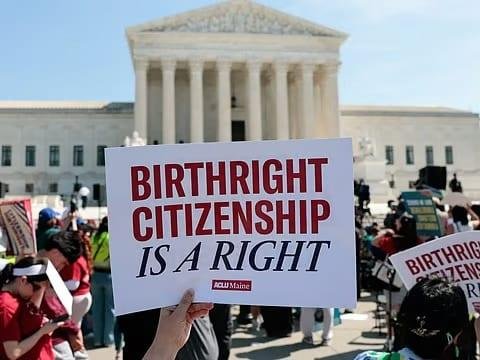
The U.S. Supreme Court (SCOTUS), by a 6–3 majority, struck down Executive Order (EO) 14160 issued by President Donald Trump, holding that birthright citizenship remains protected under the Fourteenth Amendment. The ruling has renewed debates on immigration policy, constitutional interpretation, and the limits of executive power.
Constitutional Basis of Citizenship by Birth in the U.S.
- The Fourteenth Amendment (1868) provides that all persons born or naturalised in the United States and subject to its jurisdiction are U.S. citizens.
- The Immigration and Nationality Act (INA), 1952 gives statutory recognition to citizenship acquired by birth.
- Exceptions include:
-
- Children of foreign diplomats.
- Children born in territories under enemy military occupation.
Supreme Court’s Ruling
- Majority Opinion
- The Court held that Executive Order 14160 violated the Citizenship Clause of the Fourteenth Amendment.
- It interpreted the phrase “subject to its jurisdiction” to include all persons born in the U.S. who are governed by its laws, irrespective of their parents’ immigration status.
- The judgment reaffirmed the jus soli (right of the soil) principle, under which citizenship is determined primarily by place of birth.
- Dissenting Opinion
- The dissent argued that citizenship requires permanent allegiance and domicile in the United States, which temporary visitors and undocumented migrants do not possess.
- It maintained that the Fourteenth Amendment was intended to secure citizenship for formerly enslaved people, rather than establish unrestricted citizenship by birth.
- It also expressed concerns over illegal immigration and birth tourism.
Evolution of Citizenship by Birth in the U.S.
- The original U.S. Constitution did not define citizenship.
- The Naturalization Act, 1790 restricted naturalisation to “free white persons.”
- The Dred Scott (1857) judgment denied citizenship to Black Americans.
- After the Civil War:
-
- Thirteenth Amendment (1865): Abolished slavery.
- Civil Rights Act, 1866: Recognised citizenship by birth.
- Fourteenth Amendment (1868): Constitutionally guaranteed the principle.
Issues Surrounding Citizenship by Birth
- The issue became a key element of Donald Trump’s immigration agenda and the Make America Great Again (MAGA) movement.
- Critics argue that the policy:
- Encourages illegal immigration.
- Promotes birth tourism, whereby foreign nationals seek citizenship for their children by giving birth in the U.S.
- The Court held that policy considerations cannot override an explicit constitutional provision.
Demographic Trends
- According to available estimates, births to unauthorised immigrant mothers increased from about 1.2 lakh (3% of total U.S. births) in 1990 to nearly 3.8 lakh (9%) during 2006–07.
- The figure declined to around 2.5 lakh (6%) by 2016.
- According to the Pew Research Center, the share rose again to around 9% of U.S. births in 2023.
Citizenship Framework in India
Constitutional and Legal Provisions
- Citizenship is governed by Part II (Articles 5–11) of the Constitution and the Citizenship Act, 1955.
- India follows the principle of single citizenship.
- Citizenship may be acquired through:
-
- Birth
- Descent
- Registration
- Naturalisation
- Incorporation of territory
Evolution of Citizenship by Birth
- At the commencement of the Constitution, Article 5 broadly reflected the jus soli principle.
- The Citizenship Act, 1955 subsequently codified citizenship by birth.
- The scope of the principle was gradually narrowed:
- 1986 Amendment: At least one parent must be an Indian citizen.
- 2003 Amendment: Citizenship by birth was denied if either parent is an illegal migrant.
Citizenship (Amendment) Act, 2019
The CAA, 2019 introduced the following changes:
- Reduced the aggregate residence requirement for naturalisation from 11 years to 5 years (reducing the overall qualifying period from 12 years to 6 years) for specified communities.
- Fast-tracked citizenship for Hindus, Sikhs, Buddhists, Jains, Parsis, and Christians from Afghanistan, Bangladesh, and Pakistan who entered India on or before 31 December 2014.
Comparison of Citizenship Frameworks: India and the U.S.
| Aspect | United States | India |
| Citizenship Structure | Citizens hold both U.S. citizenship and State citizenship. The U.S. also permits dual nationality with other countries. | Follows single citizenship. Voluntary acquisition of foreign citizenship results in automatic cessation of Indian citizenship under the Citizenship Act, 1955. |
| Citizenship by Birth | Broad jus soli principle under the Fourteenth Amendment. | Restricted jus soli model based on the citizenship and immigration status of parents. |
| Citizenship by Descent | Available to children born abroad to U.S. citizens, subject to statutory requirements. | Available under the Citizenship Act, 1955, subject to prescribed conditions. |
| Diaspora Policy | Permits dual nationality. | Offers Overseas Citizenship of India (OCI), providing lifelong visa-free travel and specified economic and educational benefits, but excluding political rights and ownership of agricultural land. |
Constitutional Significance
- Reaffirms the supremacy of the Constitution over executive action.
- Reinforces the role of judicial review in protecting constitutional rights.
- Clarifies the scope of the Citizenship Clause and the jus soli principle.
- Highlights the need to balance immigration control with constitutional guarantees.
- Demonstrates how constitutional interpretation shapes citizenship policy in a changing socio-political context.
Conclusion
The judgment underscores that citizenship is fundamentally a constitutional question rather than a matter of executive discretion. While the United States and India follow different approaches to citizenship by birth, both seek to balance migration management with constitutional values, national interests, and the protection of individual rights. This decision also reaffirms the enduring importance of constitutional interpretation in shaping citizenship laws and safeguarding democratic principles.