Context
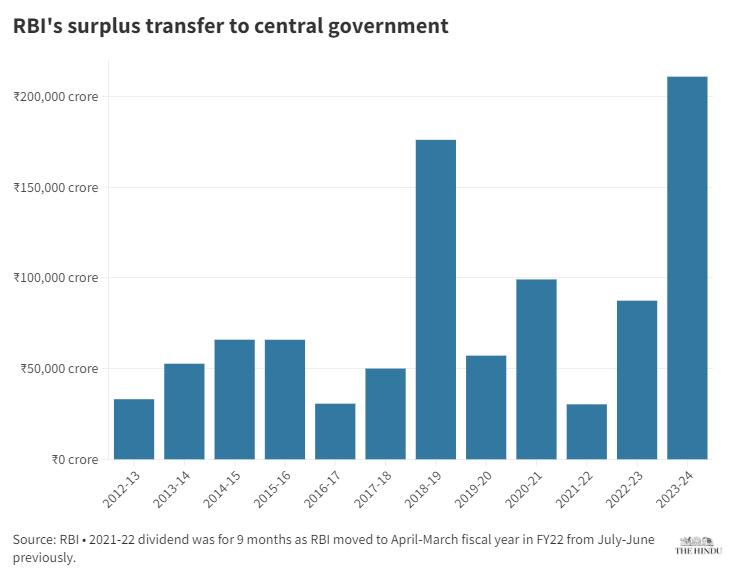
The Reserve Bank of India (RBI) has approved a record surplus transfer of ₹2.87 lakh crore to the Union Government for FY 2025–26, the highest-ever transfer by the central bank. While the transfer is in accordance with the Economic Capital Framework (ECF), its scale has revived discussions on central bank independence, fiscal policy, and fiscal federalism.
Sources of RBI Surplus
The RBI generates income through:
- Interest earned on government securities.
- Returns from foreign exchange reserves and gold holdings.
- Foreign exchange market operations.
- Reserve and investment management activities.
Strong earnings from these sources, coupled with the expansion of the RBI’s balance sheet, contributed to the record surplus.
Economic Capital Framework (ECF)
- The surplus transfer is governed by the Economic Capital Framework (ECF) adopted in 2019 based on the recommendations of the Bimal Jalan Committee.
- The framework determines the level of contingency reserves and risk buffers to be maintained by the RBI before transferring surplus to the government.
- The current transfer has been made within the provisions of this framework.
Significance of the Transfer
- Creates additional fiscal space without increasing taxes or borrowings.
- Supports fiscal consolidation and reduces pressure on government finances.
- Strengthens the government’s capacity to fund developmental and welfare expenditure.
- Reflects the robustness of the RBI’s balance sheet and reserve management practices.
- Enhances resilience against external shocks and global financial volatility.
Key Concerns
- Fiscal-Monetary Interface
- Growing surplus transfers have increased the fiscal significance of RBI earnings.
- Persistent reliance on such transfers may create perceptions of fiscal dominance, where fiscal considerations influence monetary policy.
- Frequent dependence on central bank resources may blur the distinction between fiscal management and monetary functions.
- Preserving the RBI’s operational autonomy remains essential for maintaining policy credibility and investor confidence.
- Fiscal Federalism
- RBI surplus is treated as non-tax revenue of the Union Government.
- It does not form part of the divisible pool shared with States through Finance Commission recommendations.
- Consequently, States receive no automatic share despite bearing substantial expenditure responsibilities in sectors such as health, education, and social welfare.
- This has raised concerns regarding the growing concentration of fiscal resources at the Union level and its implications for cooperative federalism.
Way Forward
- Safeguard the RBI’s independence and institutional credibility.
- Ensure strict adherence to the Economic Capital Framework.
- Maintain transparency in surplus calculation and transfer mechanisms.
- Strengthen Centre–State fiscal coordination to promote balanced fiscal federalism.
- Ensure that surplus transfers remain guided by prudential considerations rather than short-term fiscal requirements.
- Balance immediate fiscal needs with long-term monetary and financial stability objectives.
Conclusion
The record surplus transfer underscores the RBI’s strong financial position and provides additional fiscal space to the government. However, preserving central bank independence, fiscal discipline, and cooperative federalism remains crucial for ensuring long-term macroeconomic stability, policy credibility, and institutional integrity.