Context
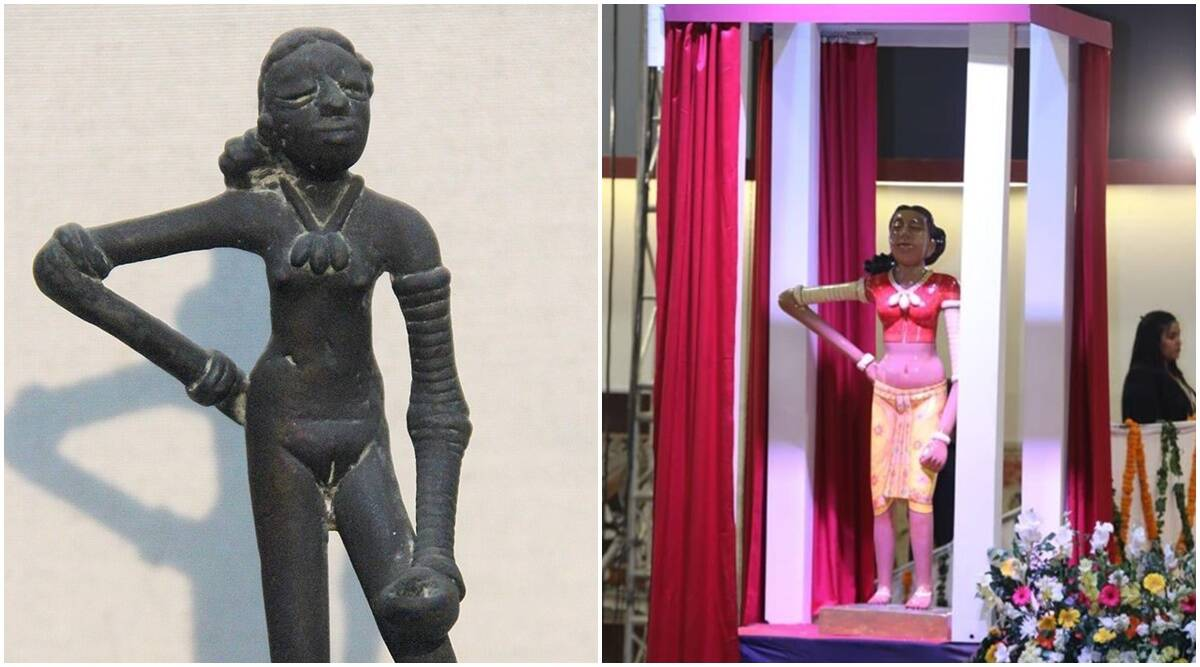
An NCERT Class 9 textbook recently featured a digitally modified image of the famous Harappan bronze figurine popularly known as the “Dancing Girl”, with its torso covered. Following criticism from historians and archaeologists, the original image was restored, reviving debates on historical authenticity, interpretation of cultural heritage, and the portrayal of historical artefacts in educational material.
About the Dancing Girl Figurine
- The figurine belongs to the Harappan Civilization (c. 2600–1900 BCE) and was discovered in 1926 at Mohenjo-daro (present-day Pakistan).
- It is a 10.8 cm high bronze sculpture, currently housed in the National Museum, New Delhi.
- The figure is adorned with numerous bangles and a necklace and is depicted in a distinctive posture.
- It was crafted using the lost-wax casting technique (cire perdue), demonstrating the advanced metallurgical capabilities of the Harappan Civilization.
- The artefact is regarded as one of the finest examples of Harappan craftsmanship and provides valuable insights into the technological achievements of the Indus Valley Civilization.
- The continued use of the lost-wax technique in parts of India reflects the enduring legacy of traditional metal-casting practices.
Origin of the Term “Dancing Girl”
- The figurine was labelled as a “Dancing Girl” by John Marshall, then Director-General of the Archaeological Survey of India.
- The identification was based largely on its posture and appearance.
- However, no archaeological or textual evidence conclusively establishes that it represents a dancer.
- Consequently, the designation is widely viewed as an interpretative construct rather than an evidence-based historical identification.
Colonial Influence on Interpretation
- Early studies of Indian antiquities were often shaped by colonial-era cultural and aesthetic perspectives.
- Victorian notions of morality influenced perceptions of nudity and artistic representation in Indian heritage.
- Such frameworks affected the classification and interpretation of several archaeological discoveries, including the Dancing Girl figurine.
- The episode highlights the need to critically examine colonial-era interpretations of India’s archaeological heritage.
Alternative Interpretations
- In the absence of deciphered Harappan texts, scholars have variously interpreted the figurine as a ritual figure, a representation of female divinity, a secular individual, or even a warrior-like figure.
- However, none of these interpretations has gained universal scholarly acceptance.
India–Pakistan Heritage Dimension
- Following Partition, several Harappan artefacts became subjects of negotiation between India and Pakistan.
- A subsequent agreement led to the division of excavated objects between the two countries.
- The Dancing Girl remained in India, while the famous Priest King sculpture became part of Pakistan’s collection.
- The episode highlights how archaeological heritage can become intertwined with questions of national identity and post-Partition cultural politics.
Key Issues
- Preservation of historical authenticity in educational resources.
- Interpretation of archaeological evidence without imposing present-day assumptions.
- Influence of contemporary social values on the representation of the past.
- Ensuring accurate representation of cultural heritage in textbooks and public institutions.
- Balancing cultural sensitivity with academic integrity.
Conclusion
The Dancing Girl figurine remains a significant symbol of the artistic and technological achievements of the Harappan Civilization. The controversy surrounding its depiction underscores the importance of preserving historical authenticity and promoting evidence-based interpretations of the past, free from both colonial assumptions and contemporary value judgments.