Context
The Archaeological Survey of India (ASI) recently removed structures added inside the main gopuram of the Virupaksha Temple at Hampi and restored a historic mantapa that had been used as an office, as part of efforts to preserve the temple’s original architectural heritage.
About Virupaksha Temple
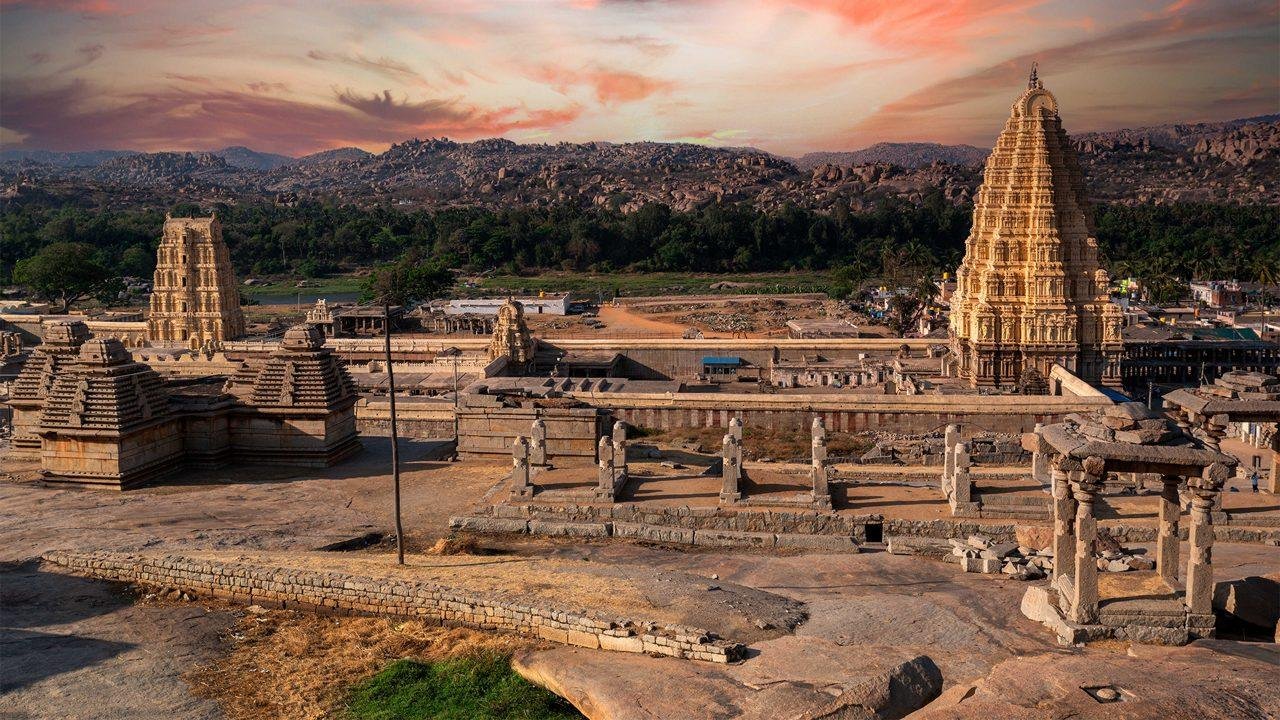
- Virupaksha Temple, also known as the Pampapathi Temple, is dedicated to Lord Virupaksha (Shiva) and is located at Hampi on the southern bank of the Tungabhadra River in Karnataka.
- It forms part of the Group of Monuments at Hampi, a UNESCO World Heritage Site since 1986.
- The temple has remained a living place of worship since the 7th century CE, making it one of India’s oldest continuously functioning temples.
- Originally a small shrine, it was expanded during the Chalukya and Hoysala periods and emerged as a major religious and cultural centre under the Vijayanagara Empire (14th–16th centuries).
- Vijayanagara rulers, particularly Deva Raya II and Krishnadevaraya, played a key role in its development by adding major structures, including the eastern gopuram and grand mandapas.
Architectural Features
- The temple is a notable example of Dravidian architecture, characterised by monumental gopurams, ornate carvings, spacious courtyards, and pillared halls.
- The complex comprises a garbhagriha (sanctum sanctorum), antechambers, mandapas, and three principal gopurams.
- The eastern gopuram, the tallest gateway tower, rises to about 160 feet and consists of nine tiers.
- The gopurams are adorned with sculptures depicting Hindu deities and mythological themes.
- Its geometric patterns and structural design reflect the advanced architectural, mathematical, and engineering knowledge of the period.
- The temple also demonstrates the pinhole camera effect, where an inverted image of the main tower is projected onto an interior wall.