Context
- Statements made by Nepal’s Prime Minister in Parliament have once again brought the long-pending border disagreements between India and Nepal into focus.
About India–Nepal Boundary Issue
- India and Nepal have an open border of around 1850 km across Uttar Pradesh, Uttarakhand, Bihar, West Bengal and Sikkim. Although most of the boundary is settled, some areas still remain disputed.
- This dispute originates from the Treaty of Sugauli (1816) signed after the Anglo-Nepalese War which recognized the Kali (Mahakali) River as Nepal’s western boundary. Differences over the river’s exact source later gave rise to competing territorial claims.
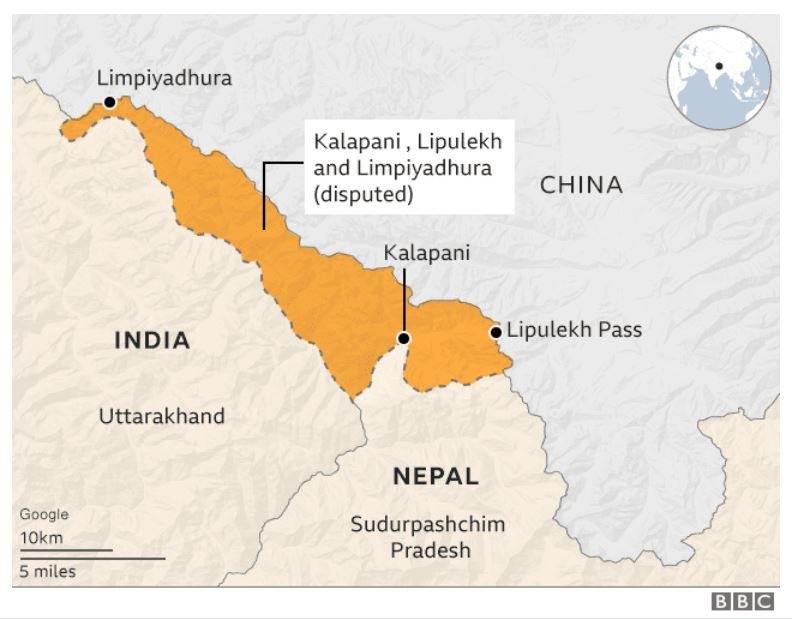
- The principal disputed areas are Kalapani, Lipulekh Pass, and Limpiyadhura.
- Kalapani – Strategically important as located at India-Nepal-China trijunction.
- Lipulekh Pass – Connect India with Tibet. Important route for Kailash-Mansarovar Yatra.
- Limpiyadhura – Nepal claims that Kali river originates from here, placing Kalapani and Lipulekh within Nepal’s territory, to which India disagrees.
- Tensions increased in 2020 when Nepal altered its official map to include the disputed regions within its claimed boundaries. India did not accept this revision and reiterated its position that such issues should be settled through established bilateral mechanisms.
- Both countries have consistently preferred a peaceful resolution through bilateral dialogue, joint boundary mechanisms, survey and mapping exercises, and examination of historical and cartographic evidence by experts.
- In his recent remarks, Prime Minister Balendra Shah stated that the dispute may not be entirely one-sided and suggested that there could be areas where Nepal occupies land claimed by India. He also revealed that Nepal had formally raised disputed territories with India, received a positive response, and proposed future discussions involving historians, surveyors, and boundary experts to establish factual clarity.
- Shah’s reference to consultations with China and the United Kingdom, citing their historical relevance to the issue, generated attention because India traditionally favours direct bilateral settlement without third-party involvement.
- His remarks also sparked debate within Nepal, where several experts questioned the claim of Nepal occupying Indian territory, while emphasizing that most boundary issues have already been resolved and that both countries continue to support a negotiated and diplomatic settlement.
Conclusion
Despite periodic disagreements over specific boundary segments, India and Nepal have consistently emphasized dialogue and mutual understanding. A fact-based and diplomatic approach remains essential for preserving the close historical, cultural, and strategic ties between the two neighbours.