Context
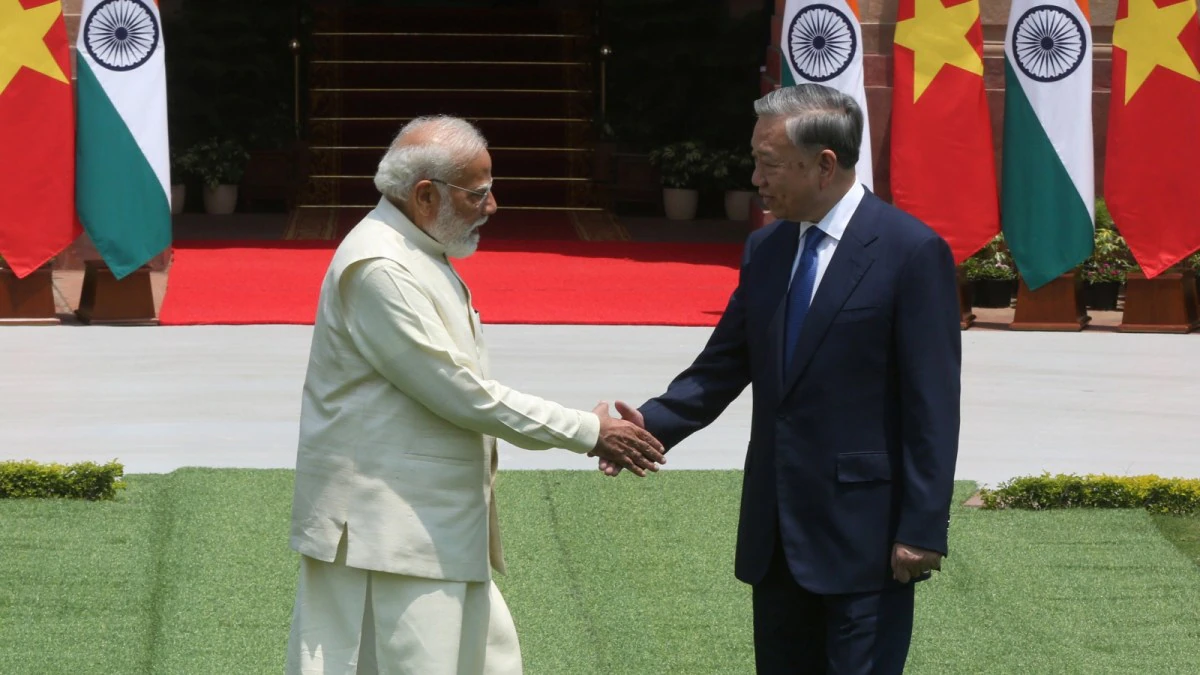
India and Vietnam have elevated their relationship to an “Enhanced Comprehensive Strategic Partnership” during the visit of Vietnamese President To Lam to India. Both countries also set a target of achieving bilateral trade worth 25 billion dollars by 2030, reflecting growing convergence in strategic, economic and Indo-Pacific priorities.
Evolution of Bilateral Relations
- India and Vietnam established diplomatic relations in 1972, though their ties originated during the anti-colonial period.
- Prime Minister Jawaharlal Nehru was the first foreign leader to visit Vietnam after the liberation of Hanoi in 1954.
- India supported Vietnam’s sovereignty during the Vietnam War and recognised unified Vietnam soon after reunification in 1975.
- Bilateral ties were upgraded to:
- Strategic Partnership in 2007, and
- Comprehensive Strategic Partnership in 2016.
- Vietnam was also the first ASEAN country with which India established a Strategic Partnership.
Major Areas of Cooperation
Economic and Technological Cooperation
- Bilateral trade has crossed 16 billion dollars, with both countries aiming to raise it to 25 billion dollars by 2030.
- Vietnam has emerged as an important economic partner for India in Southeast Asia and a key participant in regional supply chains.
- Cooperation is expanding in sectors such as:
- pharmaceuticals,
- agriculture and fisheries,
- electronics and manufacturing,
- renewable energy,
- digital economy, and
- critical minerals.
- Agreements signed during the recent visit covered areas including:
- digital payments,
- artificial intelligence,
- 6G technology,
- space cooperation, and
- digital public infrastructure.
- Vietnam’s participation in ASEAN and the Regional Comprehensive Economic Partnership (RCEP) enhances its significance for India’s economic engagement with East and Southeast Asia.
Defence and Maritime Cooperation
- Defence cooperation has become a central pillar of bilateral relations.
- Both countries share common concerns regarding:
- maritime security,
- freedom of navigation,
- adherence to international law, and
- stability in the Indo-Pacific region.
- Cooperation has expanded through:
- defence lines of credit,
- military training,
- naval exchanges,
- joint exercises, and
- defence industrial collaboration.
- Maritime cooperation assumes particular importance in the context of tensions in the South China Sea.
- India and Vietnam have reiterated support for peaceful resolution of disputes in accordance with UNCLOS and opposed militarisation in the region.
- Vietnam’s participation in the Indo-Pacific Oceans Initiative (IPOI) reflects increasing strategic convergence between the two countries.
Cultural and Development Partnership
- India and Vietnam share long-standing civilisational ties rooted in Buddhism and the historical influence of Indian culture on the Cham civilisation.
- Heritage sites such as the My Son sanctuary reflect these historical linkages.
- Cultural exchanges, academic cooperation, tourism and scholarship programmes continue to strengthen people-to-people relations.
- India has also implemented several Quick Impact Projects in Vietnam focusing on education, healthcare and community infrastructure.
Significance for India
- Vietnam occupies an important position in India’s Act East Policy and Indo-Pacific strategy.
- Stronger engagement with Vietnam enhances India’s outreach to ASEAN and supports efforts to promote a free, open and rules-based Indo-Pacific order.
- The partnership contributes to:
- diversification of supply chains,
- strengthening maritime security cooperation,
- expansion of India’s economic presence in Southeast Asia, and
- balancing strategic challenges in the region.
- Growing cooperation in critical technologies, connectivity and defence also reflects efforts to build resilient strategic partnerships in the Indo-Pacific.
Conclusion
India–Vietnam relations have evolved into a multidimensional strategic partnership driven by shared geopolitical interests, economic cooperation and historical linkages. The elevation of ties to an Enhanced Comprehensive Strategic Partnership reflects increasing convergence on regional security, economic resilience and Indo-Pacific stability. Strengthening this partnership will remain important for advancing India’s strategic interests in Southeast Asia and reinforcing a rules-based regional order.