Context
Recent scientific studies have raised concerns regarding the rapid weakening of the Atlantic Meridional Overturning Circulation (AMOC), a major oceanic circulation system that regulates global climate. Scientists warn that continued weakening of the AMOC could disrupt global weather patterns, intensify climate extremes and adversely affect monsoon systems, including the Indian summer monsoon.
Atlantic Meridional Overturning Circulation (AMOC)
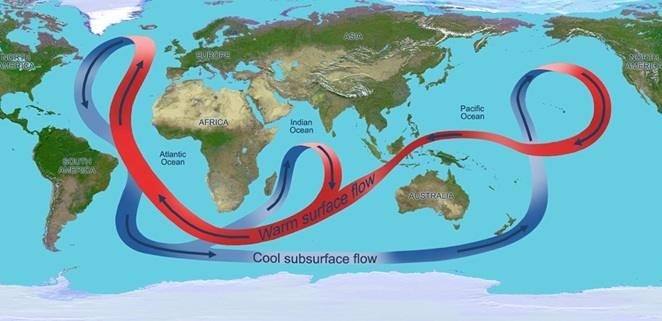
- The AMOC is a large system of interconnected ocean currents operating in the Atlantic Ocean.
- It functions as a global heat conveyor belt by transporting warm and saline surface water from tropical regions towards the North Atlantic and areas around Greenland.
- In the cold polar regions near Greenland, the water cools, becomes denser and sinks into deeper ocean layers.
- The cold deep water then flows southward before resurfacing and warming again, thereby completing the circulation cycle.
- Through this continuous process, the AMOC redistributes heat across the planet and plays a crucial role in maintaining global climatic balance.
Causes Behind the Weakening of the AMOC
- The AMOC is primarily driven by differences in ocean temperature and salinity.
- Rapid global warming has accelerated the melting of the Greenland ice sheet and Arctic ice.
- The increased inflow of freshwater into the North Atlantic reduces the salinity and density of seawater.
- As freshwater is lighter and less saline, it weakens the sinking of cold water near Greenland that sustains deep ocean circulation.
- Consequently, the overall strength of the AMOC is gradually declining.
- Scientific projections indicate that the weakening trend may intensify further during the 21st century if greenhouse gas emissions continue to rise.
AMOC as a Climate Tipping Point
- The AMOC is regarded as a potential climate tipping point because excessive weakening may trigger abrupt and irreversible changes in the global climate system.
- A major slowdown could destabilise ocean-atmosphere interactions and alter long-term climatic patterns across continents.
- Potential consequences include:
- disruption of global rainfall systems,
- increased frequency of extreme weather events,
- regional sea-level rise, and
- heightened climate instability.
Global Climate Implications
- The AMOC plays a critical role in regulating heat distribution between the northern and southern hemispheres.
- Weakening of the circulation could disturb climatic conditions across Europe, Africa, the Americas and Asia.
- It may also influence Pacific Ocean dynamics by altering the global heat balance, thereby intensifying El Niño events.
- Stronger and more unpredictable El Niño conditions can increase the occurrence of droughts, floods and heatwaves in different regions of the world.
Implications for India
- India’s agriculture, water resources and food security remain heavily dependent on the southwest monsoon.
- A weaker AMOC could alter tropical rainfall systems and reduce the strength of moisture-bearing winds reaching the Indian subcontinent.
- This may lead to:
- erratic monsoon rainfall,
- prolonged dry spells,
- increased drought frequency,
- groundwater stress, and
- decline in agricultural productivity.
- Intensified El Niño conditions associated with AMOC weakening may further increase the risk of climate-induced disasters such as floods and crop failures.
- The phenomenon poses significant challenges to water security, rural livelihoods and climate resilience in India.
Way Forward
- Global efforts to reduce greenhouse gas emissions must be strengthened to limit further disruption of ocean circulation systems.
- Countries should enhance climate monitoring, oceanographic research and early warning mechanisms.
- India needs to promote climate-resilient agriculture, efficient water management and improved monsoon forecasting systems.
- Greater international cooperation in climate governance and marine scientific research is essential to address emerging climate risks.
Conclusion
The weakening of the AMOC reflects the increasing vulnerability of the global climate system under the impact of climate change. Accelerated melting of the Greenland ice sheet and rising freshwater inflow into the North Atlantic have emerged as critical drivers of this process. Given its potential implications for monsoon dynamics, agriculture and water security, the issue holds serious significance for India and underscores the need for coordinated global climate action and resilient adaptation strategies.