Context
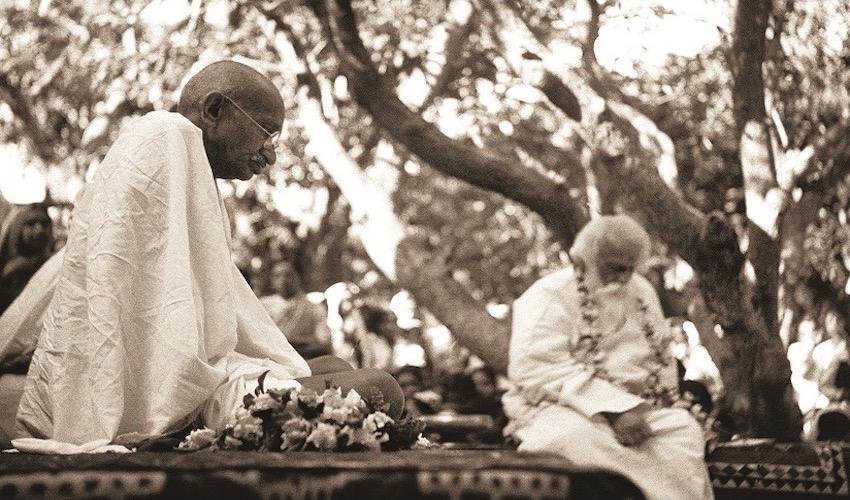
Mahatma Gandhi and Rabindranath Tagore shared a close intellectual relationship for nearly three decades, yet they differed on several political and philosophical issues. One of their most important debates centred on the charkha and the khadi movement.
Intellectual Differences Between Gandhi and Tagore
- The ideological differences between Gandhi and Tagore became visible after Gandhi’s return from South Africa and his visit to Shantiniketan in 1915.Despite mutual respect, they differed on:
- nationalism,
- education,
- political mobilisation,
- religion, and
- social reform.
- After the Jallianwala Bagh Massacre, Gandhi launched the Non-Cooperation Movement, whereas Tagore feared that excessive nationalism and mass mobilisation could weaken critical thinking and encourage blind conformity.
- Although Tagore did not join the movement, he strongly opposed colonial repression and renounced his British knighthood in protest.
- The two leaders also differed over Gandhi’s interpretation of the 1934 Bihar earthquake as divine punishment for untouchability. Tagore rejected linking natural disasters with moral or religious explanations.
- Historians often describe Gandhi as a nationalist mass mobiliser rooted in moral discipline, while Tagore is viewed as an internationalist thinker who emphasised creativity, individuality and intellectual openness.
Debate on the Charkha
- During the 1920s, Gandhi promoted the charkha and khadi movement as central elements of the national movement. Congress workers were encouraged to wear khadi and contribute hand-spun yarn regularly.
- For Gandhi, the charkha represented:
- economic self-sufficiency,
- rural reconstruction,
- dignity of manual labour,
- social cooperation, and
- resistance to exploitative industrial systems.
- He believed spinning could connect educated Indians with rural poverty and strengthen social responsibility.
- In his essay The Cult of the Charkha, Tagore criticised the excessive importance attached to spinning. He argued that:
- compulsory uniformity could suppress individuality and creativity,
- repetitive labour involved “muscles and not the mind,” limiting intellectual engagement, and
- India should embrace science and modern technology rather than reject them in the name of nationalism.
- Using examples such as Sparta and Athens, Tagore argued that societies progress through openness and intellectual development rather than rigid conformity.
- However, Tagore did not oppose the practical use of the charkha for helping poor people secure basic clothing. His concern was mainly with its elevation into a dominant political and moral symbol.
- In response, Gandhi defended the spinning wheel in The Poet and the Charkha. He argued that spinning restored dignity to labour and reduced dependence on exploitative economic systems. Gandhi also clarified that he was not entirely opposed to machinery, but supported technology that promoted social welfare without deepening inequality.
Significance of the Debate
- The Gandhi–Tagore debate reflected two different visions of India:
- Gandhi emphasised mass participation, moral discipline and village-based reconstruction.
- Tagore stressed individual freedom, creativity and intellectual openness.
- Their disagreement highlighted the diversity of ideas within the Indian national movement and demonstrated the importance of democratic and intellectual debate in shaping modern India.
Conclusion
The debate on the charkha was not merely about spinning or khadi but about larger questions concerning nationalism, freedom, technology and development.
Despite their ideological differences, both Gandhi and Tagore remained committed to India’s moral and cultural regeneration, making their dialogue an important part of India’s intellectual and political history.