Context
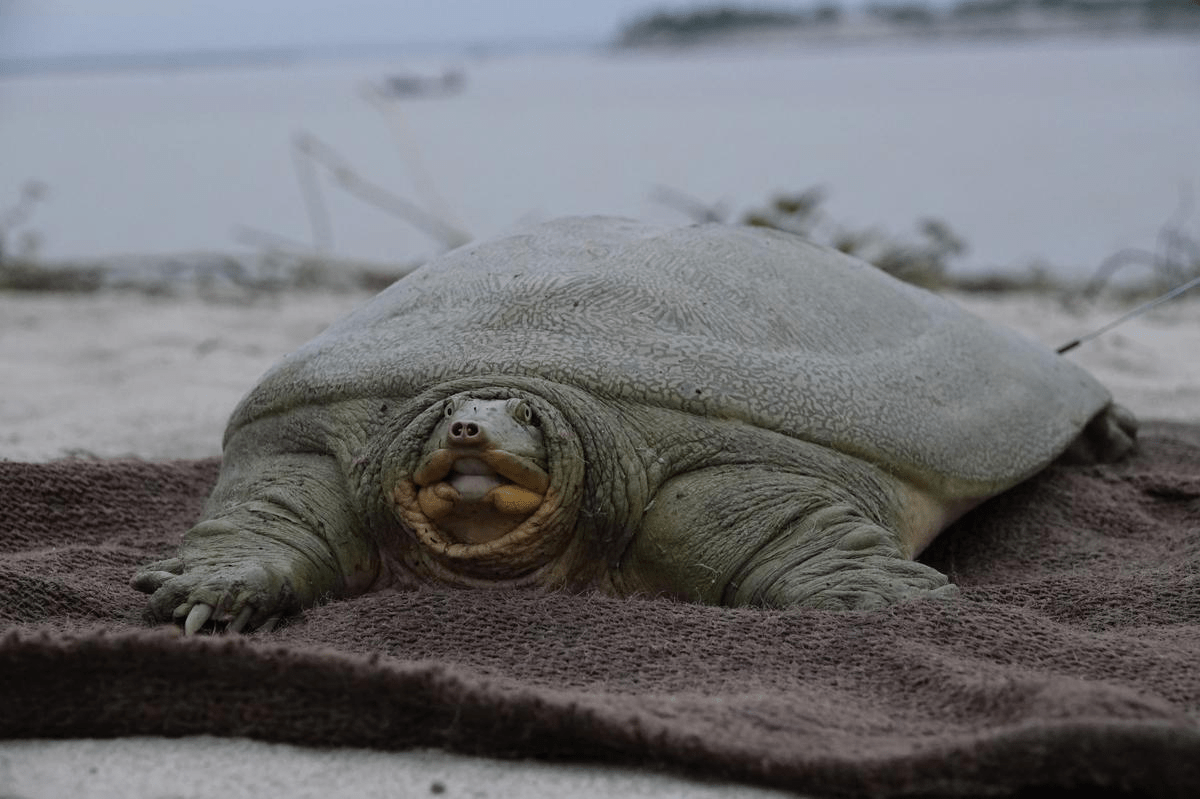
Recently, India released its first satellite-tagged Ganges soft-shell turtle in Assam’s Kaziranga National Park and Tiger Reserve as part of efforts to improve conservation and tracking of the species.
About Ganges Soft-Shell Turtle
- The Ganges soft-shell turtle (Nilssonia gangetica), also known as the Indian softshell turtle, is among the world’s largest freshwater turtle species.
- The species occurs across India, Bangladesh, Pakistan and Afghanistan, mainly in the Ganga, Brahmaputra, Yamuna, Indus, Meghna, Narmada and Mahanadi river basins.
- It inhabits deep rivers, lakes, ponds and canals with sandy or muddy bottoms and usually remains buried under sand in turbid waters.
- The turtle has a green oval-shaped carapace with yellow borders, while its long neck and tube-like snout help it breathe underwater.
- Its flattened shell enables rapid movement in water.
- The species follows an omnivorous diet consisting of fish, amphibians, molluscs, insects, carrion and aquatic plants.
- The breeding season generally extends from February to April.
- In Odisha, people often preserve these turtles in temple ponds and consider them sacred.
- Habitat destruction, agricultural expansion, poaching and illegal trade pose major threats to the species.
- The IUCN Red List classifies the species as Endangered, while the Wildlife Protection Act, 1972 provides protection under Schedule I.