Context
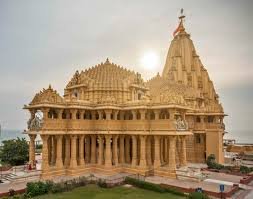
The Prime Minister will visit the Somnath Temple in Gujarat to mark 75 years since its reconstructed form was inaugurated by President Rajendra Prasad in 1951.
About Somnath Temple
- It is recognised as the first of the 12 Jyotirlingas, which represent sacred manifestations of Lord Shiva.
- The temple’s spiritual importance is further enhanced by its location at the Triveni Sangam, where the Kapila, Hiran, and Saraswati rivers
- It is located at Prabhas Patan near Veraval in the Saurashtra region of Gujarat, along the western coastline of India.
- The site has ancient origins, with references tracing its existence to around 649 BC or earlier.
- Over history, it faced repeated invasions and destruction, the most notable being the attack by Mahmud Ghazni in the 11th century.
- It was rebuilt multiple times by dynasties such as the Paramaras, Chalukyas, and Marathas, reflecting its enduring significance.
- The current temple structure was completed in May 1951, reconstructed in the Chalukya style of temple architecture.
- The rebuilding was led by Vallabhbhai Patel, and it was formally inaugurated by President Rajendra Prasad.
Architecture & Key Features of Somnath Temple
- The temple is a seven-storey structure with a height of around 155 feet, making it a major landmark on the Gujarat coast.
- Built in the traditional Hindu style of architecture, it features finely detailed carvings and rich artistic design.
- At the top of the structure, the Shikhara is crowned with a 10-ton Kalash, symbolising grandeur and religious importance.
- Its coastal orientation is unique, with a straight seaward view where it is believed that no land is visible up to Antarctica.
- Adding to its distinct appearance is a 37-foot flag mast, which strengthens its iconic visual identity.