Context
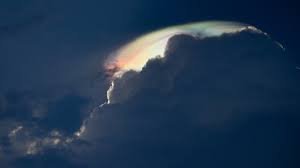
Indonesia recently saw a rare weather event called a “rainbow cloud,” also known as cloud iridescence, which attracted public attention because of its bright, colourful patterns visible in the sky.
About Rainbow Cloud
- It occurs when sunlight interacts with extremely small water droplets or tiny ice crystals suspended in clouds.
- This optical effect is produced through diffraction, where light bends and spreads after encountering particles that are similar in size to the wavelength of visible light.
- Due to this process, light is separated into multiple colours, creating visible pastel shades and rainbow-like patterns across cloud surfaces.
- The effect becomes more distinct when cloud particles are very small and relatively uniform in size, allowing clearer separation of colours.
Conditions for Formation and Rarity
- Cloud iridescence is relatively rare because several specific atmospheric conditions must occur together.
- The clouds must be thin enough for sunlight to pass through, yet contain droplets or ice crystals that are nearly identical in size.
- Even slight variation in particle size can weaken or completely prevent the colour formation.
- The phenomenon also depends strongly on the position of the Sun and the observer’s viewing angle, which determines visibility.
Types of Clouds That Produce Iridescence
- Iridescence is most commonly observed in newly forming clouds and semi-transparent clouds, where particle uniformity is higher.
- It is seen in cloud types such as altocumulus, cirrocumulus, cirrus, and lenticular clouds.
- Among these, lenticular clouds often show especially dramatic iridescence due to smooth shapes and stable airflow that support highly uniform droplet formation.
- These clouds generally develop at high altitudes, where relatively stable atmospheric conditions allow consistent interaction between sunlight and particles.
Difference Between Rainbow Clouds and Real Rainbows
- Although called “rainbow clouds,” they are not true rainbows.
- Rainbows form when sunlight is refracted, reflected, and dispersed inside raindrops after rainfall.
- In contrast, cloud iridescence is caused by diffraction and interference involving microscopic droplets or ice crystals.
- Unlike the large arc shape of rainbows, iridescent clouds show soft, uneven colour patches, often closer to the Sun and less structured in appearance.