Context
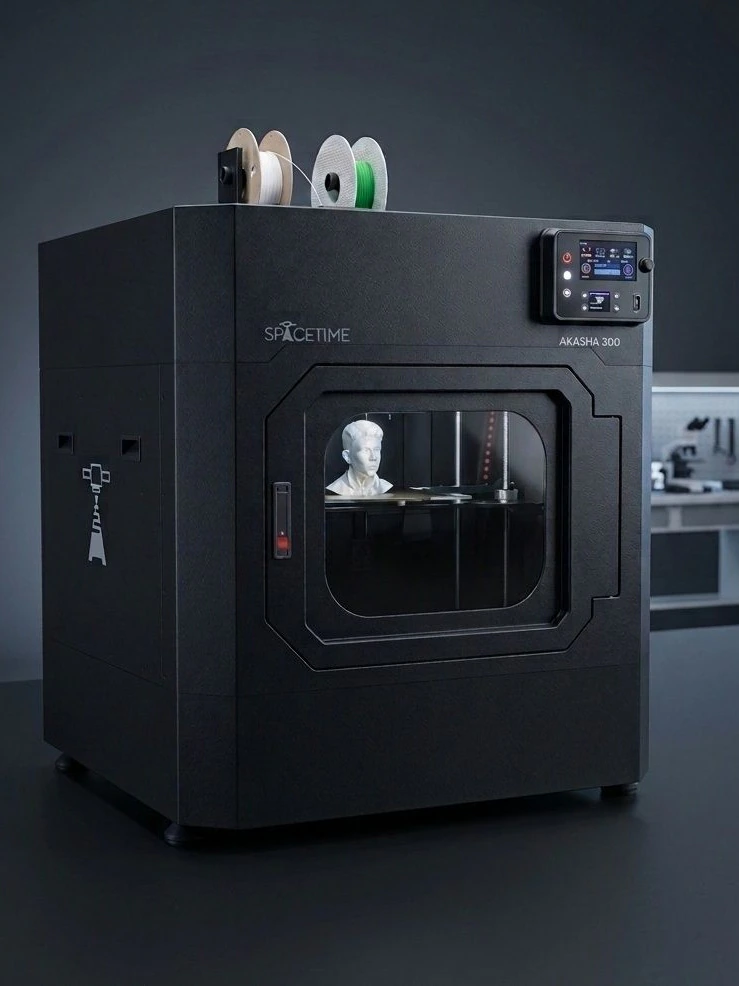
A Kerala-based start-up has delivered the Akasha300 3D Printer to Indian Space Research Organisation (ISRO), marking a significant step toward self-reliance in advanced manufacturing technologies.
Q1. What is the Akasha300 3D Printer?
- It is a high-temperature, multi-material extrusion 3D printer. It means:
- It can work at very high temperatures, which allows it to create strong and durable parts used in industries like space and defence.
- It is a machine that can print objects layer by layer using different materials (like plastics or composites).
- It is supported by Indian Institute of Space Science and Technology (IIST) and Kerala Startup Mission.
- Designed as an industrial-grade research platform for advanced manufacturing.
Q2. What are its key features?
- Dual-extrusion (two nozzles): The printer can use two materials at the same time. This helps in making more complex and stronger objects.
- High-temperature capability: Works at very high heat (up to 350°C, future 500°C). This allows printing of strong, industrial-grade materials (not just simple plastic).
- Modular design (flexible system): Parts of the printer can be changed or upgraded easily. It can be adapted for different types of printing techniques in future.
- Temperature-controlled environment: The printer has a heated base (bed) and a closed chamber that keeps temperature stable. This prevents defects and ensures smooth, accurate printing.
- High precision and safety: Moves very accurately to build fine details and has air filters to remove harmful fumes which ensures safe and high-quality output.
All these features help the printer create strong, accurate, and reliable parts, especially useful for research, space, and advanced industries.
Q3. Why is the Akasha300 significant?
- Supports R&D: Helps engineers develop functional components and prototypes
- Improves precision and speed: Enhances efficiency in manufacturing processes
- Boosts self-reliance: Reduces dependence on imported high-end 3D printing technology
- Applications: Useful in space, defence, and advanced engineering sectors
Conclusion
The Akasha300 represents a major step in India’s journey toward indigenous advanced manufacturing, enabling high-precision research, innovation, and technological self-reliance.