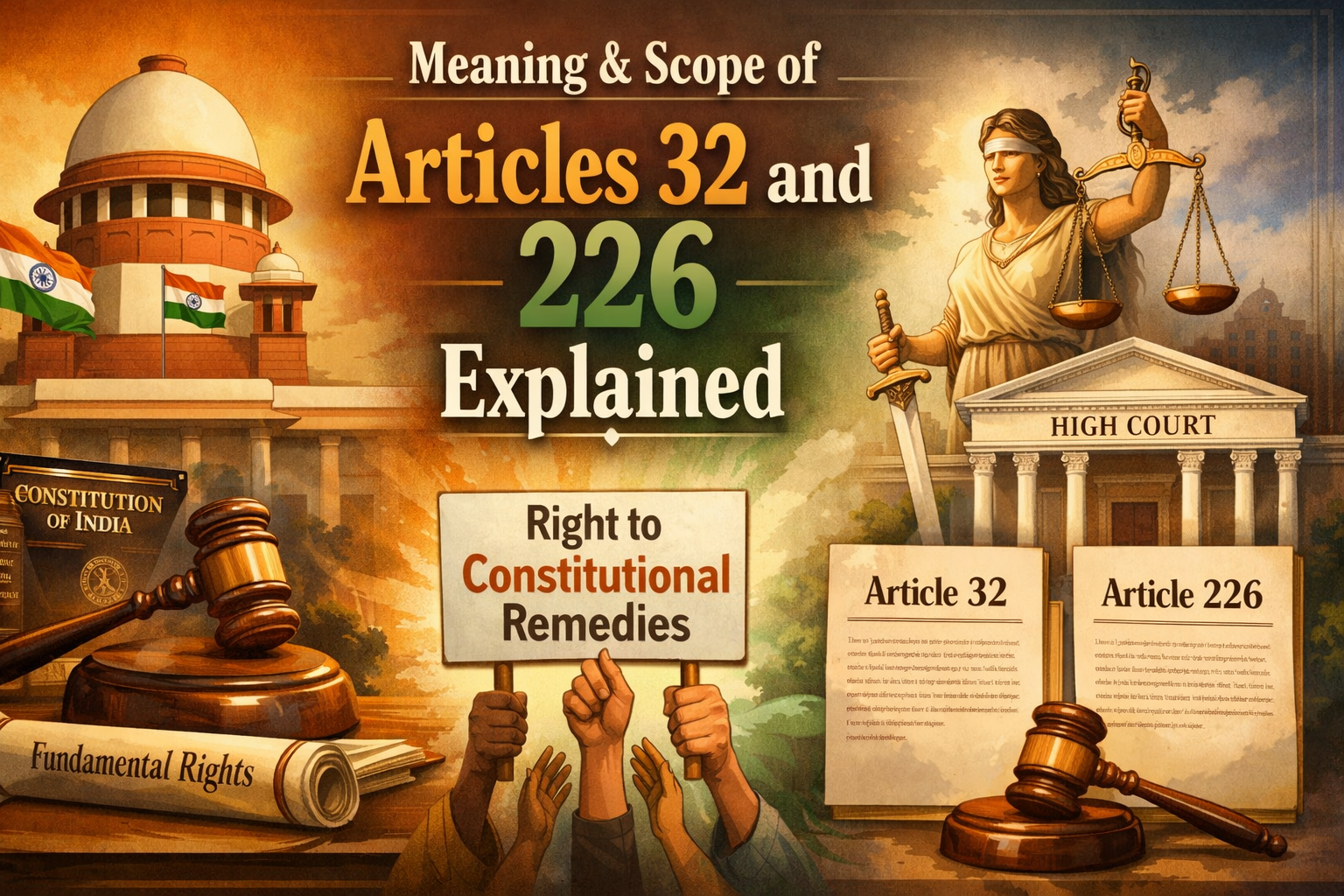
In the Indian legal framework, Writs act as the ultimate shield for the protection of a citizen’s liberty. They are formal written orders issued by the higher judiciary to provide a legal remedy against the violation of Fundamental Rights. Borrowed from the English “Prerogative Writs,” these judicial instruments empower the courts to maintain the Rule of Law and ensure that no administrative or judicial authority acts beyond its legal mandate.
Constitutional Provisions:
The power to issue writs is a primary feature of Judicial Review in India, distributed between the apex court and the provincial high courts.
Article 32: The Supreme Court’s Mandate
Often hailed by Dr. B.R. Ambedkar as the “Heart and Soul of the Constitution,” Article 32 makes the right to move the Supreme Court for the enforcement of Fundamental Rights a fundamental right in itself.
- Direct Access: A citizen can directly approach the Supreme Court without going through lower courts.
- Purpose: Exclusively for the enforcement of rights mentioned in Part III of the Constitution.
Article 226: The High Court’s Jurisdiction
Article 226 grants High Courts the power to issue writs within their territorial limits.
- Broader Scope: High Courts can issue writs not only for Fundamental Rights but also for “any other purpose” (ordinary legal rights).
- Discretionary Nature: Unlike the Supreme Court, a High Court may refuse to exercise this power if an alternative remedy exists.
The Five Types of Writs: Detailed Analysis
The Indian Constitution identifies five specific writs, each designed to address a particular type of legal or administrative grievance.
1. Habeas Corpus (To Have the Body of)
This is the most powerful writ for personal liberty. It is an order to produce a detained person before the court to examine the legality of their detention.
- Applicability: Issued against both public authorities and private individuals.
- When it is NOT issued: If the detention is lawful, for contempt of court/legislature, or if the detention is by a competent court.
2. Mandamus (We Command)
A command issued to a public official or body (including lower courts and corporations) to perform a statutory duty which they have failed or refused to perform.
- When it is NOT issued: Against a private individual, to enforce departmental instructions lacking statutory force, against the President or State Governors, or to enforce a purely contractual obligation.
3. Prohibition (To Forbid)
Issued by a higher court to a lower court or quasi-judicial body to stop them from continuing proceedings that exceed their jurisdiction.
- Nature: Purely preventive.
- Scope: Only against judicial and quasi-judicial It cannot be issued against administrative bodies or private individuals.
4. Certiorari (To be Certified/Informed)
Issued to a lower court or tribunal to transfer a case or quash an order already passed.
- Nature: Both preventive and corrective.
- Grounds: Excess of jurisdiction, lack of jurisdiction, or an error of law apparent on the face of the record.
- Recent Update: Since 1991, the Supreme Court has ruled that Certiorari can also be issued against administrative authorities if they affect the rights of individuals.
5. Quo-Warranto (By What Authority)
Issued to enquire into the legality of a person’s claim to a public office. It prevents the “usurpation” of a public office by an unqualified person.
- Requirement: The office must be a substantive public office created by a statute or the Constitution.
- Standing: Unlike other writs, any interested person (not necessarily the aggrieved party) can seek this writ.
Comparison: Supreme Court vs. High Court Writ Jurisdiction
While both courts safeguard rights, their reach and nature of power vary as summarized below:
| Feature | Supreme Court (Article 32) | High Court (Article 226) |
| Purpose | Only for Fundamental Rights. | Fundamental Rights + Ordinary Legal Rights. |
| Territorial Reach | Throughout India. | Within the State/UT (or where the cause of action arises). |
| Legal Status | It is a Fundamental Right (Cannot be refused). | It is a Discretionary Remedy (Can be refused). |
| Hierarchy | Narrower in purpose, wider in territory. | Wider in purpose, narrower in territory. |
Significance of Writs in a Democracy
- Protection of Liberty: They provide a quick and direct remedy against the arbitrary actions of the State.
- Check on Administration: Writs like Mandamus and Quo-Warranto ensure that public officials do not exceed their authority or neglect their duties.
- Judicial Oversight: They maintain a hierarchy of justice, ensuring lower courts and tribunals stay within their legal boundaries.
- Rule of Law: They embody the principle that “however high you may be, the law is above you.”
FAQs
WHO IS KNOWN AS THE PROTECTOR AND GUARANTOR OF FUNDAMENTAL RIGHTS?
The Supreme Court of India is the protector and guarantor of Fundamental Rights under Article 32 of the Constitution.
CAN A WRIT OF MANDAMUS BE ISSUED AGAINST THE PRESIDENT OF INDIA?
No, Mandamus cannot be issued against the President of India or the Governors of States for the exercise and performance of the powers and duties of their office.
WHO CAN FILE A PETITION FOR QUO-WARRANTO?
Unlike other writs where only the aggrieved person can file, any public-minded person can file a petition for Quo-Warranto, even if their own rights are not directly affected.
CAN A WRIT BE ISSUED AGAINST A PRIVATE INDIVIDUAL?
Only the writ of Habeas Corpus can be issued against a private individual. The other four writs (Mandamus, Prohibition, Certiorari, and Quo-Warranto) are issued only against public authorities, courts, or quasi-judicial bodies.
WHY IS ARTICLE 32 CALLED THE “HEART AND SOUL” OF THE CONSTITUTION?
Dr. B.R. Ambedkar called it so because, without an effective remedy like Article 32, all other Fundamental Rights would be meaningless as they could not be enforced.
WHAT DOES THE TERM “PREROGATIVE WRITS” MEAN?
The term originates from English Common Law, where these writs were issued by the King in the exercise of his “prerogative” (special right) to ensure justice for his subjects.
CAN A HIGH COURT ISSUE A WRIT FOR A NON-FUNDAMENTAL RIGHT?
Yes, under Article 226, High Courts have a wider jurisdiction than the Supreme Court and can issue writs for the enforcement of ordinary legal rights as well.
ON WHAT GROUNDS CAN HABEAS CORPUS BE REFUSED?
It can be refused if the detention is lawful, if it is for contempt of court, or if the person is detained outside the territorial jurisdiction of that particular court.
WHAT WAS THE SIGNIFICANCE OF THE 1991 SUPREME COURT RULING ON CERTIORARI?
The ruling expanded the scope of Certiorari, stating it could be issued against administrative authorities if their actions affected the legal rights of a citizen, not just against judicial bodies.