Ecological succession is the fundamental biological process characterized by the gradual, predictable, and directional change in the species composition of an ecosystem over time. This transformative journey begins on barren landscapes or disturbed sites and progresses through various intermediary stages until a stable, self-perpetuating climax community is established. Driven by the interaction between living organisms and their physical environment, succession is nature’s mechanism for restoring balance, enhancing biodiversity, and ensuring ecosystem resilience.
Ecological Succession: Key Concepts
Succession is not a random occurrence; it is an organized progression toward ecological maturity. To understand this process, one must be familiar with its specific terminologies:
- Bare Area (Nudum): A habitat devoid of any life where the process initiates. These are categorized by their water relations:
- Hydric: Wet areas (e.g., pond bottoms).
- Xeric: Dry areas (e.g., sun-exposed rock).
- Mesic: Intermediate moisture conditions.
- Pioneer Community: The very first group of organisms (pioneer species) to colonize a bare area, such as lichens on rocks or grasses on volcanic ash.
- Sere: The entire sequence of communities that replace one another in a specific area during the transition.
- Seral (Successional) Community: The transitory, developmental stages that exist between the pioneer stage and the final stable stage.
- Climax Community: The final, stable stage where species remain in equilibrium with the climate and successfully reproduce without being replaced.
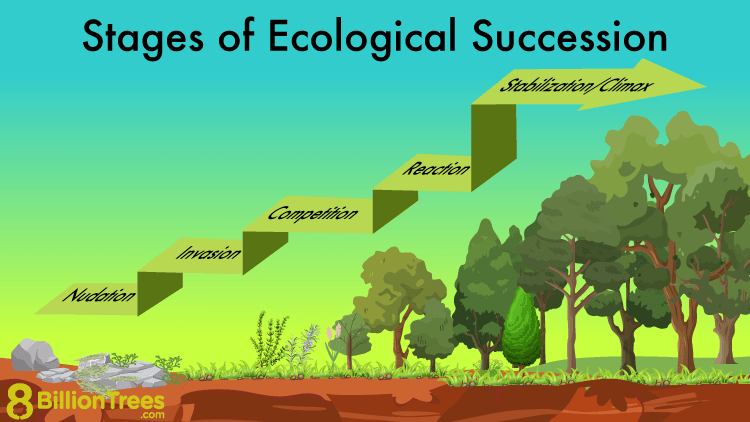
The Five Stages of Ecological Succession
Ecological succession follows a systematic five-step process that can span from several decades to over 500 years.
- Nudation: The creation of a bare area without any life. This is caused by topographic (landslides), climatic (volcanic eruptions), or biotic (deforestation) factors.
- Invasion: The successful establishment of a species in the bare area. It involves:
- Migration: Seeds or spores reach the site via wind, water, or animals.
- Ecesis: The species adjusts and establishes itself in the new environment.
- Aggregation: The population increases through reproduction.
- Competition and Coaction: As space and resources become limited, intra-specific and inter-specific competition begins. Organisms affect each other’s survival, leading to the displacement of weaker species.
- Reaction: The most critical stage where living organisms modify their own environment (e.g., plants increasing soil humus). These changes often make the area less suitable for the current community but better for the next stage.
- Stabilization (Climax): The ecosystem reaches a state of homeostasis where the community is in complete harmony with the environment and climate.
Primary vs. Secondary Succession: A Comparison
Ecological succession is broadly classified into two main types based on the starting conditions of the area.
| Feature | Primary Succession | Secondary Succession |
| Starting Point | Barren land (no previous life/soil). | Disturbed area (previous life existed). |
| Soil Presence | No soil initially; must be formed. | Soil and seeds are already present. |
| Causes | Volcanic eruptions, retreating glaciers. | Wildfires, floods, deforestation. |
| Speed | Very slow (hundreds of years). | Relatively fast (decades). |
| Pioneer Species | Lichens, Mosses. | Grasses, Weeds, Insects. |
Advanced Classification of Succession Types
Beyond the primary and secondary categories, succession is further classified by the drivers and outcomes of the process:
- Autogenic Succession: Driven by the biota (living things) For example, a forest canopy creates shade that allows shade-tolerant plants to grow.
- Allogenic Succession: Driven by external environmental forces like seasonal fires, storms, or changes in water levels.
- Progressive Succession: The ecosystem becomes more complex, with increased biomass and moisture (moves toward a mesic state).
- Retrogressive Succession: A move backward toward a simpler, less diverse state, often caused by overgrazing or chronic environmental degradation.
- Directional vs. Cyclic: Directional is a continuous move toward a climax, while Cyclic involves repeating loops of local community changes.
Initiating and Stabilizing Causes
What triggers and eventually stops succession? Ecologists divide the causes into three distinct groups:
- Initiating Causes: Topographic or climatic events (erosion, fire, wind) that create bare land or destroy existing populations.
- Continuing (Ecesis) Causes: Biological processes like migration, competition, and reaction that drive the transition through various seral stages.
- Stabilizing Causes: Primarily determined by the climate of the area, which prevents further significant changes once the climax community is reached.
Real-World Examples of Succession
- Coral Reefs: Succession begins when larvae settle on underwater rocks. Over time, they build complex calcium carbonate structures that attract fish, eventually forming a diverse reef.
- Acadia National Park: Following a 1947 wildfire, the park underwent secondary succession. Weeds and small plants appeared first, followed by deciduous trees, eventually shifting the forest composition.
- Volcanic Islands: Primary succession is observed on islands like Surtsey (Iceland), where bare lava was colonized by lichens, eventually supporting complex plant life.
FAQs
WHAT IS THE MAIN DIFFERENCE BETWEEN PRIMARY AND SECONDARY SUCCESSION?
Primary succession occurs in lifeless areas without soil (like new volcanic rock), whereas secondary succession happens in areas where a community was destroyed but soil remains (like after a wildfire).
WHO ARE THE PIONEER SPECIES IN AN ECOSYSTEM?
Pioneer species are the first organisms to colonize a bare area. In terrestrial primary succession, these are typically lichens and mosses; in secondary succession, they are often weeds and grasses.
WHY IS THE CLIMAX COMMUNITY CONSIDERED STABLE?
A climax community is in equilibrium with the climate. It remains largely unchanged because the species within it are capable of reproducing and maintaining their population without being outcompeted by new arrivals.
HOW LONG DOES ECOLOGICAL SUCCESSION TYPICALLY TAKE?
The process usually spans from 1 to 500 years, depending on whether it is primary or secondary and the climatic conditions of the region.
WHAT IS AUTOGENIC SUCCESSION?
It is a type of succession where the living organisms themselves bring about changes in the environment, making it more suitable for a new community.
WHAT ROLE DOES FIRE PLAY IN ECOLOGICAL SUCCESSION?
Fire is often an initiating cause of secondary succession. It clears existing vegetation but leaves the soil intact, allowing for rapid recolonization.
WHAT IS A SERE?
A sere refers to the entire sequence of ecological communities that replace one another in a specific area during the transition from a pioneer community to a climax community.
WHAT IS RETROGRESSIVE SUCCESSION?
This is a backward step in development where the community becomes less complex and loses species, usually due to external pressures like overgrazing or invasive species.
CAN HUMAN ACTIVITIES TRIGGER ECOLOGICAL SUCCESSION?
Yes, human activities like deforestation, mining, and urbanization create bare areas (Nudation), which then undergo either primary or secondary succession depending on the severity of the damage.
WHICH FACTOR IS THE CHIEF CAUSE OF ECOSYSTEM STABILIZATION?
According to ecological principles, the regional climate is the most significant factor that determines when an ecosystem reaches its final stable climax stage.