Context
Amid the ongoing tensions involving Iran, Israel, and the US, analysts suggest that Iran may strengthen its nuclear capability to deter future attacks. Such developments can intensify a security dilemma.
Q1. What is the Security Dilemma?
The security dilemma is a concept in international relations that describes a situation where:
- A country takes steps to strengthen its own security, such as increasing military power or developing new weapons.
- These actions are perceived as a threat by other countries, even if the original intention was defensive.
- In response, other states also increase their military capabilities, creating a cycle of mistrust, arms buildup, and rising tensions.
This process can ultimately increase the risk of conflict rather than improving security.
Q2. Who introduced the concept of the Security Dilemma?
- The idea of the security dilemma was first introduced by John Herz in his 1950 article “Idealist Internationalism and the Security Dilemma.”
- Later scholars further developed the concept, including Herbert Butterfield and Robert Jervis.
- The concept is closely associated with the Realism tradition in international relations.
Q3. Why does the Security Dilemma arise?
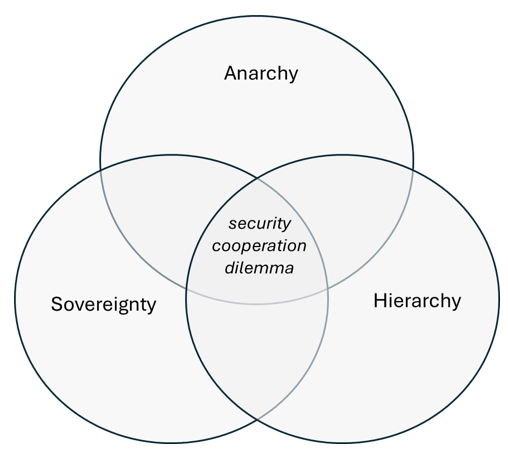
The security dilemma emerges due to structural conditions of the international system:
- Anarchy in the international system – There is no central global authority to guarantee security.
- Uncertainty about other states’ intentions – Countries cannot be sure whether others’ military actions are defensive or aggressive.
- Perception and misinterpretation – Defensive actions may be perceived as offensive threats by rival states.
These factors often lead to mutual suspicion and competitive military buildup.
Conclusion
The security dilemma explains how efforts by states to enhance their security can unintentionally increase tensions and instability in the international system, highlighting the challenges of maintaining peace in an anarchic global order.
FAQs
Q1. What is the Security Dilemma in international relations?
The Security Dilemma refers to a situation where a country’s defensive actions—such as building military strength or developing nuclear weapons—are perceived as threats by other states. This often triggers an arms race and escalates tensions, even if the original intent was purely defensive.
Q2. Who introduced the concept of the Security Dilemma?
The term was first introduced by John Herz in 1950 in his article “Idealist Internationalism and the Security Dilemma.” Later, scholars like Herbert Butterfield and Robert Jervis expanded on the idea, making it central to the Realist school of international relations.
Q3. Why does the Security Dilemma arise between nations?
It emerges due to three main factors:
- Anarchy in the international system (no global authority to ensure security).
- Uncertainty about other states’ intentions.
- Misinterpretation of defensive actions as offensive threats.
Together, these conditions foster mistrust and competitive military buildup.
Q4. How does the Security Dilemma apply to current tensions in the Middle East?
Amid ongoing tensions involving Iran, Israel, and the US, Iran’s potential strengthening of nuclear capabilities could be seen as a defensive measure. However, rivals may interpret it as an offensive threat, intensifying the cycle of mistrust and arms competition in the region.
Q5. What are the consequences of the Security Dilemma for global peace?
Instead of enhancing security, the dilemma often increases instability. It can lead to arms races, strained diplomatic relations, and a higher risk of conflict—highlighting the challenges of maintaining peace in an anarchic international system.