Important Questions for UPSC Prelims, Mains and Interview
|
Context
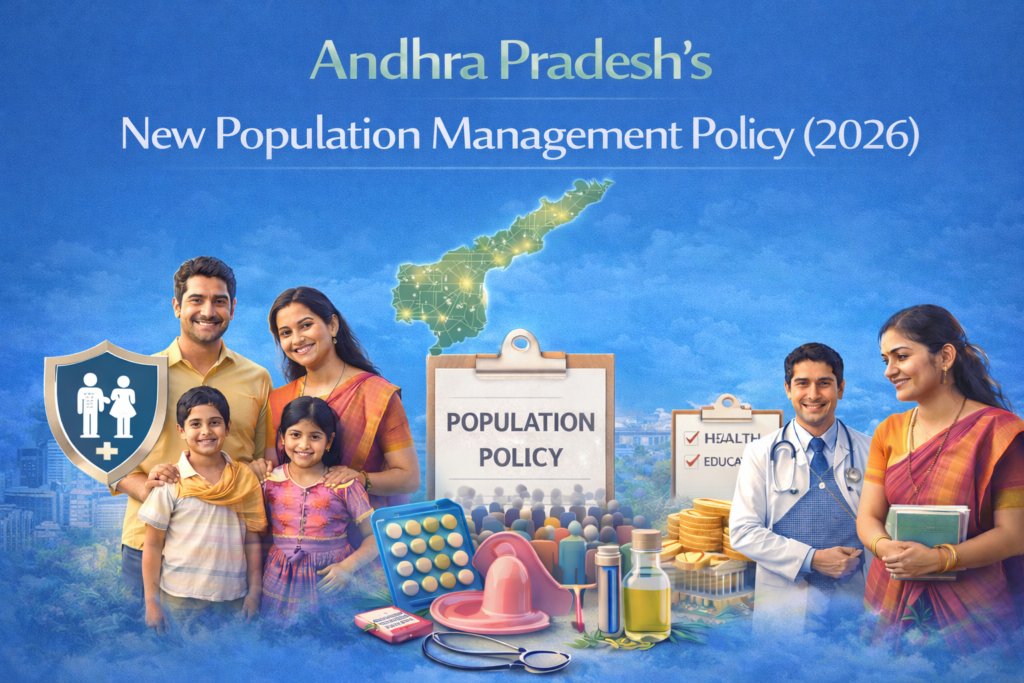
The Andhra Pradesh government has introduced a draft Population Management Policy aimed at addressing declining fertility rates and preparing for a rapidly ageing population. The state’s Total Fertility Rate (TFR) has fallen to 1.5, significantly below the replacement level of 2.1, raising concerns about long-term economic and demographic sustainability.
Q1. What are the key objectives of the Andhra Pradesh Population Management Policy, and why has the state government introduced it in response to declining fertility rates?
- The policy aims to stabilise population trends by encouraging families to have two or three children.
- It seeks to prevent a future decline in the working-age population that could affect economic growth.
- The government intends to address the rapid rise in the elderly population, which could increase welfare expenditure.
- The policy emphasises improving maternal healthcare and reproductive support systems.
- It also aims to strengthen elderly care infrastructure and social protection programmes.
- By encouraging balanced population growth, the government hopes to maintain a sustainable demographic structure for long-term development.
- The initiative also recognises that demographic changes directly influence labour markets and fiscal planning.
Q2. What demographic trends in Andhra Pradesh and India have prompted concerns about declining fertility and an ageing population?
- Andhra Pradesh’s Total Fertility Rate (TFR) has declined from about 2.2 in 2003 to 1.5 in 2023.
- Telangana has recorded a similar fertility level, indicating regional demographic convergence.
- India’s national TFR has also fallen significantly from around 3 in the early 2000s to about 1.9 today.
- Lower fertility rates are often associated with development indicators such as:
- Improved education levels
- Urbanisation and higher living standards.
- Rising life expectancy is increasing the share of elderly people in the population.
- Andhra Pradesh’s median age is already higher than the national average, indicating faster demographic ageing.
- These trends raise concerns that the demographic dividend period may gradually decline.
Q3. How do regional differences in fertility rates across Indian states influence demographic patterns and development outcomes?
- Fertility rates vary significantly across different regions of India.
- Southern states such as Tamil Nadu, Kerala, Karnataka, and Andhra Pradesh have fertility rates well below the replacement level.
- These lower fertility rates reflect stronger social development indicators, including education and healthcare access.
- In contrast, several northern and eastern states still report higher fertility rates.
- States such as Bihar and Uttar Pradesh continue to have fertility rates above the national average.
- These differences can create uneven population growth patterns across regions.
- Regional demographic differences may also influence labour markets and migration patterns.
Q4. What are the major policy pillars of Andhra Pradesh’s population management strategy, and how do they aim to address demographic challenges?
- The policy framework is structured around five key pillars designed to address demographic and social needs.
- Matrutva focuses on improving maternal health services and reducing risks during childbirth.
- Shakti aims to increase women’s participation in the workforce by creating better employment opportunities.
- Kshema emphasises strengthening welfare and care systems for senior citizens.
- Naipunyam promotes skill development in sectors such as healthcare to support children and elderly populations.
- Sanjeevani aims to expand digital health systems to improve healthcare accessibility and efficiency.
- Together, these pillars aim to create a balanced approach combining population growth with social development.
Q5. What incentives and welfare measures has the Andhra Pradesh government proposed to encourage families to have more children?
- The government proposes a ₹25,000 financial incentive for families having a second or third child.
- A monthly support payment of ₹1,000 for five years is planned for the third child to ensure nutrition and early care.
- Children born as the second or third child will receive free education in government institutions until the age of 18.
- Subsidised in vitro fertilisation (IVF) treatments will be provided through public-private partnerships.
- The policy also proposes improved healthcare facilities for mothers through:
- Expanded maternal health services
- Better monitoring during pregnancy.
- These incentives are designed to reduce the financial and social barriers to raising children.
Q6. How could declining fertility rates affect political representation and the delimitation debate in India?
- Parliamentary representation in India is largely based on population size of states.
- States with faster population growth may gain greater representation in Parliament after delimitation.
- Southern states with lower fertility rates could lose relative representation compared with northern states.
- The delimitation process, which redraws parliamentary constituencies, has been suspended for several decades.
- When suspension ends, population-based seat allocation could become a major political issue.
- Some states fear that successful population control efforts may unintentionally reduce their political influence.
- This has triggered debates about balancing population control with equitable political representation.
Q7. What are the broader economic and social implications of population ageing and declining workforce participation in Andhra Pradesh?
- A growing elderly population will increase demand for healthcare and social welfare services.
- A shrinking working-age population could reduce economic productivity and labour supply.
- Higher dependency ratios may place greater fiscal pressure on government budgets.
- Andhra Pradesh already has a median age higher than the national average, indicating faster ageing.
- The share of the population above 60 years is projected to increase significantly by 2047.
- Female workforce participation in the state remains relatively low, which could further affect labour supply.
- Increasing women’s employment participation may help offset labour shortages and sustain economic growth.
- Addressing demographic ageing requires long-term investments in healthcare, skill development, and social security systems.
Conclusion
The Andhra Pradesh Population Management Policy reflects growing concerns about declining fertility and an ageing population. By combining incentives for childbirth with healthcare improvements, skill development, and elderly welfare, the state aims to maintain a balanced demographic structure and sustainable economic growth. The policy also highlights the broader national debate on population trends, economic development, and political representation in India.