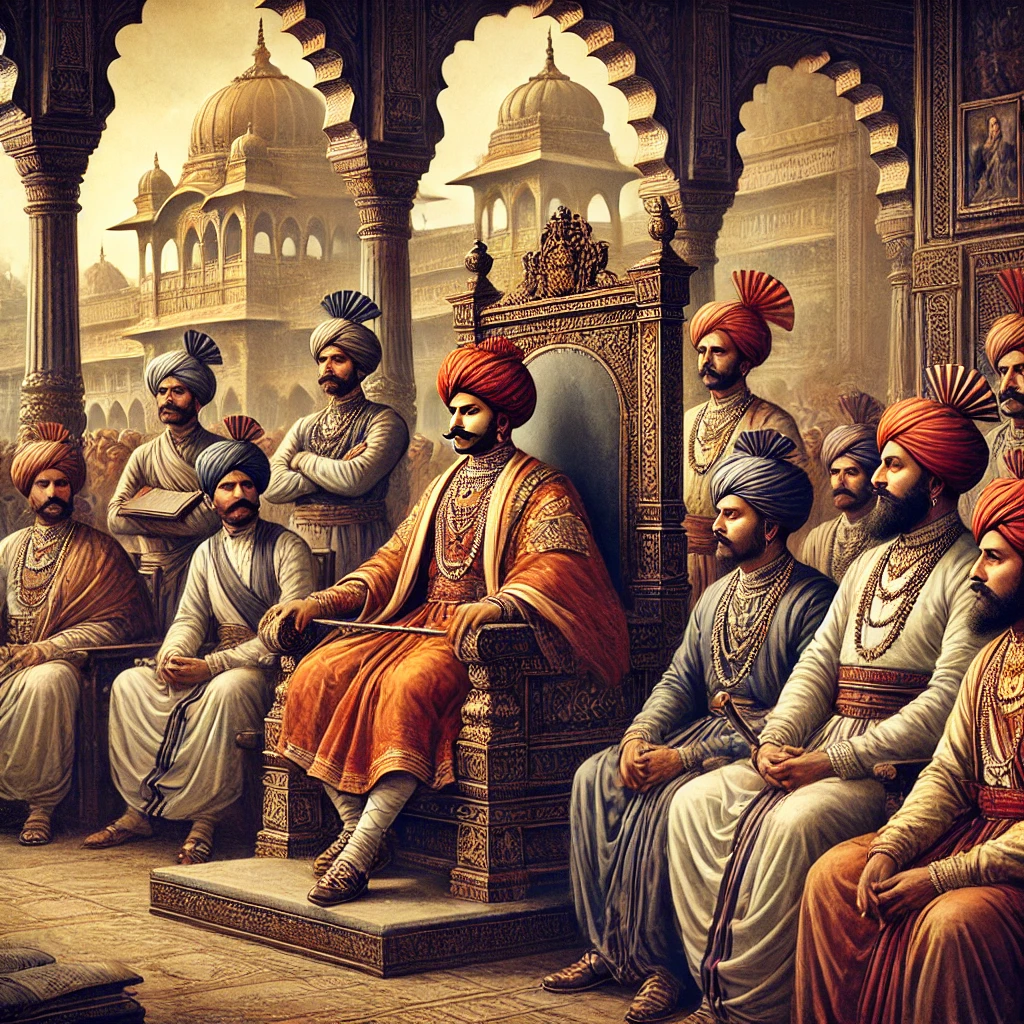
The Maratha Empire, established in the 17th century, stands as one of the most formidable and influential kingdoms in Indian history. Under the leadership of visionary rulers, the empire transformed the cultural and political landscape of India by defeating powerful invaders and resisting British colonial forces. Known for their military skill, guerrilla tactics, and administrative smartness, the Marathas expanded their influence from the Konkan coast to as far as Punjab and Tamil Nadu by the mid-18th century.
1. The Chhatrapati Rulers: Sovereigns of the Empire
The title of Chhatrapati was designated to the supreme sovereign ruler of the Maratha Empire. These figures were central to the establishment, expansion, and ideological foundation of the state.
1 Chhatrapati Shivaji Maharaj (1674–1680):
- He was the founder of the Maratha Empire and was formally crowned in 1674.
- He introduced the concept of Swarajya (self-rule) and a highly disciplined administrative and military system.
- To protect the coastline, he established a powerful navy.
- He led successful campaigns against the Mughals and the Bijapur Sultanate.
2 Chhatrapati Sambhaji Maharaj (1681–1689):
- The son of Shivaji, he is remembered for his fierce resistance against the Mughal Emperor Aurangzeb.
- He achieved military victories over the Portuguese and Chikka Deva Raya of Mysore.
- He was eventually captured and executed by the Mughals in 1689.
3 Chhatrapati Rajaram Maharaj (1689–1700):
The younger brother of Sambhaji, he sustained Maratha rule by leading guerrilla warfare against the Mughals from the Gingee Fort in Tamil Nadu.
4 Chhatrapati Shahu Maharaj (1707–1749):
The grandson of Shivaji, his reign marked a major shift in governance with the introduction of the Peshwa system.
He granted administrative and military control to Balaji Vishwanath, facilitating a massive expansion of Maratha influence across India.
2. The Peshwa Rulers: De Facto Leaders and Prime Ministers
Originally appointed as Prime Ministers, the Peshwas gradually evolved into the de facto rulers of the empire during the 18th century, managing military and political strategies.
1 Balaji Vishwanath (1713–1720):
The first hereditary Peshwa from the Bhat family, he strengthened the empire’s financial systems and secured the release of Shahu Maharaj from Mughal captivity.
2 Baji Rao I (1720–1740):
A legendary military strategist, he established the Maratha Confederacy.
Under his leadership, the Marathas became the dominant power in India, expanding into Malwa, Gujarat, and Bundelkhand.
3 Balaji Baji Rao (Nana Saheb) (1740–1761):
He oversaw the empire’s peak territorial extent in North India but also led the Marathas during the tragic Third Battle of Panipat in 1761 against Ahmad Shah Abdali.
4 Madhav Rao I (1761–1772):
He is credited with reviving the empire after the loss at Panipat by stabilizing finances and restoring law and order.
5 Baji Rao II (1796–1818):
The last Peshwa, his defeat by the British in the Third Anglo-Maratha War led to the final collapse of the empire.
3. Comparison: Chhatrapati vs. Peshwa
While both positions were vital, the power dynamic shifted significantly over the century.
| Feature | Chhatrapati | Peshwa |
| Position | Supreme sovereign ruler | Prime Minister / Chief Executive |
| Primary Role | Symbol of sovereignty and leadership | Military and administrative head |
| Founder | Shivaji Maharaj | Balaji Vishwanath (Hereditary) |
| Power Shift | Held absolute power initially | Became the real power center in the 18th century |
Frequently Asked Questions (FAQs)
WHO WAS THE FOUNDER OF THE MARATHA EMPIRE?
The Maratha Empire was founded in 1674 by Chhatrapati Shivaji Maharaj.
WHAT IS THE MEANING OF THE TITLE “CHHATRAPATI”?
It was the title given to the supreme sovereign ruler of the Maratha Empire.
WHO WAS THE FIRST HEREDITARY PESHWA?
Balaji Vishwanath (1713–1720) was the first hereditary Peshwa from the Bhat family.
WHICH RULER INTRODUCED THE “SWARAJYA” SYSTEM?
Chhatrapati Shivaji Maharaj introduced the concept of Swarajya, or self-rule, along with an efficient administrative system.
WHO WAS THE LAST PESHWA OF THE MARATHA EMPIRE?
The last Peshwa was Baji Rao II, who was defeated by the British in 1818.
WHICH PESHWA EXPANDED THE EMPIRE TO ITS DOMINANT POSITION IN NORTH INDIA?
Baji Rao I was a brilliant strategist who expanded Maratha rule to Malwa, Gujarat, and Bundelkhand.
WHAT WAS THE SIGNIFICANCE OF THE THIRD BATTLE OF PANIPAT (1761)?
Led by Peshwa Balaji Baji Rao, the Marathas fought against Ahmad Shah Abdali, resulting in a major loss that temporarily weakened the empire.
HOW DID THE POWER SHIFT FROM THE CHHATRAPATI TO THE PESHWA?
Starting with Shahu Maharaj, the Peshwas were given more administrative control, eventually becoming the de facto rulers while the Chhatrapati remained a symbolic head.
WHICH RULER IS KNOWN FOR RESISTING AURANGZEB?
Chhatrapati Sambhaji Maharaj is celebrated for his bravery and resistance against the Mughal Emperor Aurangzeb until his capture in 1689.
WHAT WAS THE ROLE OF MAHADJI SHINDE?
He was a powerful ruler of the Shinde Dynasty who controlled Delhi politics and defended Maratha interests against both the British and Afghans in the late 18th century.