Important Questions for UPSC Prelims / Mains / Interview
|
Context
According to the World Obesity Atlas 2026, India has ranked second globally in the number of children living with overweight and obesity. The report highlights the growing burden of obesity among children and adolescents and warns about its long-term health consequences.
Q1. What are the global trends in childhood obesity?
- Childhood obesity has become a major global public health challenge over the last two decades.
- Key global trends include:
- More than one in five children aged 5–19 years worldwide are overweight or obese.
- The global prevalence increased from 14.6% in 2010 to about 20.7% in 2026.
- Over 200 million school-age children who are overweight or obese are concentrated in just ten countries.
- China, India, and the United States account for a significant share of the global burden.
- The World Obesity Federation estimates that about 507 million children worldwide could be overweight or obese by 2040.
- These trends indicate that childhood obesity is no longer limited to high-income countries and is rapidly rising in developing and middle-income nations.
Q2. What is India’s ranking and current situation regarding childhood obesity?
- India currently ranks second globally after China in the number of children living with overweight and obesity.
- Key statistics from the World Obesity Atlas 2026 include:
- Around 41 million children in India have a high Body Mass Index (BMI).
- Approximately 14 million children are living with obesity.
- Age-wise distribution shows:
- Nearly 14.9 million children aged 5–9 years are overweight or obese.
- More than 26 million adolescents aged 10–19 years are overweight or obese.
- Although India ranks high globally, experts note that the country’s large population size contributes significantly to this ranking.
- Within the World Health Organization South-East Asia Region, India has the highest number of children and adolescents affected by overweight and obesity.
Q3. What are the future projections for childhood obesity in India?
- The World Obesity Atlas projects a significant increase in childhood obesity in India between 2025 and 2040.
- Key projections include:
- Around 20 million children in India may be living with obesity by 2040.
- Nearly 56 million children are expected to be overweight or obese by the same period.
- Associated health risks are also projected to rise:
- BMI-related hypertension cases may increase from 2.99 million to 4.21 million.
- Hyperglycaemia cases may increase from 1.39 million to 1.91 million.
- High triglyceride levels, a risk factor for cardiovascular disease, may increase from 4.39 million to 6.07 million.
- These projections suggest that childhood obesity could significantly increase the burden of non-communicable diseases (NCDs) in India.
Q4. What are the health implications of childhood obesity?
- Childhood obesity exposes children and adolescents to several serious health risks.
- Major health implications include Hypertension, Cardiovascular diseases, Type 2 diabetes and Metabolic disorders.
- According to projections:
- Over 57 million children may show early signs of cardiovascular disease by 2040.
- More than 43 million children may develop hypertension symptoms.
- Additionally, children with obesity are more likely to remain obese in adulthood, increasing the risk of chronic diseases and creating long-term health and economic burdens.
Q5. What factors are contributing to the rise of childhood obesity in India?
- Several lifestyle, nutritional, and social factors are contributing to the increasing prevalence of obesity among children.
- Key contributing factors include:
- Low Physical Activity: About 74% of adolescents aged 11–17 years do not meet recommended physical activity levels.
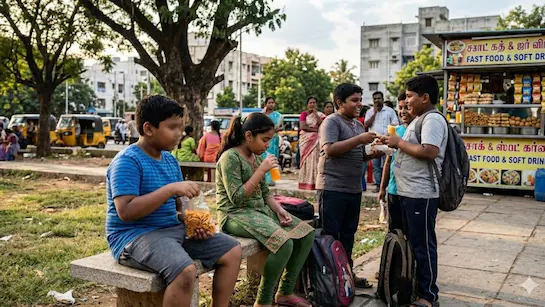
- Poor Dietary Patterns: Increased consumption of processed foods, junk food, and sugary beverages leads to excessive calorie intake.
- Limited School Nutrition Coverage: Only 35.5% of school-age children receive school meals, indicating gaps in nutrition programmes.
- Early-Life Nutrition Challenges: Around 32.6% of infants experience sub-optimal breastfeeding, which may increase obesity risk later in life.
- Maternal Health Risks: About 13.4% of women aged 15–49 have high BMI. Around 4.2% of women in this age group have Type 2 diabetes, which can influence childhood obesity risk.
- These factors show that childhood obesity is shaped by a combination of lifestyle behaviours, nutritional habits, and broader social determinants of health.
Q6. What policy measures and prevention strategies are recommended?
- The World Obesity Federation recommends a comprehensive policy response to tackle childhood obesity.
- Key measures include:
- Creating healthier school food environments.
- Restricting marketing of unhealthy foods to children.
- Introducing taxes on sugar-sweetened beverages.
- Promoting regular physical activity among children.
- Protecting and promoting exclusive breastfeeding practices.
- Integrating obesity prevention strategies into primary healthcare systems.
- Experts also emphasise early screening, monitoring, and intervention to identify at-risk children and provide timely healthcare support.
Conclusion
Childhood obesity is rapidly emerging as a major public health concern in India and across the world. India’s second-place global ranking highlights the scale of the challenge, especially given the country’s large population and changing lifestyle patterns. Addressing childhood obesity requires a combination of improved nutrition policies, increased physical activity, early health interventions, and strong public awareness to prevent a future surge in non-communicable diseases.